The math is simple and inescapable: For $50 or $100 a month, a primary-care provider can keep a person’s asthma under control through medication, careful monitoring, and practical efforts to remove the triggers of asthma.
But if the patient can’t afford to pay for doctors’ visits, or for an inhaler, or for medication to keep the asthma in check, she may forgo care until there’s a crisis and end up requiring thousands of dollars in hospital care.
It can happen in any country, but a new international study shows U.S. patients are at a particularly high risk.
The study, released last month by the Commonwealth Fund in New York, involved a survey of 7,500 adults, each with at least one of seven chronic diseases – high blood pressure, heart disease, lung disease, diabetes, cancer, arthritis and depression – in Australia, Canada, France, Germany, the Netherlands, New Zealand, Britain and the United States.
Fifty-four percent of the U.S. patients didn’t get recommended care, fill prescriptions or see a doctor when sick because of costs, the study found, verus 7 to 36 percent in the other countries. In addition, 41 percent of the Americans said they’d spent more than $1,000 out of pocket on medical costs last year, while in Britain, it was 4 percent, and in the Netherlands, 8 percent.
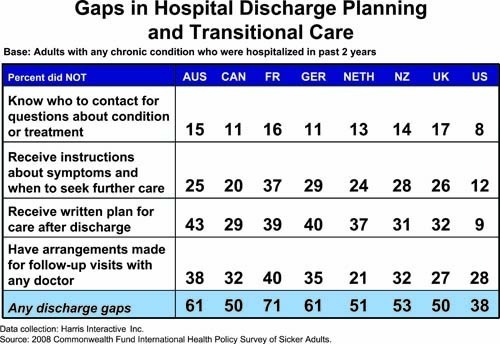
The study also found 34 percent of U.S. patients experienced medical errors or poorly coordinated care, such as duplicate tests, unavailable test results and delays in the availability of medical records; in some countries, the problems were half as common.
And only 26 percent of U.S. and Canadian patients reported same-day access to doctors when sick, and one-fourth or more reported long waits, while same-day appointments were available to 60 percent of Dutch, 54 percent of New Zealand and 48 percent of British patients.
“Lack of affordable access, waits for primary care, and inadequate coordination put chronically ill U.S. patients – especially those with multiple chronic conditions – at high risk of poor health outcomes,” the study says.
The study also found that uninsured U.S. patients were particularly at risk for these problems, with 82 percent forgoing recommended care or skipping medications because of the cost. But the insured aren’t doing that well, either: 43 percent of those who were insured all year skipped care because of costs, well above rates in other countries.
“The U.S. is not only facing an economic crisis, we are facing a health-system crisis,” said Commonwealth Fund President Karen Davis in a news release. “Our leaders need to come together to develop reforms which will make lasting improvements for patients, to assure universal coverage and high quality, efficient care.”
Locally, health care leaders said the study’s findings confirm what is already known about the U.S. system’s flaws. Christopher F. Koller, the state health insurance commissioner, noted that the United States lacks two key things the other countries have: “They have universal access to health care, and they have a systemic commitment to primary care,” Koller said.
Other countries have also aligned their health care financing systems “to build an infrastructure that supports better outcomes,” noted Dr. David R. Gifford, the state health director. “Until we can change the design of our system,” he said, “we’re not going to achieve these outcomes.”
Dr. John B. Murphy, vice president for medical affairs and chief medical officer for Rhode Island Hospital, said another problem is that the United States doesn’t have a true health care system, but rather a scattered, poorly interconnected set of providers who often can’t share information effectively and can’t coordinate care for their common patients.
That’s a big part of why medical errors are more common in the United States, and why there is more duplication and waste as well, Murphy noted – the transitions from one provider to another, from hospital to nursing home, from hospital to home, etc., aren’t smooth.
“We’re the only developed country that does not have a national health care system,” he added. “Investment in the development of [health care] IT is a fraction of what it is in the U.K., and a lot of potential problems can be created for not having a common database.”
Hospitals are particularly challenged on this front, Murphy said, because they have to struggle to piece together patients’ medical histories and medication lists in the emergency room, and they’ve had to recruit a growing number of hospitalists because primary care doctors are paid so little that most won’t provide hospital care anymore.
And at discharge, though hospitals work painstakingly to plan for follow-up care and connect patients to community resources, informing their doctors and coordinating post-discharge care is difficult, Murphy said; much of the communication is still by fax and mail.
Insurers have stepped in, to some extent, to facilitate communication. UnitedHealthcare of New England, for example, uses its powerful databases and software tools to track whether, for example, a patient filled a prescription, and alert the doctors if needed care is missed.
Blue Cross & Blue Shield of Rhode Island has made particular efforts to reach diabetics, contacting them and encouraging them to follow their doctors’ guidance. A pilot project is even reducing the co-pays for diabetes drugs for members who follow specific instructions, such as getting an eye exam, said Dr. Harold Picken, associate chief medical officer.
And locally, Koller noted, projects such as the Chronic Care Sustainability Initiative (CSI-RI) are laying the ground work for new, more effective models based on primary care.
“I think we have elements in place to make a commitment to primary care,” he said. Ensuring universal access to care, on the other hand, is harder, he acknowledged. That will require “both national and local conversations.” •