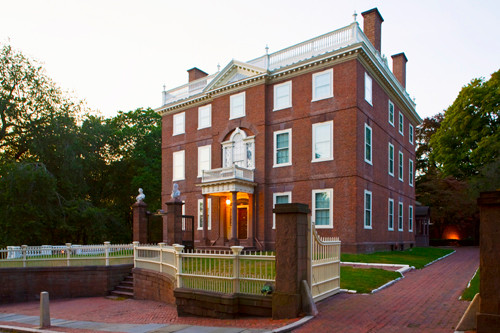
The Rhode Island Historical Society has teamed with the Providence Warwick Convention & Visitors Bureau to offer, for the first time, the chance to visit five separate historic sites clustered along Providence’s Benefit Street as one package.
The program, designed solely for group tours and particularly conventioneers, is currently being marketed and organizers hope to see it take off next spring or summer.
“What we realized is that it is interesting for us, as an organization, and for visitors to think of the development of this area [Benefit Street] in terms of these five great architectural, cultural and historic sites,” said Barbara Barnes, tourism services manager for the historical society.
The five sites are: the John Brown House, the Stephen Hopkins House, the Providence Athenaeum, the Rhode Island School of Design Museum of Art and the First Baptist Church, all located on what Barnes called the “most historic street in the city,” Benefit Street.
Barnes’ comments touch upon what it is that makes cultural-heritage travelers different from others. “[They] seek leisure destinations that are educational. They want to engage with local residents in their cultural and heritage activities, and will spend more money and travel farther to get that experience,” said Cheryl Hargrove, a travel consultant with Xola Consulting Services based in Santa Fe, N.M.
A former cultural-tourism director with the National Trust for Historic Preservation, who also served as associate director of the National Geographic Service’s Center for Sustainable Destinations, Hargrove offered a presentation in October at the Blackstone Valley Tourism Council, based in Pawtucket, on the advantages of cultural-heritage tourism.
Hargrove said her research shows that people traveling to cultural-heritage areas generally are older, more educated and more affluent than other travelers, and they are frequent travelers. On average, the cultural-heritage tourist spends one-third more on travel than an average visitor.
Clustered in a five-block area, the five Providence sites being marketed as “Five Alive on Benefit Street” have been designed for group tours largely because, Barnes noted, each site must agree to be open at the time of the tour, a commitment that could mean extra staffing and other special arrangements for some.
Similar to the package offered for Newport mansions by the Preservation Society of Newport County, one ticket to “Five Alive” allows entry to one or more of the five attractions, for periods of time that vary depending on how long a visitor chooses to stay, Barnes said.
From Providence to the Blackstone Valley and South County, agencies in charge of attracting visitors see the benefits of cultural-heritage tourism.
Myrna George, president of the South County Tourism Council, reeled off a list of popular historic and cultural sites that regularly draw tourists to the area, such as Smith’s Castle, the Gilbert Stuart Birthplace and the General Nathanael Greene homestead.
“People travel to discover the authentic, unspoiled spaces and they look to experience life, not only as it once was, but also as it is now,” George said of cultural-heritage travel.
Perhaps no tourism agency in the state focuses as intensely on cultural-heritage tourism as the Blackstone Valley council, in part because the area generally lacks the beaches, mansions and museums of other parts of the state.
What the valley does have, in addition to a rich history that includes Slater Mill and the start of the American Industrial Revolution, are plenty of ethnic eateries, from Portuguese cuisine in Cumberland to Thai food in Burrillville.
“The food tours [organized by the council] give visitors the opportunity to learn how ethnic foods are prepared and they also promote these eateries,” said Robert D. Billington, president of the council.
Meanwhile, in Newport, the preservation society recently completed development of yet another attraction – the Bellevue Avenue History Trail.
The trail is defined by a series of 11 markers whose texts and photographs recount the breadth, diversity and preservation of Bellevue Avenue buildings from the Newport Casino, home of the International Tennis Hall of Fame and Museum to Rough Point, Doris Duke’s estate.
“By following the markers, visitors … will get a complete overview of the architectural history and remarkable preservation of one of America’s most legendary streets,” the society said. •