Patients at Barrington Family Medicine know they can count on the doctors to answer a page at midnight or on a Sunday, and that living in town, they’ll even go into the office at odd times. But with the help of technology, they often don’t have to.
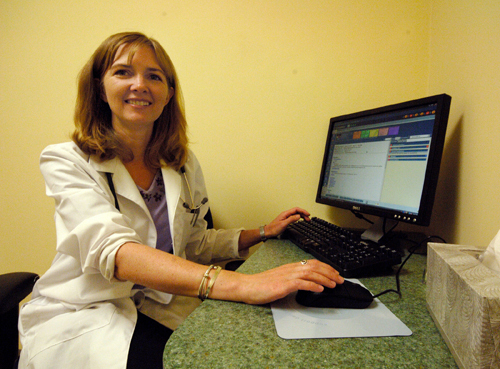
Drs. Lisa Denny and Andrea Arena use a secure Web portal where patients can book appointments, get test results, and e-mail questions – nothing urgent, but perhaps a concern about a drug’s side effects, or an update on blood sugar levels.
“It’s just another way for them to communicate with us,” said Denny, who has offered patients the Web tools since the office opened early last year. She and Arena have a “micropractice,” stripped down of costly support staff and focused on maximizing direct doctor-patient contact, and they pay extra to have a patient portal on their medical records software, eClinicalWorks.
“People particularly love getting their lab results the same day, and the appointment reminders are nice, too,” Denny said. The practice doesn’t offer “virtual visits,” as some doctors in other states do, but about 80 percent of patients get at least e-mail appointment reminders, and 40 to 50 percent use other features, too, she said.
Yet Denny and Arena are actually rare exceptions in Rhode Island when it comes to online communications with patients. An informal Providence Business News survey of local doctors and electronic medical records (EMR) software providers found little use of even readily available tools, and a general reluctance by doctors to venture in that direction.
Across the country, however, more and more doctors are using e-mail, Web portals, Web cameras, remote diagnostics equipment and even mobile phone applications to connect with their patients, especially in markets where insurers are willing to pay for such services.
A recent survey by the health-information firm Manhattan Research, a division of Decision Resources Inc., found 39 percent of doctors said they had communicated with patients online, up from 31 percent in 2007 and 19 percent in 2003, when the federal Health Insurance Portability and Accountability Act (HIPAA) imposed a slew of new privacy requirements. The vast majority of U.S. doctors – 84 percent – are now online, the firm found.
A secure technology created by American Well Corp. and being rolled out nationally by a division of UnitedHealth Group Inc. is making it easy for doctors to offer “e-visits” enabled by Web video, live chat or phone. And on July 15, United and Cisco launched a partnership called “ConnectedCare” that will bring telehealth services to rural, urban-core and other underserved areas, using audio and video technology as well as remote diagnostic tools.
Deborah A. Hogan, project manager for Electronic Health Records of Rhode Island (EHRRI), a collaboration by major physician groups that has brought eClinicalWorks to more than 250 Rhode Island doctors’ offices (including Barrington Family Medicine), said several factors are at play in keeping e-tools from being widely used in this state.
For starters, Hogan said, the demand isn’t strong. Except for family doctors and pediatricians, a large share of Rhode Island physicians have mostly older patients, she noted, and “people believe that our aging population can’t connect with that.”
But most important, Hogan added, not a single insurer in Rhode Island pays for e-visits or patient e-mails yet, and doctors are reluctant to take on more work for which they can’t get paid – or for which they would have to develop a whole separate billing system.
“I’m looking at it and saying, it’s just not fair to [doctors],” she said.
Noah Benedict, executive director of Polaris Medical Management, which sells EpiChart, a locally developed EMR widely used by primary care doctors, said some tools are already in use, such as e-mail reminders for high-risk patients, and e-mailed lab and radiology results. But doctors still see the phone as quicker than e-mail, so given the lack of pay, a call may make more sense. Privacy is also an issue, and e-mail is generally not secure.
Dr. Diane R. Siedlecki, president of the Rhode Island Medical Society and an internist at Anchor Medical Associates, said the group practice uses EMRs but not a patient portal, and while e-mail could still be an option, “it’s really not encouraged at this point.”
Adapting to EMRs is challenging enough, Siedlecki said, and having to check e-mail on top of that would add more tasks to keep going back and forth with. There are also liability issues, Siedlecki said, since it might be hard to determine the seriousness of a patient’s condition by e-mail.
Yet there is a lot that could be done online, Siedlecki said, and that is worth pursuing. Diabetics could be helped to manage their blood sugar levels online, for example, and people with cardiovascular problems could manage their blood pressure. Prescription refill requests are a natural, as are simple, nonurgent questions.
Russ Keane, vice president of Ingenix CareTracker Solutions (the former LighthouseMD, now part of a United division), said there is definitely a growing demand for online patient tools, enough that CareTracker will be launching a patient portal in the winter.
But doctors who really want to use online tools aren’t waiting for reimbursements and technical issues to be all worked out. Take Dr. Yul D. Ejnes, at Coastal Medical.
A founding partner of EHRRI, Coastal uses eClinicalWorks, but not the patient portal. Ejnes has been using e-mail with his patients since the early 1990s. After HIPAA raised the standards for security, he switched to a secure Web-based portal, Medem.com.
Moreover, Ejnes said, the e-mails take the place of phone calls that, in his experience, would take more time. “It lets them pour their hearts out without having to worry about tying me up on the phone,” he noted, and he can respond when he’s free. “It’s a lot easier for me, and the patients love it – they feel they have more access to their doctor.”
Coastal is looking at adding the eClinicalWorks patient portal in the near future, Ejnes said, but he doesn’t expect doctors there or in general to embrace e-tools until they are paid for it.
Dr. Nitin S. Damle, of South County Internal Medicine, said that’s the deciding factor for his practice, which has been using EMRs for about a decade but doesn’t want to “set a precedent” by starting to take and reply to e-mails for free.
“I think that most of the patients who ask are in our non-Medicare population – younger, tech-savvy patients – if the offer was made, I think we would have a significant use of e-mail,” he said.
Instead, Damle likes the idea of including the service in an enhanced “medical home” – a model being tested now by a handful of practices in a project called CSI-Rhode Island.
“We think [e-mail] is a valuable service,” he said. “It just takes a fair amount of our time.” •