Small-business lenders in Rhode Island have not seen an increase in U.S. Small Business Administration-backed lending after the recent Standard & Poor’s downgrade of the nation’s credit rating, contrary to findings of an online organization that matches lenders and borrowers nationwide.
BoeFly, with 30 years of experience in the commercial lending market, said in an Aug. 19 release that it investigated the results of the Aug. 5 downgrade in response to the concerns of “countless small-business owners [who] wondered whether access to financing would become even more difficult.”
“A review of loan sales on BoeFly by banks, spanning multiple geographic regions, reveals no negative impact on prices paid to banks for SBA-guaranteed loans since the S&P downgrade,” the company said, claiming that, in fact, demand is up. The latter, BoeFly said, is due in part to “lower borrowing costs since the downgrade.” The group did not provide a regional breakdown of its findings.
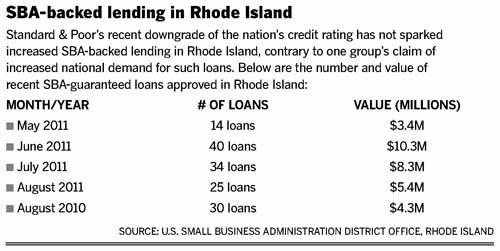
The latest lending statistics from the Rhode Island district office of the SBA, however, do not bear out the claim of increased demand. In August, fewer SBA loans were made than the month before and fewer than the same month a year ago.
Last month, according to Mark S. Hayward, executive director of the SBA’s state office, 25 SBA-backed loans worth $5.4 million were approved. This compares to 30 loans worth $4.3 million in August 2010.
In May of this year, the SBA in Providence reported the approval of 14 loans worth $3.4 million; in June, 40 loans for $10.3 million; and, in July, 34 loans worth $8.3 million.
From Oct. 1 2010 to Sept. 7, a total of 413 loans were approved, worth $115.7 million, Hayward said. In the previous fiscal year 2010, running from Oct. 1, 2009 through July 31, 2010, 457 loans were granted worth $98.3 million. Figures include both 7(a) and 504 loans, as well as micro-loans.
Hayward reported that it is neither easier nor more difficult than it was before the Aug. 5 downgrade to obtain an SBA-backed loan, an opinion echoed by William A. White, president of Coastway Bank in Cranston.
“I don’t think the two are related,” White told Providence Business News, referring to the downgrade and the pace of SBA lending. “Business [in loans] was good before the downgrade and it’s been good since.”
A more significant factor has been the drop in the SBA guarantee from 90 percent to 75 percent and reinstatement of the fees the SBA charges for loan applications, White suggested. The fees had been waived and the guarantee raised to 90 percent to help stimulate the economy, but both federal provisions were temporary and have expired.
A state proposal to add a 15 percent, state-funded guarantee and so retain the 90 percent level has won approval from the R.I. Economic Development Corporation board, but awaits federal OK before enactment, EDC spokeswoman Melissa Chambers says.
The SBA application fees range from 2 percent to 3 percent of the amount guaranteed. For instance, a $1 million loan with a 3 percent fee on the guaranteed $750,000 would result in a charge of $22,500. “That is money the borrower could use to create jobs that is going to the SBA,” White said, “so borrowers are reacting to that more than anything.”
Leland Merrill, senior vice president in charge of commercial lending at BankNewport, said he never considered a connection between the downgrade and SBA loans until a reporter asked him about it, and like White, he sees no connection between the two.
The difference between an AAA S&P rating and an AA rating for the nation has proven “meaningless, as far as SBA lending goes. I do not think any of the banks would make that kind of association,” he said. “We certainly haven’t. The guarantee of a government AA rating is very solid.”
Henry A. “Bud” Violet, president of Ocean State Business Development Authority in Providence, said he thought at first that the downgrade would affect SBA loans and was concerned about it, fearing rates would rise as a result.
The OSBDA handles a significant number of SBA-backed loans, with 42 approved in the last fiscal year, including two each in Massachusetts and Connecticut.
Violet said this fiscal year’s total at the authority so far is 17 loans worth $10.3 million, and is not expected to reach last year’s level (the federal fiscal year ends Sept. 30). “Given the economic climate in Rhode Island, we’re happy with the number of projects we can do,” Violet said.
Rather than the downgrade, or even the loss of the 90 percent guarantee and fee waiver, Violet attributed the slow pace of lending to the reluctance of borrowers to take on added financial obligations due to economic uncertainty at state and national levels.
Seldom one to defend banks, Violet said he sometimes thinks banks are being unfairly criticized for not lending enough, when in fact the problem lies with hesitant borrowers. “There is not a lot of loan demand,” he said. He noted that the SBA fees are built into most transactions “so there is no out-of-pocket expenses to the borrower” and, if a 2 percent or 3 percent fee presents a problem, “then perhaps a borrower shouldn’t be borrowing.”
Regarding a state guarantee for SBA loans, state and SBA officials, including Gov. Lincoln D. Chafee, touted the prospect of adding a 15 percent guarantee to the standing 75 percent SBA backing at a small-business meeting in April, attended by SBA Administrator Karen Mills.
Plans call for $5 million for the new guarantee to come from the Job Creation Guaranty Program administered by the R.I. Economic Development Corporation; some $75 million of the $125 million total is reserved for Curt Schilling’s 38 Studios in downtown Providence.
When the 90 percent federal guarantee was in place and fees waived, SBA lending generally increased both in Rhode Island and nationwide. •