Executives at Electric Boat had thought they were heading into a quiet time for the Groton, Conn.-based submarine maker, at least in the areas of design and engineering.
EB – a division of General Dynamics – was scheduled to wrap up construction work on the USS New Hampshire, the latest Virginia-class attack sub, by this fall. It also was supposed to complete design work on a next-generation aircraft carrier, a collaborative effort with Northrop Grumman Shipbuilding, in Newport News, Va.
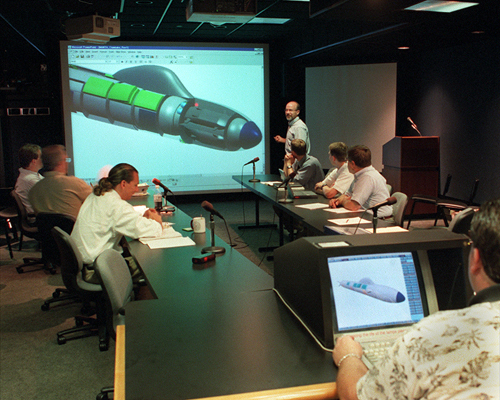
But EB is finding that there is lots more design work to be done and is looking to hire 200 engineers and 200 designers for upcoming projects and redesign work. It’s the most significant block of hiring for the defense contractor since 2001, according to EB officials.
The reason: Funding for the aircraft-carrier project has been extended, and EB said it has been working on tweaking the Virginia-class designs to reduce construction costs and, in turn, persuade the Navy to order more subs.
In addition, EB is performing design work for a new destroyer that will be constructed by the Bath Iron Works in Maine, also owned by General Dynamics. And EB is conducting early concept studies for the next generation of nuclear subs.
“Add all this together and what they thought would be a lull for design work in the ’08-’09 timeframe really hasn’t developed,” said EB spokesman Robert Hamilton.
The hiring will make up for attrition – and then some.
Although Electric Boat employs about 2,000 tradesmen at its Quonset Point manufacturing plant in North Kingstown, Hamilton said designers and engineers hired for the new positions will be assigned to the Groton shipbuilding facilities.
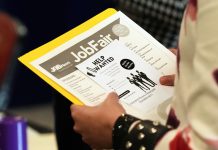
A job fair held at the EB’s Groton location on March 1 attracted hundreds of applicants. In fact, Hamilton said 67 people were offered positions immediately. “It was a very good day for us,” he said. “Basically, it was six weeks of our normal recruiting in one day.”
The hiring spree is in line with what EB President John Casey said in a public presentation in December on the division’s future. At the time, Casey gave a strong forecast, saying Electric Boat would have a steady need for 2,000 workers in Rhode Island over the next 10 years.
He also said the EB, which employs about 10,500 today, would be able to maintain a work force of at least 8,000 for the foreseeable future, buoyed by the increased production schedule of the 353-foot Virginia-class subs.
Company executives said the Navy is expected to order two subs a year starting in 2010. Orders for the subs in recent years have been alternated between EB and Northrop Grumman Shipbuilding, formerly Newport News Shipyard.
Despite the positive long-range outlook and the need for engineers and designers, EB does have a short-term work force issue.
The company expects to deliver the latest sub, the U.S.S. New Hampshire, by the fall, months ahead of schedule, Hamilton said.
Because construction work on the sub is winding down, EB is not hiring new tradesmen. In addition to the New Hampshire, EB is completing shakedown work on the Texas, another Virginia-class sub, and finishing another major repair job.
The hope is that some of workers might be able to shift over to become designers, a job that requires technical know-how but not necessarily an advanced degree.
So far, EB engineers and designers have been successful in reworking some components of the Virginia-class design to cut $40 million off the cost of the $2.5 billion subs.
Those changes include redesigning the bow so the 12 vertical missile tubes are replaced with two larger, more-versatile tubes that can either deploy missiles or unmanned aerial or undersea vehicles.
Revised designs also call for replacing the sonar sphere with a less costly “lightweight, large-aperture bow array.”
Where the sub was once built in 10 sections at Quonset, then barged to Groton, EB is now building four sections in Quonset.
Those types of cost-saving redesigns will be part of the focus of the new engineers and designers, because EB said it pays dividends in the long run.
“The Navy told us, ‘Look, you get the price down to $2 billion and we’ll order two subs a year,’” Hamilton. “We’re probably about 90 percent of the way towards that.” •