
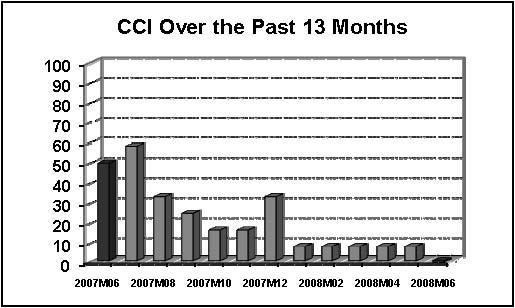
KINGSTON – Rhode Island’s economy plumbed new depths in June, according to University of Rhode Island economist Leonard Lardaro, as his Current Conditions Index (CCI) fell to 0 for the first time.
According to Lardaro, not one of the 12 of the CCI indicators improved relative to June 2007, when the state posted a neutral score of 50. (Any value higher than 50 signify the economy is in expansion while anything below 50 signifies retraction.) The score of 0 comes after four of the year’s first five months scored 8 (only April, with a 17, had a better score).
He noted that even the federal economic stimulus payments could not prevent retail sales in the state from falling 2 percent relative to June last year.
“The ongoing negative of our state’s economic weakness were more than enough to offset [the stimulus payments],” he said in a statement that accompanied the release of the index.
The four indicators having to do with employment fell, some dramatically. The state’s unemployment rate grew to 7.5 percent, a 50-percent gain on the 5.0-percent rate in June last year. Unemployment benefit exhaustions increased 43.4 percent, meaning that long-term unemployment is growing; and at the same time, the labor force contracted by 1.0 percent. And new unemployment claims increased 12.7 percent, as the economy continues to shed jobs.
As Lardaro said, “the disappointing economic data didn’t end with the labor market.” Permits for single-unit home construction fell 54.5 percent, something that he said was a positive development.
“While single-unit permits and new home construction continue to fall sharply, this is fundamental to our ability to reduce the inventory of unsold homes here,” he said.
Other indicators suffering double-digit drops compared with June 2007 were U.S. consumer sentiment (-33.5 percent) and employment services jobs (-16.3 percent).
Lardaro ended the report by noting that “at long last, we have gotten from Rhode Island’s economy precisely what we have always demanded from our state’s government: absolutely nothing!”
The Current Conditions Index, created by University of Rhode Island economist Leonard Lardaro, measures the strength of the state’s economic climate. Values above 50 points indicate the economy is expanding. Additional information, including historic data back through 1983, is available at members.cox.net/lardaro/current.
Rhode Island's Market Has Changed. Developers, Builders, Investors and Sellers Must Change With It.
By Emilio DiSpirito IV License Partner | Engel & Völkers Oceanside Leader | The DiSpirito…
Learn More












I admire and respect Prof. Lardaro’s work and echo his sentiment that ‘we get what we deserve’ regarding the general assembly and other elected leaders.
But I must point out that there is a segment of our economy that is growing and thriving under the radar: the various parts of the technology industry. Known only to certain facets of the state EDC, STAC, The Tech-Collective, Brown Enterprise Forum, The Slater Foundation, the very informal Providence Geeks, and other techno-networking groups of movers and shakers, this industry is chock full of innovation, talent, and energy.
Could that be because this industry has too many moving parts to pin down? Could it be that the established and staid brokers of the Rhode Island economy can’t get a bead on the newer innovations? Is it because some of these innovations cannot be quantified based on 20th century economics?
I believe it’s the latter. Companies who don’t see the value of the information economy are the same companies that are losing talent to MSAs such as Boston, New York and Washington, D.C. Weren’t we here in the early 1980s? Doesn’t anyone remember Big Iron and the PC? The PC and Networks? LANs/WANs and the Internet? Each time the innovators pushed the envelope and there were winners and losers.
The compensation paid by companies to Information Professionals who understand the pace, innovations, and business is relative to the value placed on these workers to push the envelope within each and every company. Working ‘with’ not ‘directing at’ makes a team successful.
Unfortunately, if companies don’t trust, understand, or relate to the rapid pace of applying today’s and (the insight to recognize) future technologies, they will have their lunch eaten by competitors who do.
Those individuals who have insight and support from the companies I’ve mentioned (and there are many more from outside of Rhode Island) will create companies and wealth in spite of a ‘zero’ CCI. And then, they will have the opportunity to move anywhere where the tax and economic environment is beneficial and the talent pool is rich with energy and innovation. We, as a state, are getting there, but under the radar.
Bravo Professor, now that you have the research, it needs to be said, continuously.