/
The baby boomers are aging, but they aren’t all retiring, experts say. They will, however, continue to change the labor market and the way Rhode Island’s human resources professionals have to look at hiring.
By 2015, the U.S. Bureau of Labor Statistics predicts, the number of workers in the state aged 55 to 64 is expected to increase by 22,448, and the number of workers 65 and older, by 3,775. At the same time, the number of workers in the 35-to-54 age bracket will decrease by 12,849, and the number of workers under 30 will only increase by 12,315.
“There will be a big succession problem for employers,” said Paul Harrington, an economist at the Center for Labor Market Studies at Northeastern University. “This is going to be a spicy meatball for the business community in the coming decade.”
Harrington gave his assessment at a breakfast sponsored by the Greater Providence Chamber of Commerce. “Work force development is a high priority for our members, so we thought this would be a good fit,” said Chamber spokeswoman Bethany Costello.
Along with Harrington’s presentation – which included a comprehensive analysis of the demographic trends and their economic implications – the event featured a panel discussion with Kyle Adamonis, senior vice president of human resources and legal affairs at Taco Inc.; Kate Brewster, executive director of The Poverty Institute at Rhode Island College; Mary Connor, manager of human resources for Cox Communications; Brandon Melton, senior vice president of human resources for Lifespan; and Edwin Redfern, a national program consultant for the AARP.
Melton said Lifespan is expecting the aging of the work force to make a significant impact. “By 2025, we expect a 25-percent vacancy rate in management and a possible 50-percent vacancy in nursing,” he said.
And those vacancies will come at a time when the aging of the general population is creating a much higher demand for health care services, Melton added.
Connor said she is also concerned, because at Cox, highly skilled workers will be needed to replace those who leave.
Redfern said that this is why it is important for human resource professionals to keep an open mind about hiring older workers who have experience, even if their work history is not specific to the employer’s industry.
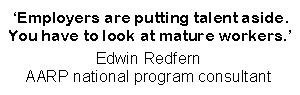
“The challenge that human resources is having is finding people who are qualified,” he said. “But employers are putting talent aside. You have to look at the mature workers.”
This, he said, requires looking at skill sets, as opposed to work history alone, to find someone who would be a good fit for the position.
As the work force ages, Redfern added, this will become even more important, because people may not want to do the same job even though they’re remaining in the labor force.
“Boomers who have been in the same profession for 20 to 25 years may not want to do that anymore,” he said.
Because this talent will be integral to the business community, Redfern also urged employers to consider what they need to offer to hire those skilled, experienced workers.
“I tell HR managers that compensation alone isn’t going to be the deciding factor,” he said. “You will be competing for talent that is looking for other reasons to work for an organization.”
According to an AARP survey of 2,001 workers aged 50 to 70 years old, the issues most important issues to older workers were “respect from employers, flexible work options, opportunities for training and new experiences, competitive health care benefits and competitive retirement benefits.”
Those factors don’t necessarily add up to higher costs for employers.
According to a report put together by Towers Perrin, entitled “The Business Case for Workers Age 50+,” retirement costs and paid time off are age-neutral, and although health care claims may increase in an older work force, “older workers may be more effective partners in employer efforts to promote better consumer behaviors in health-care purchasing.”
Harrington offered a similar assessment. Although the aging work force will be a challenge for employers, he said, it will be much easier to navigate with a different approach to hiring.
“Focus on the skill sets,” Harrington said. “A lot of the skill sets are transferable. But job-seekers also have to be more savvy with positioning their skills to employers.”
Building a Strong Data Foundation in the Age of AI
Artificial intelligence (AI) has become a key priority in the boardroom and across management —…
Learn More