With the R.I. Economic Policy Council predicting that the amount of state employees retiring this year will be the largest percentage in at least 28 years, Gov. Donald L. Carcieri and other state leaders see a chance to restructure state government.
While not willing to advocate for a reduced state work force, Rhode Island Public Expenditure Council Executive Director John C. Simmons does agree the mass departures provide a rare opportunity to re-examine state services.
“We do know that they are using the Six Sigma process … to go through every department as they begin to look at whether [filling] those positions is necessary,” he said. “We believe that now is an ideal time because they’re probably in excess of 1,200 people down, probably an 11-percent reduction in the work force from the 2008 revised budget.”
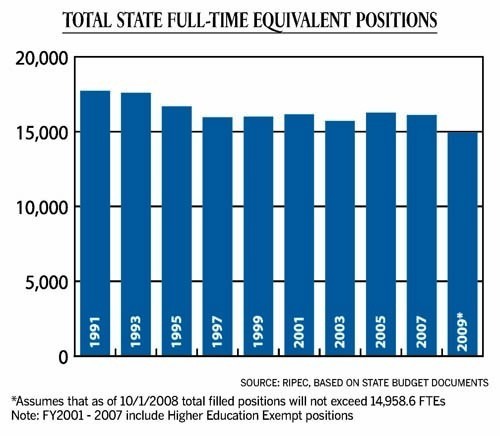
The 14,958 full-time employees that RIPEC has predicted for the state for FY2009 would also be the smallest amount of employees the state has had since at least 1990, according to RIPEC figures. By the end of October, the R.I. Department of Administration and Carcieri’s office will have final figures for the number of retired employees and the amount those vacated positions will save the state, Amy Kempe, the governor’s spokesman said last week.
The number of full-time employees has been falling since 2006, when it was at 16,417, according to RIPEC. But it has gone through periods of growth and reduction during the last 28 years. Historically, it was highest in the early 1990s, when it was at more than 17,000 full-time employees for five years. This decade, the largest growth has been a 4.2-percent leap in 2005 and the yearly change – either growing or shrinking – has averaged 1.92 percent of the state work force.
In the face of a looming budget deficit the state, before the current fiscal year took effect July 1, had already started the process of planning for reduced allocations for state personnel, Simmons said.
“The intent was to reduce the headcount to meet a budgetary need, but also at the same time to afford the state an opportunity to begin to restructure and reexamine the basic services that the state provides,” he said.
Kempe said the administration is in agreement. While final tallies for departed state workers aren’t yet available, state departments now are looking at this as a chance to review staffing and services, she said.
The onslaught of retirements this year was brought on by a change – dubbed Article 4 – to the retirees’ health insurance coverage. [The departures have caused problems meeting federal mandates at the R.I. Department of Elementary & Secondary Education and have classes and services at the state colleges and other agencies. READ MORE] So, if a state employee retired before Sept. 31, he or she would have paid health care for the rest of their lives, Simmons said.
But Simmons stopped short of saying the reduced work force would be a “positive” change for the state. There are issues that could arise from the restructuring, he said. “I think it will be a structural change for the state,” he said. “I think there will be some transition issues for the state.”
He added, “How are services going to be rendered in the time period when people have left state government? Who’s going to provide services? How is it going to be provided?”
It’s also difficult to single out the retiring employees as the only part of planning for the future, because they’re just one portion of the reductions the state is attempting, said RIPEC Director of Policy & Research Susanne Greschner. Personnel spending is essentially one of three major categories for the state, she said. The other two are Medicaid and Local Aid. “Each one of them is pretty much about $1 billion in general spending,” she said. “And what the governor is trying – as well as the [General Assembly] – is to cut in all three areas.”
At the state Treasurer’s office, Frank Karpinski is executive director of the employee retirement system. He said his office administers a defined benefit plan and calculates the cost of benefits – but does not regulate policy. About 1,200 employees have left, “but as far as the intent and what happens after is the difficult part,” Karpinski said.
There is a 19-member committee that’s been formed by the General Assembly to discuss employee pensions that met earlier this year and will likely meet again before the end of the year. Their decisions could be wide ranging, Karpinski said, “but that’s kind of a moving target – what will they do, if anything, and the extent of what they’ll do, we don’t know.”
“For the people who are still around, nothing has really changed for them … other than a reduction in health care,” he said.
Kempe, in the governor’s office, said that the state is still taking the first steps, deciding whether new policies in hiring are needed. No decisions have yet been made.
“It’s simply a matter that we have to let it wash out for a little bit, particularly when it comes to cost savings,” Kempe said. “Right now, with the retirees, many of them are still receiving paychecks because of unused vacation time and things of that nature – primarily sick days … We’re still looking at the numbers.”
She said the state is looking at this as a chance to eliminate “redundancies.”
It’s a time “to see if there are some functions that we are performing that perhaps we don’t need to,” she said. “Recognizing that these are extremely difficult economic times, we need to tighten our belts.” •