If you want to know how much scrap, electronics and other products Rhode Island exports, the U.S. Commerce Department can tell you. This export data focuses on what’s known as “origin of movement,” tracking manufactured goods by U.S. Customs, according to Maureen Mezei, international trade director at the R.I. Economic Development Corporation.
“We have to rely on the federal government to track this information, whether it’s goods or commodities,” Mezei said. “We don’t have the resources to do that.”
But what if you’re exporting knowledge, based on scientific research, or expertise, and not widgets? How does that get measured and counted within the economic-value chain for Rhode Island exports? It doesn’t now, according to many of the state’s international business experts.
“I’ve never seen anything that measures what Rhode Island is exporting in services and expertise and the knowledge economy,” said Ray Fogarty, director of the John H. Chafee Center for International Business at Bryant University.
Even nationally, there are no really good tracking devices to measure exports of engineering services, consulting services and advisory services, according to Fogarty. A recent report by the U.S. International Trade Commission, “Small and Medium-Sized Enterprises: Overview of Participation in U.S. Exports,” issued in January 2010, provided some important data points, according to Gerald Cohen, trade specialist at the Chafee Center. Cohen cited the report finding that 79 percent of all the small and medium-sized enterprises in the U.S. deliver services, rather than manufacture products.
Fogarty said there is a growing recognition that the knowledge economy is reshaping the traditional definition of what exports are – and Rhode Island businesses are beginning to position themselves to take advantage of that change.
Without good data sources, much of the documentation is anecdotal, but there are some good stories to tell about Rhode Island, according to Cohen. One is Banneker Industries in North Smithfield, a privately held company with 50-60 employees and between $15-20 million in annual revenues, which Cohen says is transforming the concept of supply chain management related to exports, likening it to the historical role that Yankee clipper ships once played in moving products from New England all over the world.
In the last year, Snead has traveled five times to China in order to build new potential markets for Rhode Island goods and services. “We’re helping manufacturers here develop the opportunity to sell products in China, developing relationships and conducting research about what kinds of products the Chinese are interested in buying from America,” he said.
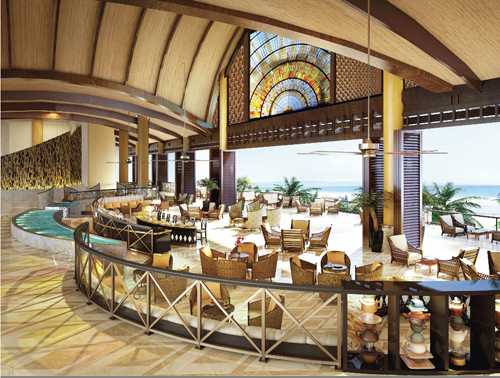
Another Rhode Island “export” services story is DiLeonardo International Inc., founded in 1971, that does about $10 million in business a year. “We don’t buy anything, we’re just a service,” said President James Lehouiller about his architectural services in the hospitality-design business, focused on interior architecture for luxury hotels and results.
“Ninety-nine percent of our business is overseas. We have zero business in Rhode Island,” he said. The company employs 40 people at its Warwick offices and another 60 at its offices in Dubai, Hong Kong, Shanghai and Manila.
For Lehouiller, it would be a tremendous advantage for Rhode Island – and the United States – to be able to quantify what service-based exports amount to.
“We’re no longer focused on manufacturing as an industry in Rhode Island. Being able to understand what services are being exported will be very important for the state to be able to plan for its economic future. It will help educate the people in power in government,” he said.
Timothy M. Hennessey, a political science professor at the University of Rhode Island, isn’t sure how to place an economic value on the export of his expertise. Hennessey has been working as an academic consultant in West Africa, in the Baltics region of Europe and India, helping countries develop management plans for diminishing fishery resources. The focus of his work is large marine ecosystems.
“We’ve been working with three countries in West Africa – Angola, Namibia and South Africa – to develop a convention to manage the boundaries of the hake fishery,” he said. “The area is heavily fished by the European Union, because the fisheries in Europe are in such terrible shape.”
Until there is a way to quantify the value of the fisheries resource, Hennessey said, “people won’t value the resource.”
The nexus of the knowledge economy with university research in Rhode Island is another source for growth in the export of services and expertise. A new Rhode Island startup, Banyan Environmental, Inc., begun in October 2009, has been spun out of research at Brown University about how to contain mercury vapor from broken, compact fluorescent light bulbs. With 290 million fluorescent compact bulbs manufactured in 2007, mostly in China, the market potential for the company’s expertise is huge and growing, said Love Sarin, the entrepreneur behind the company. “We developed an absorbent that will bind the mercury and stabilize it in a solid form,” he said. The technology is patent-pending – Brown University filed the patent, and Banyan has the exclusive worldwide license. The process will enable the mercury vapor captured to be recycled into future production of bulbs – as well as prevent harmful environmental consequences, Sarin said. He expects to begin to begin test-marketing the process during the next year.
In terms of the future of the Rhode Island economy, Fogarty said, the message needs to be focused on expertise and services, as well as products. He said he was about to meet with a Rhode Island company, which he declined to name, with expertise in the coffee-trading business, to help it work with another client who is harvesting coffee in a Central America country. The hope is to develop new markets for the product.
“It’s expertise that’s being marketed” by the Rhode Island company, he said. •