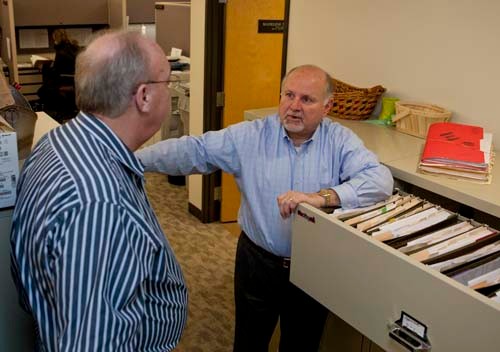
Pawtucket Credit Union President and CEO Karl Kozak needed to read just the first page of an Obama administration report to know that the suggestions, if implemented, would fundamentally change the home-mortgage game.
In February, a report from the U.S. Treasury Department and U.S. Department of Housing and Urban Development outlined a plan for the federal government to largely retreat from the home-mortgage business. The report sent shockwaves through the financial industry, with some commentators declaring the end of the storied 30-year, fixed-rate home loan.
For his part, Kozak was stunned, especially at a suggestion to wind down the Federal National Mortgage Association and the Federal Home Loan Mortgage Corp., better known as Fannie Mae and Freddie Mac. Combined, the two enterprises charted by Congress control the majority of the nation’s secondary-mortgage market.
Kozak’s Pawtucket Credit Union sells between 10 percent and 20 percent of its loan volume each year to Fannie Mae. (He keeps the rest.) The sales provide cash that the bank uses to fund more loans. And the sales offer the bank a hedge if inflation rises faster than the rates on the mortgages.
If Fannie exits the market, Kozak wonders what he would do. He could stop reselling mortgages but, with less cash on hand, he would need to scale back lending. He could sell to the private market, but that comes with higher interest rates.
“Mortgage rates will continue to rise so that the consumer is going to foot the bill,” Kozak said. “Banks are going to do everything they can not to foot the bill.”
For some, Fannie and Freddie are already gone. The two organizations once snapped up 75 percent to 80 percent of bonds issued by Rhode Island Housing, which used the proceeds to fund loans for Rhode Islanders. About three years ago, Fannie and Freddie stopped buying the loans, sending Rhode Island Housing scrambling to find new investors.
Rhode Island Housing Executive Director Richard Godfrey said that the U.S. Treasury has filled part of the void, but eventually he foresees the quasi-public corporation needing to tap the private market.
Of course, private markets would need to emerge and Godfrey does not see that happening in an economy with weary investors.
“No one knows what will emerge five years from now but unfortunately we are in the time when we need Fannie and Freddie the most right now to be able to kick-start the moribund housing industry,” Godfrey said.
Of course, winding down Fannie and Freddie could take a long time. Treasury officials say it could take five to seven years for the government to shut down the institutions. And under one scenario the government would hand off the loan-making business to the private market but compel companies to buy reinsurance through the government, although the government would only pay if the private mortgage guarantors disappeared. The Obama administration has yet to pick a specific course of action and it remains unclear whether Congress’ approval would be necessary to shut down Fannie and Freddie.
The report outlines other steps as well in an effort to shift the home-mortgage business to the private market. The report calls for raising down payments for government-backed mortgages, raising guarantee fees and reducing the maximum size of loans. All those steps would in essence price the government out of the market during good economic times and come with one significant side effect: “All these things increase the cost of homeownership,” said Bryant University professor of finance Peter Nigro.
Nigro said banks may find themselves “going back to the future” with how they handle loans. Once upon a time banks tended to keep loans on their books, dutifully collecting payments and waiting years for their return. But about 20 years ago, banks started selling the loans – or packages of loans – to investors. Insurance companies guaranteed against losses and bankers started issuing loans as fast as people could sign.
But Kozak said the solution is not necessarily to kill off the organizations. The report acknowledges that oversight of them was weak. So Kozak urges improved supervision.
“I’m kind of thinking the government is overreacting a little bit,” he said.
The government may also be overreaching, said Edward M. Mazze, distinguished university professor of business administration at the University of Rhode Island. Mazze said an exit by the federal government makes a major assumption – that the markets are ready to trust private companies, many of which helped create the mess in the first place.
“I’m not sure that we’re going to be able to trust private banks, mortgage companies and others to do this,” Mazze said.
Plus, Fannie and Freddie, for all their troubles, do set de facto loan standards because of their sheer sizes. That, Mazze said, offers the government a way to prevent another crisis without throwing out Fannie and Freddie altogether.
Mazze also worries that investors overseas will snap up loans in an industry dominated by private players. The worry, Mazze said, is investors buy up underperforming loans that default and a global crisis ensues.
And, Mazze said, no matter how the mortgage industry shapes up, underhanded lenders will always appear.
“Don’t ever underestimate our ingenuity to develop financial products that no one understands,” he said. •