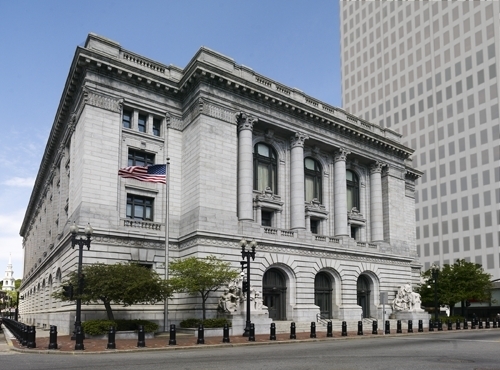
Two statues that frame the entrance to the U.S. District Court for the District of Rhode Island in downtown Providence stand as visual reminders of the federal legal system that has operated inside its halls since the courthouse first opened its doors in 1908.
The statue on the right of the doorway was built to represent federal supremacy. The statue to the left of the entrance represents Rhode Island’s independence.
This year, as the stately federal courthouse on the east side of Kennedy Plaza turns 100 years old, federal district court administrators are using the occasion to raise public awareness of the historically significant building and the legal system at work within its marble and mahogany corridors.
Mary M. Lisi, chief judge of the U.S. District Court for the District of Rhode Island, worked with the U.S. General Services Administration (GSA) and the Rhode Island Bar Association to plan a year-long celebration of the courthouse’s centennial, said U.S. District Court Clerk David A. DiMarzio.
“This building is not usually a place that the public has a chance to see,” he said. “And Chief Judge Lisi felt that the 100th anniversary of the building would provide an excellent opportunity for us to be able to open the doors of this beautiful, historic building to allow as much of the public in as possible – not only to see the building, but to become better acquainted with what the work of a federal district court is.”
The Providence Post Office, Court House and Custom House – as the building was originally named – is considered an exceptional example of the classical Beaux Arts design chosen for many large, important public buildings at the turn of the 20th century. Designed by the local architectural firm of Clarke & Howe, it was considered one of the finest federal buildings outside of Washington, D.C., when built.
Outside, the courthouse is sheathed in New Hampshire granite and Indiana cream limestone. Inside, the building is built of marble, mahogany and oak. The lobby features 24-foot arched ceilings and limestone pillars. Courtroom 1 boasts a domed, stained-glass ceiling that portrays a crested eagle with a banner that reads “E Pluribus Unum.”
The public will have the opportunity to explore the building and learn about its architecture and history this spring, at a free panel discussion and tour sponsored by the federal bench-bar committee of the Rhode Island Bar Association.
The event – slated for April 3, from 7 to 9 p.m., in Courtroom 1 – is part of a year-long program of events to celebrate the 100th anniversary of the U.S. Courthouse.
The program kicked off on Feb. 12, with a visit by John G. Roberts Jr., chief justice of the U.S. Supreme Court. Roberts’ visit and speaking program marked the first time in more than 200 years that a sitting U.S. Supreme Court chief justice had visited the courthouse in a formal capacity, DiMarzio said.
The centennial program will continue with a naturalization ceremony in June, and will end in November with a gala celebration.
The local federal district court has contributed a handful of very influential judges throughout its history, said Thomas Connolly, an associate at Vetter & White in Providence, who researched the court’s history for an article that will be published in the March/April issue of the Rhode Island Bar Journal, the journal of the Rhode Island Bar Association.
The first judge to sit in the courthouse was Judge Arthur Lewis Brown, who served from 1896 to 1927. A direct descendent of Chad Brown, who helped Roger Williams found Rhode Island, Judge Brown was known for his contributions to patent law at a time when patents related to the recently invented telephone and the first wireless devices were driving advances in communication.
It was reported that, during his time on the bench, the U.S. Supreme Court would not issue a decision in the area of patent law without first consulting the decisions of Judge Brown, Connolly said.
Judge Ira Lloyd Letts, who filled Brown’s seat in 1927 and served until 1935, became equally famous for his handling of Prohibition cases. Considered a law-and-order man when he took the bench of the federal district court in Providence, Letts surprised some by directing criticism at both criminals and the heavy-handed tactics of government at the time, Connolly said.
More recently, Judge Bruce Selya, now a senior judge in the U.S. First Circuit, sat on the bench in the district court from 1982 to 1986. A Rhode Islander who served as the liaison for Chief Justice Roberts’ visit to Providence last week, Selya is among the most cited judges in the country, trailing only Richard Posner, Frank Easterbrook and Sandra Lynch in a survey of cases between 1998 and 2000. •