The global credit crunch is hitting home.
Al Lubrano, president and chief operating officer of Technical Materials Inc. (TMI) in Lincoln, told most of his more than 200 employees to stay home last week because he had no work for them. “We are operating with a skeleton crew right now,” he told Providence Business News in a telephone interview.
Lubrano made headlines recently because he was one of about a dozen manufacturers who met with President George W. Bush in Washington, D.C., to talk about the distressing state of the economy. He met with Bush on Oct. 2, the day before the U.S. House of Representatives gave final approval to the $700 billion economic bailout plan called the U.S. Emergency Economic Stabilization Act of 2008.
“We do a lot of business in automotive electronics and, as you know, even people who normally would have no problems getting loans can’t get loans right now,” Lubrano said. “You combine that with the lack of confidence, and nobody’s buying automobiles. If people don’t buy automobiles, our customers don’t need products from us, therefore we don’t have any work for our employees.”
Lubrano’s business is not the only one in Rhode Island getting squeezed by the credit crunch.
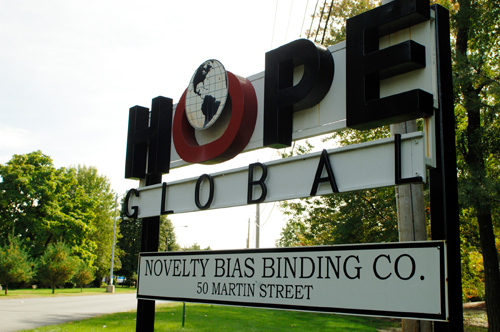
Hope Global, a manufacturing firm with more than 300 employees in the Berkeley section of Cumberland, relies on the auto industry for approximately 75 percent of its business, according to Cheryl Merchant, its president and CEO. “There’s no financing for automobiles, so the inventory is growing and the trickle-down effect is happening,” she said.
“All of our operations are starting to feel the pain in both areas – in the U.S. and Europe,” she said during a recent interview. “We will adjust our operations accordingly. Cuts will be made according to the loss in business.” Sales are down, Merchant said, and she mentioned some “suppliers and customers” who are going out of business.
Hope Global, a specialized textile manufacturer for automotive, commercial and industrial use, as well as a frequent supplier to the U.S. military, has plants in Michigan, Mexico, Ireland, Brazil and the Czech Republic, as well as a facility it recently purchased in Chester, S.C. A credit crunch “was not what was planned when we invested millions” to acquire the South Carolina plant, Merchant said. She assured doubters that the credit crunch is real. “It’s horrific. I don’t have any other name for it,” she said.
Leslie W. Taito, chief executive officer of the R.I. Manufacturing Extension Services (RIMES) in Providence, said she has heard from manufacturers in similar straits, but declined to put a number on how many. Five potential clients, however, have pulled back their contracts with RIMES until the new year because “they are only using their money for absolute necessities, they are so worried about the credit crunch and the impact of energy costs this winter,” Taito said.
Asked what advice she would give a manufacturer, Taito replied: “I would tell manufacturers to proceed with caution and focus on how their money is spent. People are going to have to be frugal and make cuts to save their businesses. We would encourage all of them to implement lean methodologies.”
The credit crunch is affecting more than manufacturers.
Recent surveys show that small businesses, in particular, are also hard hit by the lack of capital, with 67 percent of business owners nationwide reporting that their enterprises have been affected by the credit crunch, according to an August telephone survey sponsored by the National Small Business Association.
“It affects all businesses, particularly those positioned to grow, those in need of growth capital,” said Saul Kaplan, executive director of the R.I. Economic Development Corporation (EDC).
That does not mean that all businesses are struggling, however.
He applauded the announcement that Opinion Factor, a firm that offers market research services, had opened a new call center data-collection facility last week at 80 Commerce Drive in Warwick, bringing what company officials said will be more than 350 new jobs to the Ocean State. The firm also has facilities in Utah, California and Colorado.
“Don’t mistake the pockets of real strength in our economy and the nation’s economy,” Kaplan said. “Some companies are growing, and they’re looking to hire people, they’re taking advantage of the downturn in the economy to strengthen their positions.”
For those businesses that are hurting, “We need to see the federal [rescue plan] take effect across the country,” thereby freeing resources, he said.
The EDC will work with local lenders to see that financial opportunities, in the form of growth capital, are available to eligible companies “so they can grow again,” Kaplan said. “Whatever we can do to free up working capital for good business opportunities – not bad ones – we will do.”
The EDC has proposed – and will propose again, Kaplan said – the creation of a growth-capital guarantee program in which the EDC, like the U.S. Small Business Administration (SBA), would guarantee loans and thereby encourage lenders to make capital available to worthy businesses.
Lubrano believes the solution lies in the federal government’s $700 billion U.S. Emergency Economic Stabilization Act of 2008.
“Passing that economic stabilization act was the right thing to do and, given some time now, things will start settling out,” he said. “A floor has been established now, and I think we’ll start to see confidence being restored again.”
There is no danger of TMI shutting down, Lubrano said. “But our business is dropped off and we are adjusting our work force using temporary layoffs.”
Founded in 1968, TMI is an electroplating firm that supplies components to the computer and automotive industries among others. Business is down due in large part to the worldwide slump in automotive production and sales, according to Lubrano.
U.S. Sen. Sheldon Whitehouse, who toured TMI last week, held out hope that the $700 billion bailout eventually will resolve the credit crunch.
“The turmoil in the financial markets is putting Rhode Island families and businesses alike in a tough spot, as scarce credit makes it more difficult to get a car loan or cover payroll,” he said in a prepared statement.
“The recovery plan, while imperfect, will help put the brakes on our downward economic spiral, but it’s clear that our efforts to help can’t end here,” Whitehouse added. He also called for health care and credit card reform and homeowner assistance. •