There haven’t been any recent studies of the economic impact of the Newport jazz and folk festivals. Not even 83-year-old impresario George Wein, who founded the festivals more than 50 years ago knows the answer – but some positive effects are certain.
The festivals bring thousands of people to Newport, the hoteliers and restaurateurs benefit from the business generated by the productions and, even more importantly to some, both the jazz and folk festivals are signature events for which Newport – and to a lesser extent, Rhode Island – is known worldwide.
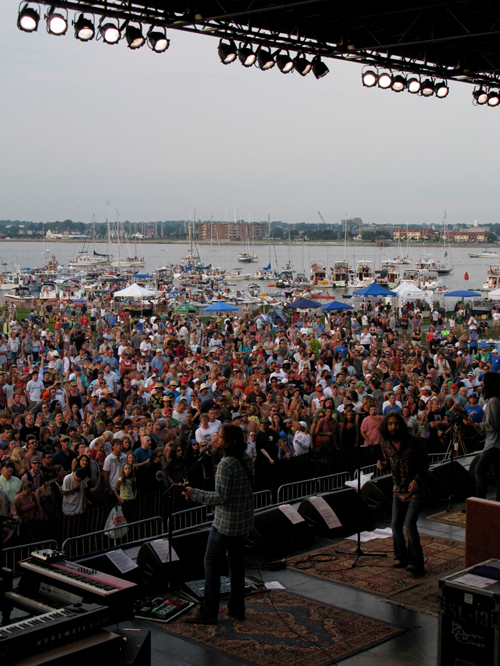
“We do not draw the people we used to. We have much more competition,” Wein said during a recent telephone interview from his home in New York City. The festivals combined used to draw as many as 40,000 people to the City by the Sea up through the mid-1990s, Wein said. This year, he expects 20,000 to 30,000 for both, a drop attributed to today’s increased competition for the entertainment dollar.
“I don’t know what the festivals mean to the Newport economy, they never release figures like that,” Wein said. “All I know is [Newport businesses] all want the festivals back.”
Working with Louis and Elaine Lorillard of Newport, Wein established the jazz fest in 1954 and the folk fest in 1959, when a teenage Joan Baez (scheduled to return to the folk festival this year) was one of the performers. He later created a company that he has since sold to oversee the events, but in recent years has limited his involvement. However, when he heard the festivals might be canceled this year due to financial troubles at the new production company, he came out of semi-retirement to form yet another company – New Festival Productions LLC – and save the events.
“The people who produced the festivals last year didn’t have any money to do them this year, so I just jumped in there. I created these things and I have to keep them alive, that’s all,” Wein said. “I’ve been producing them for 55 years and, hey, I’m 83 years old, I’ve got nothing else to do. When something is part of your life, you don’t want to see it disappear just because some people goofed.”
The folks in Newport are mighty glad he and his festivals are back.
Kathryn Farrington, vice president of marketing for the Newport County Convention & Visitors Bureau, said she received calls of alarm from local hotel and restaurant owners when it seemed the festivals might be canceled. “We are so lucky to have George Wein continue his events here in Newport,” she said.
Neither the city, nor the visitors bureau or the local chamber of commerce could provide data on how much money the festivals bring to Newport and Rhode Island. However, in 1994, the University of Rhode Island conducted a study to determine the average total audience expenditures for both festivals for Newport residents, Rhode Island non-Newport residents and people not from Rhode Island.
According to the 1994 study, 590 Newport residents each spent an average of $153 at the festivals, as well as $410 in Newport and $39 elsewhere in Rhode Island; 1,735 Rhode Islanders who did not live in Newport spent an average of $98 at the festivals, $125 in Newport and $94 elsewhere in the state. Some 11,590 out-of-state attendees spent an average of $187 at the festivals, $1,865 in Newport and $162 elsewhere in Rhode Island. Combined, that adds up to $26.6 million. Adjusted for inflation, today that would equal $38.6 million.
The average daily expenditures at the festivals, in Newport and in Rhode Island per person, the 1994 study said, were: $24, Newport residents; $28, Rhode Island residents; $64, out-of-staters.
“Over the last 50 years, the festivals have given Newport national and international recognition. Thousands of people come from around the world,” said Keith W. Stokes, executive director of the Newport County Chamber of Commerce. “They bring in some of the highest-end … visitors any community would want to have.”
To add to the festivals’ fiscal impact, the Arts & Cultural Alliance of Newport County and the Newport County Convention & Visitors Bureau this year have added a new facet to the events, BridgeFest, Aug. 3-6, four weeknights of live jazz and folk music at 14 venues in Newport, Jamestown, Portsmouth and Middletown.
To make sure the festivals continue long into the future, Wein intends to create a nonprofit corporation to run the events in the future. “It is my hope that, in the next few years, I might be able to make [the Newport festivals] into a 501(c)(3) nonprofit and have local people in the state and the city involved in that,” he said. “That’s the only way it will last.”
Certainly, the hoteliers and restaurateurs in the Newport area would be happy to know the festivals always would return.
“They are one of the things that have put Newport on the entertainment and leisure marketing map,” said Len Panaggio, corporate beverage director of the Newport Harbor Corporation, which owns and operates several restaurants in Newport, including The Mooring Seafood Kitchen & Bar, which Panaggio formerly owned for 22 years. The festivals “bring a lot of people in and they’re all hungry,” he said.
Panaggio has noticed over the years that jazz crowds generally are more well-heeled than folk fans. “The jazz festival fans have higher incomes and they spend more than the folk festival people do, or at least it seems that way,” Panaggio said. A particularly appealing aspect of the festivals for restaurateurs is that they take place during the day and end in early evening, at dinnertime. “They come out and they’re all jazzed up and they want dinner,” Panaggio said. “I would rather sell them dinner than lunch.”
The jazz festival, in particular, tends to attract visitors from the tri-state area of New Jersey, New York and Connecticut, noted Bill Clarke, director of sales and marketing for the Hyatt Regency Newport Hotel & Spa. “Many of these guests plan a long weekend stay,” he added.
Perry Kessler, director of sales and marketing at the Newport Marriott, noted that the festivals are one of the major attractions that allow Newport to be marketed as “an exciting destination, one that is rich in contemporary culture, as well as historical and natural interest. We think this is every bit as important as any incremental lift in business.” •