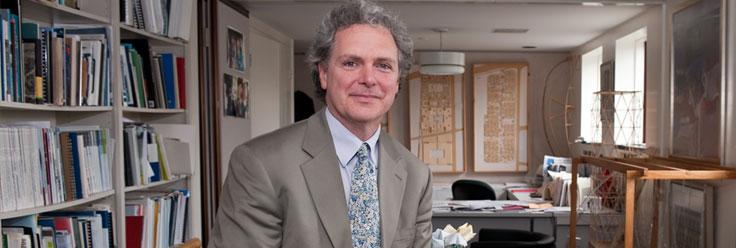
Stephen White is the dean and professor of architecture at the School of Architecture, Art and Historic Preservation at Roger Williams University. He was educated at Washington University in St. Louis, where he received a bachelor and master of arts in architecture, and a master’s degree in literature and history. He joined Roger Williams University as an assistant dean in 1993 and became dean in 1997.
PBN: The School of Architecture, Art and Historic Preservation has numerous degree paths. Which are the most popular degree programs?
Selling Luxury Real Estate Requires More Than Exposure
By Emilio DiSpirito IV License Partner | Private Office Advisor Engel & Völkers Oceanside www.DiSpiritoteam.com…
Learn More
WHITE: Architecture is a very large program. What has been increasing the most are the graduate programs, the master of architecture and the master of science in historic preservation. We have, overall, in architecture, about 90 [students], and in historic preservation we have 10.
PBN: You teach courses as dean. What do you teach and why do you continue to take an active role in that?
WHITE: I teach the freshmen, with a couple of other colleagues, an introductory course called Foundations of Architecture. I also teach in the graduate thesis, design. As dean of the school, it’s great to see students coming and going. I certainly enjoy it. It’s good for all of us to teach. As the dean, it’s great to be a professor with the students. It also lets me know how things are going. I team-teach also, so I get to know how my colleagues are seeing things and teaching students.
PBN: What is the purpose of architecture?
WHITE: Architecture needs to balance the man-made and the natural. And where we are in the history of things. A primary purpose for us is to fit more people and more institutions onto the earth, without spoiling the surroundings. That’s, for me, one of the most urgent, contemporary things. Thinking that architecture happens with institutions is a key idea. Buildings don’t happen by themselves. Houses are about families and people living. Colleges and government buildings are about how to support the institutional ideas or the urban development.
PBN: Roger Williams University recently noted that half of the recent American Institute of Architecture awards in New England had a university connection, either alumni or teaching firms in residence. Is the university known for a specialty or type of architecture?
WHITE: We’re really known for working in context. A lot of things really depend on where you are. Our design philosophy is kind of situational. It’s how people see you fitting in. Is it there to accentuate or more of a new catalyst idea? We’re not automatically modernist or automatically historicist, we try to respond to where we are.
PBN: Do you have a favorite building or space in Rhode Island?
WHITE: One of the things I think is incredibly important in Rhode Island is the river project in downtown Providence, from Waterplace Park out to India Point, which was designed by an architect named Bill Warner. What an incredible project, to recover the riverfront. Here is that thing that brings so many things together. It spawned a lot of new building. It helped preserve other things around it. And it has a great sense of scale. You can walk along and can eat outside. You can walk along the river. There were a few people that proposed it. He was the one who carried it all out, working with the city.
Another one is the Ledges in Newport. It really is very dramatic, as you drive on Ocean Drive, it almost looks like it’s a rock outcropping but it’s a building. It really fits into the land. It’s a huge building, but it accentuates the landscape there.
Mary MacDonald is a PBN staff writer.