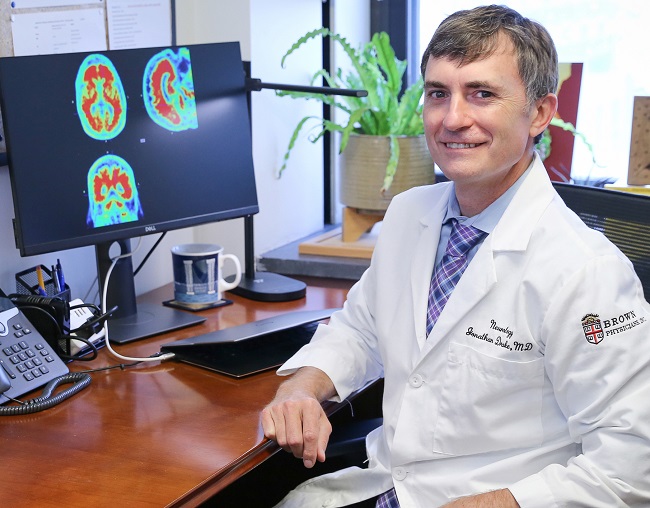
Dr. Jonathan D. Drake is the associate director of Rhode Island Hospital’s Alzheimer’s Disease & Memory Disorders Center and an assistant professor in the department of neurology at the Warren Alpert Medical School of Brown University.
Drake discusses ExosomeAD, a new collaborative study between Lifespan Corp. and Brown University, which aims to find ways to detect early signs of Alzheimer’s disease. Rhode Island Hospital is currently enrolling participants for the study.
Your Business Has Gone Global. Has Your Insurance?
A decade ago, “doing business internationally” was mostly a large-company concern. Today, a manufacturer in…
Learn More
PBN: Can you tell us about the ExosomeAD study? How did it get started and what does it involve?
DRAKE: In this study, we are collecting what are called “exosomes” from the saliva and analyzing them for potential indicators of Alzheimer’s disease in the brain. Exosomes are small packets of cellular material that contain real-time information about gene and protein products in living bodily tissues and organs. Exosomes are produced by most cells in the body, and circulate throughout bodily fluids, and provide an important means of communication regarding the health and/or disease state of various tissues [and] organs in the body.
This study was started when our collaborators, Drs. Peter Quesenberry and Jill Kreiling, were studying salivary exosomes in patients with traumatic brain injury. They found that analyzing the content of these exosomes was able to tell the difference between people who had brain injury and who did not. In doing so, they also happened to find that some of the signals resembled what we would expect in Alzheimer’s disease.
We then did a small pilot within patients from our clinic with mild cognitive impairment and dementia due to Alzheimer’s disease and compared those with people with normal cognition and found that the test was able to tell the difference between those three groups. We subsequently received a $3.9 million grant from the National Institute on Aging to conduct a study to explore use of this test for detecting Alzheimer’s disease in a larger group of people to see if this type of testing could potentially be further developed as a new diagnostic test for use in clinics.
PBN: How important is it to be able to identify and diagnose Alzheimer’s disease early on?
DRAKE: It is critical to be able to identify and diagnose Alzheimer’s disease early on, and we currently lack the technology to do so for most of our patients. Historically, it often takes several years before someone’s symptoms develop to the point where it is obvious that Alzheimer’s is the cause of those symptoms. As a result, people typically experience rather significant decline in their ability to function day to day before the diagnosis becomes clear. A test with a clear biological signal of Alzheimer’s disease would enable more timely diagnosis and treatment.
PBN: How many participants are you enrolling and what does participating involve?
DRAKE: We are targeting a total of 375 participants. We will be enrolling 150 people with normal cognitive function from the community, and 50 people with mild symptoms due to Alzheimer’s disease (i.e., mild cognitive impairment) from our clinics.
Additionally, we will recruit 35 people with mild dementia due to Alzheimer’s disease, and the same number of patients with other neurodegenerative conditions such as Parkinson’s disease, Lewy body dementia, frontotemporal dementia, and ALS [amyotrophic lateral sclerosis] to see if the test can tell the difference between Alzheimer’s and other neurodegenerative disorders.
PBN: Have similar studies been conducted before?
DRAKE: The value of exosomes as potential disease markers is becoming increasingly recognized by researchers and is an important area of emerging medical science. However, currently there are comparatively fewer groups studying salivary exosomes in neurodegenerative disorders. Research is a collaborative effort, and it often takes data from several studies from different research groups to provide convincing evidence that a new technique might be a viable option for routine use in clinical care.
PBN: What’s the potential impact of this study on Alzheimer’s research?
DRAKE: We are always looking for new avenues for understanding the underlying biology of Alzheimer’s disease and of aging in general, discovering new potential targets for treatment, and developing more-reliable, cost-effective and less-invasive diagnostic tests for neurodegenerative disorders.
Our ability to care for our patients has historically been hampered by lack of good diagnostic tools and effective treatments, in large degree due to our lack of complete understanding of these diseases for the reasons noted above. Any improvement in these areas has the potential to impact the lives of patients suffering from these disorders in very important ways.
Claudia Chiappa is a PBN staff writer. You may contact her at Chiappa@PBN.com.