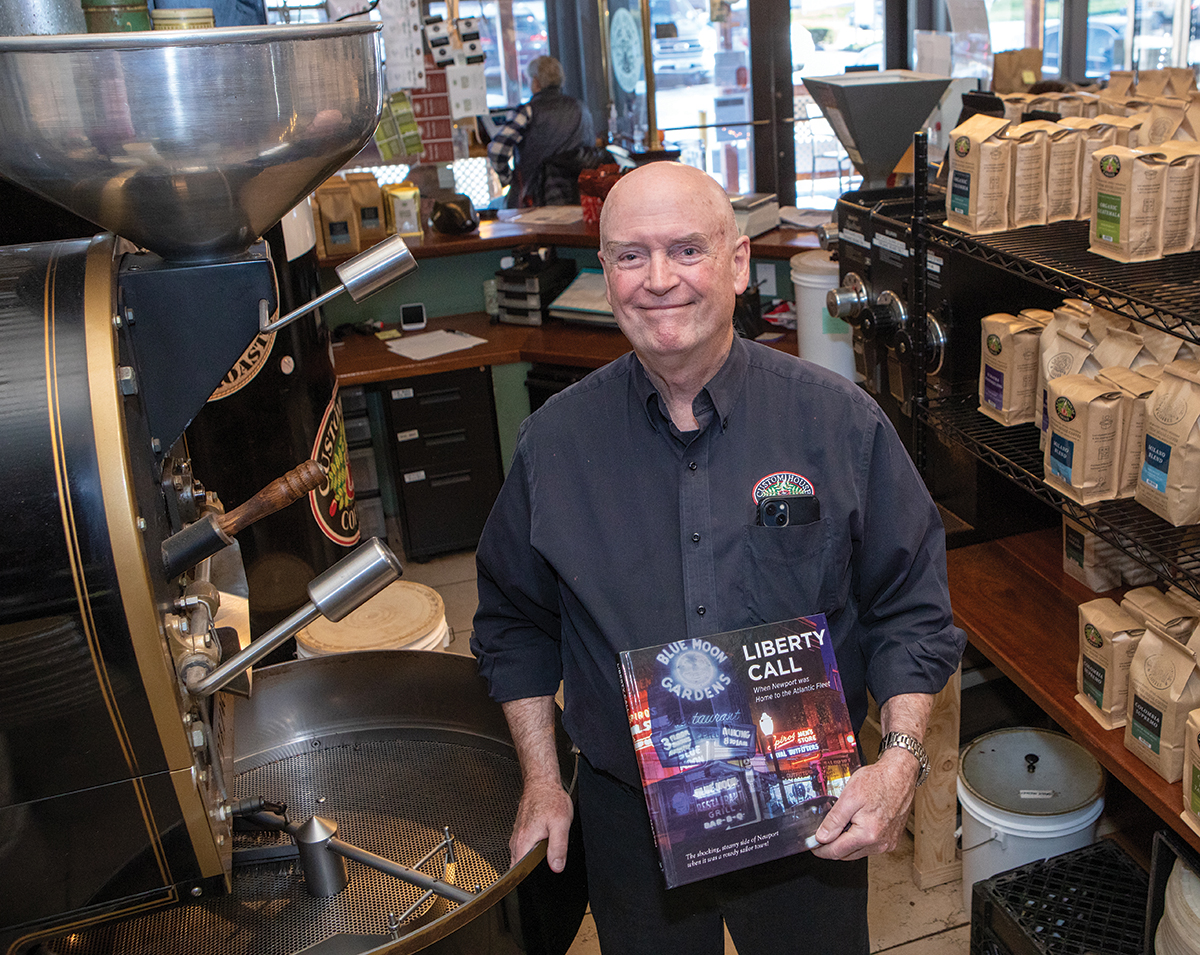
Robert Mastin | Author, ‘Liberty Call: When Newport Was Home to the Atlantic Fleet’
1. What inspired you to write about Newport’s history as a sailor town and its evolution into a tourism destination? The magnitude of the transformation of Newport from a wild [U.S.] Navy town into a world-class destination was remarkable. And these huge changes happened in a relatively short period of time.
When the fleet left in 1973, all the businesses that catered to the thousands of sailors in Newport – bars, lunch counters, locker clubs, dry cleaners, uniform shops – all shut down. What was truly amazing was how quickly the local business community pivoted to focus on tourism.
2. You have described Newport’s days as a “rough-and-tumble sailor town” as a previously untold story. Why has this period been overlooked, and why should readers be aware of it? The period between World War II and 1973 was unique in Newport’s history. In catering to the thousands of sailors and marines who came through here, Newport quickly evolved into the prototypical sailor town, serving these young men with the services and entertainment they were seeking. Much of this was unsavory, consisting of dives, strip joints and brothels. The Navy Shore Patrol was always busy breaking up fights and collecting drunken sailors in the paddy wagon.
3. How did your lived experience at the tail end of Newport’s sailor town era influence this work? The fact that I was stationed here on a warship at the end of this period gave me firsthand experience of what it was like. When I arrived in 1972, on the USS Joseph Hewes, Newport had already shed some of its image as a wild and rowdy sailor town.
4. How did your role as a longtime local business owner impact your research and writing process? While operating Custom House Coffee over the past 23 years, I have met and talked to thousands of locals, many of whom are elderly and had lived through the Navy days here in Newport. Many of their stories were raucous, fun and fascinating. The most important part of this book are the stories from these people.
5. What did you find most striking or surprising while researching this book? The most interesting part of my research was learning about the monumental ramp-up of Newport and Narragansett Bay during World War II. Quonset Point Naval Air Station and the Seabee base at Davisville were built in a year. The Motor Torpedo Boat Squadrons Training Center was built from scratch in 1942 at Melville in Portsmouth. Several huge 16-inch guns were installed at fortifications on Point Judith and Sakonnet Point to protect the entrances to Narragansett Bay. Rhode Island was essentially on the front lines of the Battle of the Atlantic.