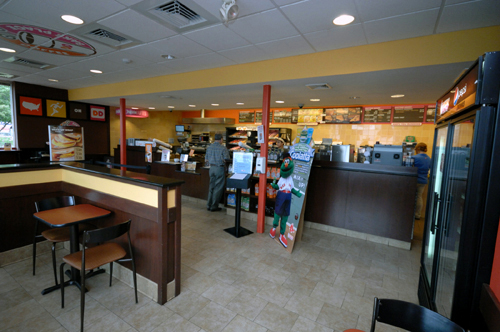
A washed out bridge can really put a crimp in travel plans. And as Rob Batista found out, it can also hammer sales of doughnuts and coffee. For almost five months, business at his Warwick Dunkin’ Donuts was down about 20 percent while workers repaired the Natick Bridge. Flooding in March severely damaged the bridge that carried 14,500 vehicles a day on East Avenue and finally reopened Aug. 16.
Months after record rainfall flooded hundreds Rhode Island businesses, some hospitality executives continue to pick up the pieces. The R.I. Health Department reported that as of Aug. 10, a dozen restaurants remained closed, including eight in the food court of the Warwick Mall, which recently reopened. The NYLO Providence/Warwick hotel remains closed after 2 feet of water devastated the 163-room structure.
And the U.S. Small Business Administration continues to see a trickle of loan applications from businesses tallying up lost income because of flood-related events like closed roadways.
Five restaurants in Rhode Island have received such loans as of Aug. 12, according to the SBA, which will stop accepting applications on Dec. 29. (In May the agency ceased accepting loan applications to cover the cost of physical damage.)
And while some hospitality businesses leaned on government-backed loans or drew from a rainy day fund, others found the cost of repairs insurmountable. Chelo’s Hometown Bar & Grill decided not to reopen its Warwick Mall restaurant after estimating it would cost $500,000 to repair the eatery the company built just five years ago for about $1 million.
“Given the revenue we would do there the math didn’t work,” Vice President of Operations Bob Crowley said. “It was more expensive to reopen than it was to close.”
The Twist restaurant near the mall has seen a 20 percent drop in business since the floods, said Steve Marra, owner of the Pinelli Marra Restaurant Group, which owns the eatery. The restaurant opened just two weeks after the storm that delivered 9 feet of water in the basement and caused damage stretching into the six figures.
“We’re still getting calls at the restaurant, months later, ‘Are you open yet?’ or ‘When will you be open?’ ” Marra said.
Fewer customers translate to less work for his employees. So Marra has tried to let them pick up shifts at the group’s other locations to mitigate the impact on their pocketbooks.
Statewide, the floods put thousands of people at least temporarily out of work. As of the end of June – the most recent data available – the R.I. Department of Labor and Training estimated 1,700 people remained out of work because of the flooding. Of those, 325 had worked in the lodging or food service industries. And some continue to collect unemployment insurance under a special program that allowed a wider group of displaced workers to apply, including self-employed professionals.
Particularly affected were workers in central Rhode Island. The Pawtuxet River that cuts through Cranston, Warwick and West Warwick crested at 20.8 feet – a record height – and forced the closure of Interstate 95, the Warwick sewer treatment plant and the city’s animal shelter. Dozens of businesses also closed, at least temporarily.
But Warwick Mayor Scott Avedisian said the city’s long-term situation looks sunny thanks to some unexpected good news. The television show “Body of Proof” opened a studio in Warwick and the cast and crew have kept local eateries and hotels busy, Avedisian said. Hotels have also reported increased business – even higher than last year at the same time – thanks to construction workers repairing water-logged buildings.
Warwick hotel occupancy in the three months following the flooding – April, May and June – was higher than during the same months last year, according to the Providence Warwick Convention and Visitors Bureau and data from STR Global.
More than 300 employees from the Federal Emergency Management Agency, which set up a temporary office in Rhode Island, also provided a boost for hotels and restaurants. Most employees came from out of state and took up residence in Providence-area hotels. The 34 remaining employees – many from outside Rhode Island – will leave at the end of August, said R.I. Emergency Management Agency spokesman Steve Kass.
“The cool thing was we actually made some money,” Crowley said.
The state was not as lucky. The money collected in Warwick from the state’s 1 percent tax on meals dropped by 5.8 percent in April compared with a year earlier. But by May, the difference narrowed to 1.5 percent.
And in general, the hospitality industry appears to have escaped without much permanent damage, said Dale Venturini, president and CEO of the Rhode Island Hospitality Association.
“I think for the most part people have moved on,” she said. “In some cases it was a very costly venture for them to clean up. In other cases people used it as an opportunity to refurbish.”
At least a few stores in the Warwick Mall – including the Panda Express, Target and Wet Seal – took advantage of the unexpected closure to update their stores to their latest formats.
And in further good news for the hospitality industry, pictures of the state underwater appear not to have been burned in the minds of travelers. Venturini said she has heard no reports of visitors steering clear of Rhode Island over concerns about a potential flood or lingering damage from March. Neither has Martha Sheridan, president and CEO of the Providence Warwick Convention and Visitors Bureau.
“From our perspective … in the meeting and planning community the floods had no impact” on whether programs were located in Rhode Island, Sheridan said.
The flooding did, however, certainly impact how Batista will choose a franchise location in the future. He said next time around he plans to spend some more time checking out the surrounding area and reviewing insurance options with his agent.
“I would certainly do my homework,” he said. •