Aquidneck Employment Services Inc. places about 20 temporary employees in Newport, Portsmouth and Middletown each week, according to Staffing Coordinator Carol Quirk. Many of those temporary employees are brought into accounting firms and other financial businesses, with the explicit purpose of grooming them for a full-time position.
“It’s like a trial period for both the employee and the employer – to make sure it’s a good fit,” she said. And they’re hired “most of the time, too. It usually works out because they have an [on-the-job] interview with the company before they start.”
About 59 percent of companies that hire a temporary worker from Aquidneck are looking to fill a full-time position, according to the company. In a survey that asked why clients use temporary staff, that was the fourth- most common answer in the questionnaire (which allowed human-resource staff to give multiple answers). The other top reasons, according to Aquidneck, are: filling in for absent employees, extra support and short-term projects.
Temporary work is often seen as professional development by finance, accounting and bookkeeping professionals, according to survey results released by Accountemps, an international temp agency that has 360 offices.
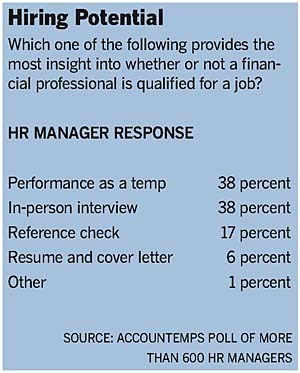
According to that survey – “The Personal Connection,” released on Sept. 11 – 38 percent of financial human- resource managers said they prefer to have an employee in a temporary position, to see how they perform, before hiring them full time.
Accountemps Chairman Max Messmer said in a statement that there’s “no substitute” for face-to-face contact between employers and potential hires. He called it the “human side” of the hiring process, adding, “Meeting face-to-face provides a way to evaluate a jobseeker’s communication abilities, business acumen and interpersonal skills, in addition to his or her technical knowledge.”
Another 38 percent of the 600 finance human-resource professionals that were polled said that an interview was the most important factor in hiring. Reference checks were less important and only 6 percent of respondents said that a resume and cover letter were the most important.
While that face-to-face meeting is important to about two-thirds of human-resource managers, temporary workers who want to be hired full time are still going to need to have the qualifications to do the job, Human Resource Management Association of Rhode Island President David L. Goldman said last week
“Just because the person is a temp and has exposure from that agency doesn’t mean they’re a good performer,” he said.
He added that if the temporary employee’s qualifications match what an employer is seeking, a temporary worker who “speaks the language quicker” might have an edge in being hired.
“It seems to me that there would be a predilection in terms of leaning toward them as a strong candidate right off the bat,” he said.
But temp agencies can also make it a little more difficult to hire an employee, Goldman said, citing time restrictions that are imposed by most temporary contracts. Most temp agencies use 13-week contracts, where the hiring firm pays the agency directly and the worker is paid by the agency.
“There’s some built-in amount that you have to pay the agency if you want to buy them out of their temporary status,” Goldman said. So a firm will have to either wait out the 13 weeks or pay up front to cancel the contract. “And that should not factor into whether this person is their primary choice. In an ideal world … what you put on the table is the closest match to what the job needs.”
Realistically, however, spending money – maybe $1,000 or more – to break a contract could restrict some temporary workers from becoming full-timers. “I don’t think that’s necessarily the right decision, but I would have to say that it enters the mind of any hiring manager,” Goldman said.
In an economic downturn, the use of temporary agencies is sometimes cut down – instead of entering a contract with a set 13-week term, a company may want a shorter-term worker that they hire themselves, Goldman said. “So they’re your employees,” he said. “When you use a temp agency, the employees get their benefits and pay from the temp agency and they bill your company, usually with their margin of profit built in.”
Overall, as far as professional development, being a temp worker seems to be a good way to learn the inner workings of a company, Goldman said. But in the end, that does not mean that they will be any good at their jobs.
Temporary employees are usually aware they have to work hard when they’re temping – if they want to be considered for a full-time position, he said.
They know the basics and they have on-the-job experience, but there’s no guarantee of success. Even some full-time employees aren’t great at their jobs, he added. So when evaluating a resume of a temporary worker and a new applicant, he suggests that human-resource managers try to think of the hiring in an “ideal world,” meaning one where the background and ability are the yardsticks of qualification.
“There has to be a basis of comparison and just because one might see that person here every day as a temp doesn’t mean I should allow the better candidate to walk out the door,” Goldman said. •