While the internet may seem unavoidable – even crucial – in day-to-day life, just 80% of Rhode Island residents have a laptop or desktop computer at home, according to the state’s recently published Digital Equity Plan.
That’s a figure that lags 14 percentage points behind the countrywide average of 94%, under the most recent U.S. Census Bureau estimates. And while 92% of the state’s residents at least have access to the internet via a phone, these devices can’t always facilitate essential tasks.
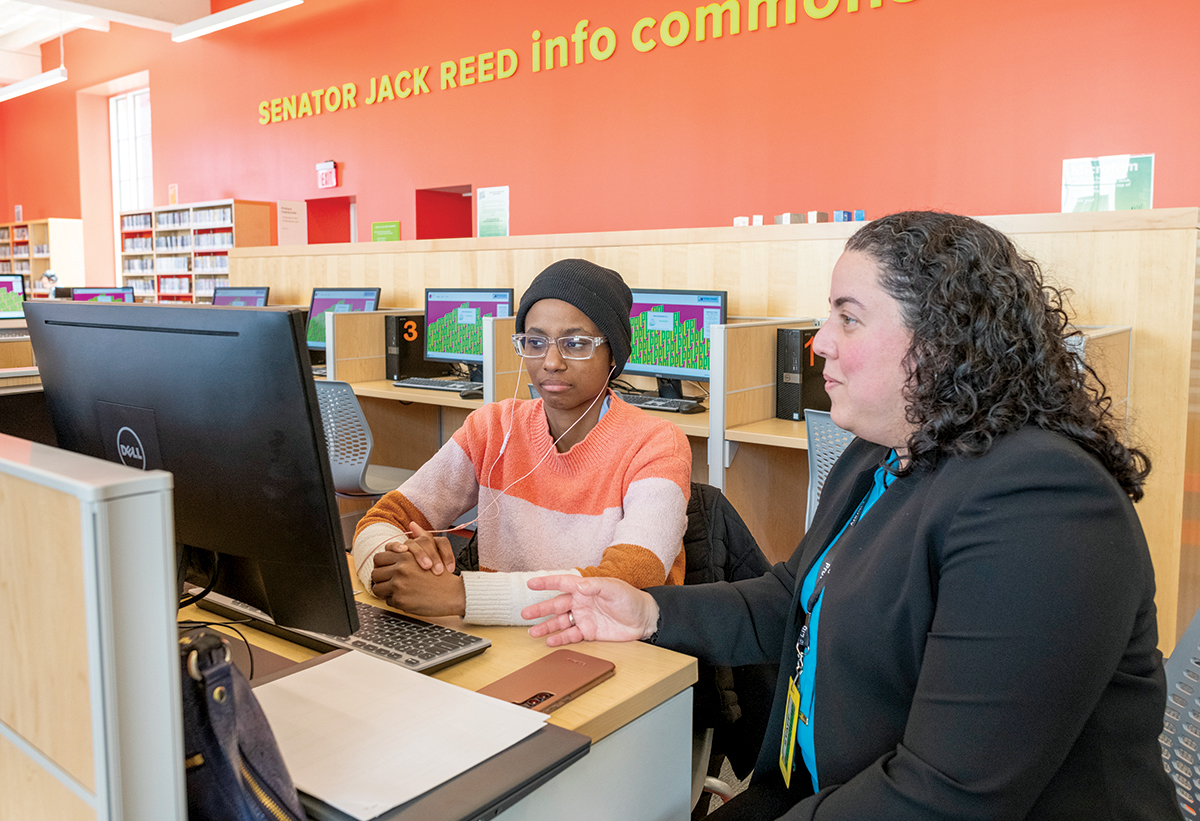
Rhode Island’s household computer access rate comes across even lower in practice, says Lina Bravo, digital equity and learning coordinator at the Providence Public Library. As a leader in the library’s digital education initiatives, Bravo often works with community members who lack reliable access to a computer or internet services.
“When we speak to these people, sometimes they have a computer that is very old,” Bravo said, “so they tend not to even use it. Or it’s a computer [belonging to] their children or their partner, and they can’t really use those computers. So that number goes down.”
As a result, these patrons are often still learning the basics of technology that are commonly required for essential tasks such as applying for jobs or accessing medical information.
Bravo leads digital education classes that are popular but limited in size and frequency. But with a $506,000 federal allocation toward digital equity in the Ocean State, she hopes to expand this program, starting in Providence and eventually extending the effort into rural communities.
That funding, awarded under the National Telecommunications and Information Administration’s Digital Equity Act, was designated to Rhode Island in 2022 for use in workforce training, digital literacy and device accessibility initiatives. But to tap into the allocation, the state first had to devise and submit a Digital Equity Plan to the NTIA, which received approval last month following a community feedback period.
Institutions such as the Providence Public Library, as well as public and academic libraries throughout the state – known as “community anchor institutions” for their role in providing public Wi-Fi access – are key players identified in the state’s plan to improve digital equity.
But to reach a statewide goal of providing all Rhode Islanders with high-speed broadband access by 2027, the 203-page report acknowledges that the state needs a broader effort.
A significant part of that initiative will involve bringing all areas of the state up to speed on broadband quality, says David Marble, CEO and president of OSHEAN Inc., a North Kingstown nonprofit that helps municipalities establish their own high-speed, affordable broadband networks.
While Rhode Island doesn’t have to contend with the broadband deserts that vex states with larger rural populations, Marble says, a larger problem in the Ocean State is that not all broadband access provides equal support.
According to a 2022 report published by Connect Greater Newport, 42% of populated square miles in Rhode Island are considered unserved or underserved under federal broadband speed guidelines.
It’s an issue Bravo often sees in her work with community members. While low-income households can usually receive a discount on Wi-Fi, the affordable-rate plans don’t always provide the level of access users need – a problem that becomes glaring when multiple family members need to use the Wi-Fi at once, Bravo says.
The report focuses specifically on eight covered populations that include about 71% of the state’s population. Those groups are individuals in households earning at or below 150% of the federal poverty level; individuals age 60 or older; incarcerated individuals; veterans; individuals with disabilities; individuals with a language barrier; members of racial or ethnic minority groups; and residents of rural areas.
While 78% of residents in these covered groups subscribe to a broadband service, the report found, just 15% of those surveyed considered their broadband affordable.
And in areas with limited service competition, the report notes, providers can easily charge a premium on their base rates.
For the Digital Equity Plan to hold meaning, Marble says, the state needs to not only expand resources and infrastructure but to enact education and workforce training initiatives.
Under current conditions, many haven’t received a strong digital foundation. Older patrons sometimes need help powering on a device, Bravo says, and even children and teenagers of the “digital nomad” generation sometimes struggle with aspects of computer-based technology. While younger patrons are often well-accustomed to web-based applications such as Google Docs, she says, they may struggle with older-but-still in-use programs such as Microsoft Office.
Marble and Bravo, who both consulted with the state during R.I. Commerce Corp.’s public comment period, say they’re pleased with the blueprint.
“I don’t know if, at this point, we have to prove to anybody how critical [an] internet connection is,” Marble said. “But it is becoming the lifeblood, as much as electricity was in the past.”