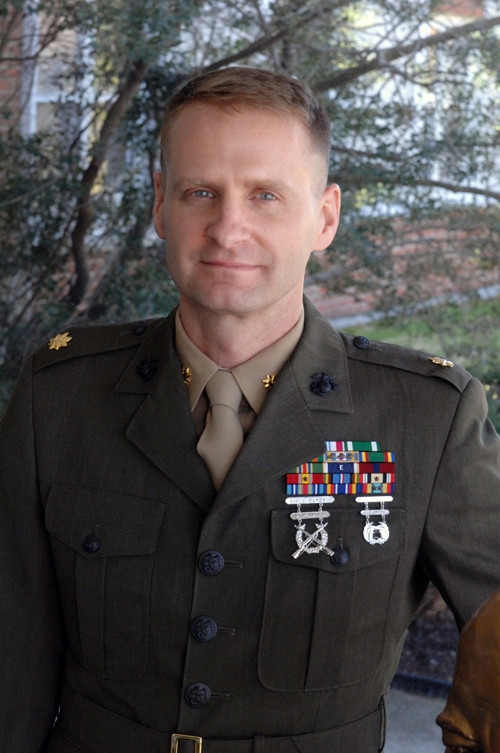
Maj. Bradley W. Phillips has an unusual mission for a chief financial officer – he helps the U.S. military train young officers.
Phillips is executive officer – that’s second in command – at the Naval Academy Preparatory School in Newport, an institution with 371 employees and a total operating budget of $5.9 million. He’s responsible for all those tasks that a private company would assign to a chief financial officer and more. He reports to the school’s commanding officer and its parent organization, the United States Naval Academy in Annapolis, Md.
One of his most challenging tasks at present is holding the line on spending. Congress has yet to approve the allocation for the current fiscal year, which means the school must operate within the past year’s budget constraints, despite a projected million-dollar increase in costs.
Phillips has reduced the payroll by leaving some positions vacant, limited travel allowances, and cut administrative costs by postponing the replacement of copiers, cellphones and other office equipment. “We’re given a fiscal budget, and we must operate within that fiscal budget,” he said. “We’re not allowed to go in the red. It’s our job to be good stewards of the taxpayers’ money.”
Of course, as an officer in the U.S. Marine Corps, Phillips has plenty of experience with tough assignments. His career has included service with missile and air defense centers and two deployments to Iraq. He’s a 1996 graduate of Iowa State University, with a bachelor’s degree in political science, and the Marine Corps Command and Staff College, Quantico, Va.
Those unfamiliar with military life may wonder why a Marine officer is stationed at a Navy facility. By way of explanation, Philips points out that the Navy and the Marine Corps are run by one government department, and the Naval Academy trains officers for both branches. “We put a Marine face on the school,” he said.
The purpose of the Newport prep school is to give students a scholastic boost before they enter the U.S. Naval Academy. Though they’ve shown they have the qualities necessary to be an officer, they need remedial classes before tackling the demanding course work of a military academy. In Newport, they spend 10 months studying chemistry, math, physics and English composition. The program includes some military training and sports as well.
While Phillips is seldom in the classroom himself, he is nonetheless involved with students. Working with community organizations in the Newport area, he helped launch a mentoring program for young people at the school. “We’ve found families in the Newport area who are ready to take these young men and women into their homes for family dinners, weekend visits, things of that sort,” he said. “Many of these young people are straight out of high school, and they may need a mentor or someone who can take them under their wing or provide them with a family situation. We started this year with 300 midshipmen candidates, and more than 100 of them take part in this program.”
Phillips describes his leadership style as collaborative. “I like to get input from everyone involved and bring everyone into the decision-making process,” he says. “If there’s no consensus, I’ll make the decision.”
“We used to make small supply orders for things like medical supplies,” Phillips said when asked about his quest for efficiency. “Now we’re making more bulk quantity orders. It reduces paperwork and the staff work involved, as well as costs.
“We also used to print an awful amount of paper. Under my direction, we’ve created a central point in our network. We scan all documents related to our business here and post it in that repository, and we send emails to people telling them the information is there.”
Like many top executives in the private sector, Phillips has worked hard to get his organization involved with the community. In a typical year students will provide more than 2,400 hours of volunteer work for various programs in the Newport area, including the Special Olympics Regatta, Relay for Life, the Salvation Army, the Boys & Girls Club of Newport, Middletown’s Norman Bird Sanctuary, and Battleship Cove, a Fall River museum site that features retired naval vessels.
“We have two civilians on our staff as community-service coordinators who line up projects,” he said. “Our students will go to places like Battleship Cove and Norman Bird Sanctuary and do small maintenance jobs, such as painting or sweeping.”
He’s also a big booster of food drives. With his encouragement, students and staff have donated enough canned goods to local food pantries to provide more than 100 meals. He also keeps an eye out for outdated or retired academic materials that could be used by other schools. This year’s donations topped $6,000.
Phillips first enlisted in the Marines to get some financial assistance with college tuition. “It seemed like a great opportunity to get an education, as well as some training and travel experience, and to grow up a little,” he said. “After college I reapplied as an officer candidate and got accepted into a program.”
Phillips and his wife, Lori, now live in Portsmouth, where they are raising three children, Zak, 13; Hunter, 6; and Kayla, 4. He says the military continues to provide him with education through experience. “My wife, Lori, is from Georgia and I’m from Iowa,” he said. “And we’ve both found we love living in New England.” •