Bob Burke’s Independence Trail brings to life with the help of technology the forgotten role Rhode Island and Providence played to spark the American Revolution.
That role is generally unacknowledged in academic and popular circles, with attention going to Boston and Philadelphia, but it has been Burke’s passion for at least the last five years to bring the world’s attention to it through development of the Independence Trail.
What makes his project especially innovative are the changes he’s made in the last few months, refining access to the self-guided tours through a sophisticated IVR (interactive voice response) cloud-based voice information service anyone with a cellphone can reach free of charge.
“Google changed the world by offering free information subsidized by advertising – 24/7/365 via computer,” said Burke, a well-known Providence restaurateur and entrepreneur whose Independence Trail Education Foundation is Providence Business News’ 2011 innovation winner for professional services.
The award, he said, “highlights that the restaurants, that hospitality and tourism, are innovating in a very important segment of our economy.”
Formally established in May with proclamations signed by Gov. Lincoln D. Chafee and Providence Mayor Angel Taveras, the walking trail is a 2.5-mile circular course that winds its way through downtown Providence, following what Burke likes to call “400 years of history.” It goes from the general area of today’s R.I. Convention Center to the Statehouse, Prospect Park and the South Main Street memorial that commemorates the 1772 burning of the British ship Gaspee in Narragansett Bay.
Perhaps the most unique aspect of the trail is the way that trail-walkers can use their cellphones to hear a narrative about each of 26 sites they visit. It’s a narrative written and recited by Burke that covers historic events, recent and from Revolutionary War times, in about five to six minutes. At Waterplace Park, for instance, he explains that the scenic oasis before the visitor was a derelict rail yard not long ago and now hosts Barnaby Evans’ world-known WaterFire.
At the final stop, the Martin Luther King Jr. Bridge overlooking Waterplace, he asks listeners to imagine a conversation between King and Rhode Island’s founder, Roger Williams, perhaps sharing insights on the nature of human independence.
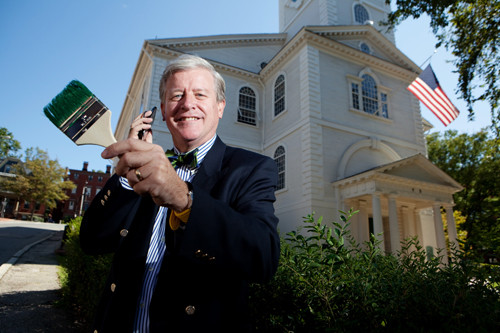
The trail is marked by a painted green line along the sidewalk that visitors can follow, calling using their cellphones to access the narratives, each matched by number to a site on the trail.
Burke said the server is equipped to perform these functions: inbound text messaging; customized outbound responses, for coupons, specials and promotions, for instance; broadcast messaging that can reach conventions and entire group meetings. He has ordered QR-code emblems from a Texas company for installation on the trail in October to enable instant connection to websites, podcasts and tourism services. By the end of 2011, printed guides and maps and traditional advertising vehicles will be available, providing operational revenue.
Guides, actors and trolleys will become part of the trail, along with dramatizations to include dialogue and sound effects reminiscent of old-time radio. For instance, on Gaspee Day, a vignette could dramatize the ship’s burning for listeners standing at the site of the memorial, the long-gone Sabin Tavern where the plot was hatched by John Brown and other Providence colonists. Listeners will hear the rowing oars creak and the colonists whisper.
Financial support would come from members of the business community, who would be acknowledged in simple, somber PBS-type (Public Broadcasting System) statements, Burke said, along the lines of “this historic moment brought to you by …” “You will never hear a commercial or an advertisement, like you hear on [commercial] radio,” he said. Besides business support, he’ll seek grants and donations. Access will always be free to trail-users, he said.
Businesses also will be asked to adopt a kiosk for placement outside the front door of the business and at central spots in the city, such as the train station and bus stations, as well as at the historic sites themselves. Eventually to be equipped with built-in, iPad-like devices, the kiosks would be repositories of links to historic and trail information, as well as other local tourist sites and related businesses.
There’s one scenario Burke cannot wait to see, and he’s sure it will happen. “Since Roger Williams was convicted and sentenced in Massachusetts for preaching the fundamental freedoms – conscience and religion – along with tolerance for minorities, we wonder, why do we send our students all the way to Boston to learn about freedom from the descendants of freedom’s Neanderthals?” he asked. “One day children from Boston will be bused to Providence to learn about American independence.”
Since the trail opened officially Aug. 13, visitors have come from as far afield as Nepal, Italy and Peru, Burke said. That is quite an achievement for a project that began, by default, about five years ago. As proprietor of Pot au Feu, a French restaurant on Custom House Street in the Financial District, Burke said a customer asked about a walking tour. “Nobody was doing it at the time, so I met them in the Westin lobby and I ended up giving them an hour-long tour,” he said.
Burke was “fascinated” by what he found while researching local history before the first tour, so he made it a regular but informal offering at the restaurant. Once he obtained the necessary approvals, he went public, so to speak, with the first tour open to others besides his patrons four years ago. He needed a bull-horn to address everyone because 1,000 people showed up, he said, a stunning turnout that convinced him the enterprise has potential.
So far, Burke said, development of the Independence Trail has been funded entirely by himself and his wife, Annie. Asked how much they’ve spent, he replied with a chuckle, “a lot more than I would have liked” but declined to specify a sum. After a second’s thought, he added, “We’re leaving something behind that Providence didn’t have before, and that’s priceless.” •