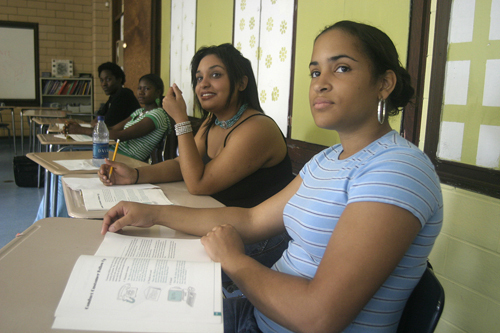
Hope High School doesn’t have any air conditioning or fans. Yet 15 students, recent graduates who needed jobs, sweated their way through four weeks of intensive study in a basement room. The students were there to learn about things that would help land them jobs, including basic customer-service skills and how to handle and serve food and alcohol.
One of the students, Lorpu Bolo, moved to Rhode Island three years ago from Liberia. “I’m very happy. They helped us a lot,” she told Providence Business News last week. “I’m going to CCRI in the fall and I plan to use the skills I learned here to work my way through college.”
Using the training to work their way through college was one of the program’s goals, said Catherine Ricker, school coordinator at Hope High and a career education specialist who worked with the students Monday through Thursday, 8 a.m. to noon, She said organizers also hope students who don’t go to college can use the program as a steppingstone to a career.
The pilot program was orchestrated by Workforce Solutions, which coordinates employment, training and related education efforts funded by federal and state agencies in Providence and Cranston.
“We pooled all of our resources together and asked the question: how can we put a program together for students who don’t have immediate college plans,” said Robert Ricci, executive director of Workforce Solutions. “The project made sense to us – help students and also help the city of Providence.”
Workforce Solutions then obtained a grant to fund the project. There are 42 people on the board at Workforce Solutions, all of them appointed by Mayor David N. Cicilline. Among them are representatives from the Providence Skills Center and the Rhode Island Hospitality and Tourism Association. Those two organizations partnered to create the pilot program at Hope High School in Providence. The hospitality association worked on the food service part of the curriculum and the skills center worked on the customer-service part.
Once the project was put together, the notice was announced to the senior class at Hope High. The only requirement was age – the students needed to be at least 18 years old to be able to serve alcohol. Other than that, the first 18 students to show up were accepted. Many of the students who enrolled have ties to different countries, including in Africa and Southeast Asia. Some students who took the course had to deal with language difficulties, and much of the teaching was about basic customer-service skills.
Topics covered included: how to detect a personality type of a costumer; how to make certain personality types happy; how to work with other employees and unhappy costumers and most of all, how to become comfortable with public speaking.
Then there was the food-handling course: temperature; how to wash fruits and vegetables; how to serve alcohol and knowing when a costumer has had too much to drink.
After completion of tests, the students will be awarded certificates in customer service, from the National Retail Federation and the hospitality association.
“We all think that the program was a great success,” said Ricker. “We had some very hot days. Only three kids dropped out. We started with 18 and ended with 15. That shows me that the kids who entered the program wanted jobs, wanted a future. Most any high school has trouble with summer programs but these kids – despite less than stellar high school performance and often language difficulties – did very well. I’m proud of them.”
Last week, Cicilline dropped by for visit. He talked to the class about the importance of skills in the 21st-century work force and in today’s difficult economy. The mayor also touched on the importance of training and of success. Then he talked with each student individually. “It was cool meeting the mayor,” Bolo said. “He spent time talking with each of us, one at a time.”
Cicilline in a news release said the program “is providing these students with the necessary skill set to obtain good jobs, while generating a much-needed pool of trained employees for our hospitality and tourism sector.”
The mayor again visited the students on the last day of class last week. Also there was Robert Crowley, the vice president of operations of Chelo’s Restaurants. They talked with the students and thanked them for their hard work. Then Crowley put the students to work, interviewing each student for potential employment. Every student was offered a job at Chelo’s.
“I think the pilot worked,” said Ricci of Workforce Solutions. “Now we’ll take this model and try to incorporate it into the program next year. We’re also going to follow the 15 students this year and see how they perform in the job market.” •