Call it a double-whammy. Just as new, higher rates on adjustable mortgages kicked in, the Rhode Island economy tanked and people’s incomes declined, sometimes to zero. That, along with a persistently high unemployment rate, means many Rhode Islanders are putting aside far too much to pay for housing, say affordable housing advocates.
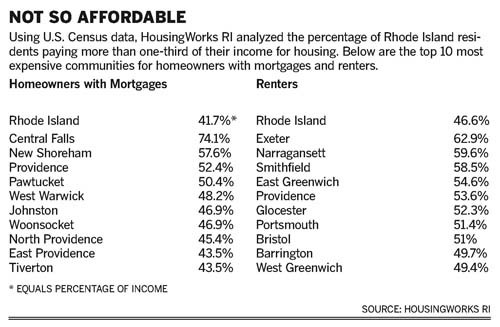
In an analysis of U.S. Census data, HousingWorks RI – a coalition of organizations – found 41 percent of Rhode Islanders put more than one-third of their income toward housing-related costs. That included 42 percent of homeowners with a mortgage and 23 percent of homeowners without a mortgage.
Meanwhile 49 percent of renters were putting up 30 percent or more of their income for housing.
Those numbers worry affordable housing advocates, who point to federal and state standards that recommend households put no more than one-third of their income to housing costs.
“Despite the housing bubble being burst we still have a housing crisis in this state,” HousingWorks RI Executive Director Nellie Gorbea said.
HousingWorks pulled the data from the American Community Survey, which collected data nationwide on population and housing characteristics between 2005 and 2009. It was the first time the U.S. Census undertook a five-year estimate.
Gorbea and those that study real estate say Rhode Islanders are clearly struggling. Bryant University professor of finance Peter Nigro said many Rhode Islanders took out adjustable-rate mortgages when banks peddled them to virtually anyone willing to sign on the line. Many people could not afford the mortgages to begin with and when the economy crashed things only grew worse as rates rose while people lost their jobs.
Then, the real estate market tumbled and homeowners found themselves owing more on their mortgages than their houses were worth. Put that all together and the HousingWorks RI findings come as no surprise, Nigro said.
“I think a lot people entered into mortgage contracts they didn’t understand,” he said.
Renters also face a difficult employment market and landlords with shifting priorities. Phipps said in good years landlords considered rental properties long-term investments that would appreciate in value. But now, with falling real estate prices, landlords are looking for fast cash and are reluctant to lower rents.
And the rental market remains limited. The foreclosure crisis left many multifamily homes vacant. But potential buyers looking to purchase them cheap find stringent credit checks implemented after banks were criticized for their freewheeling lending practices.
So Rhode Island appears rather stuck when it comes to affordable housing. Gorbea, from HousingWorks, said incoming Gov. Lincoln D. Chafee would need to tackle affordable housing head on for the costs to decrease. And she said the incentive to build affordable housing goes beyond a social good.
The state risks losing potential employees and employers who are turned off by the cost of housing. HousingWorks RI says Rhode Islanders faced the highest housing costs in New England.
To lower housing costs, Gorbea called for the state to continue to support bonds that help pay for the construction of affordable housing. Voters approved a $50 million bond in 2006, which will run out when the state’s fiscal year ends June 30. And Gorbea called for lawmakers to continue funding the Neighborhood Opportunities Program, which pays for operating costs for affordable housing projects. Gov. Donald L. Carcieri has in the past proposed the elimination of the program. •