Dr. Mitchell M. Levy has worked internationally to promote patient safety, reduce hospital-acquired infections and improve treatment of life-threatening conditions. Within the medical intensive-care unit (MICU) at Rhode Island Hospital, he long has emphasized safety and collaboration.
But even Levy, the well-respected expert, can point out several improvements in his unit that are the direct result of the Rhode Island ICU Collaborative.
There are the hand-sanitizer dispensers, always present but now placed all along the corridors, so you can easily reach for a gob of foam before entering each patient room.
There are the central-line kits, which include everything a doctor or nurse needs to safely hook up a patient to an IV – a good dozen items, including a drape to cover the whole body and bed, so only the insertion spot is left uncovered.
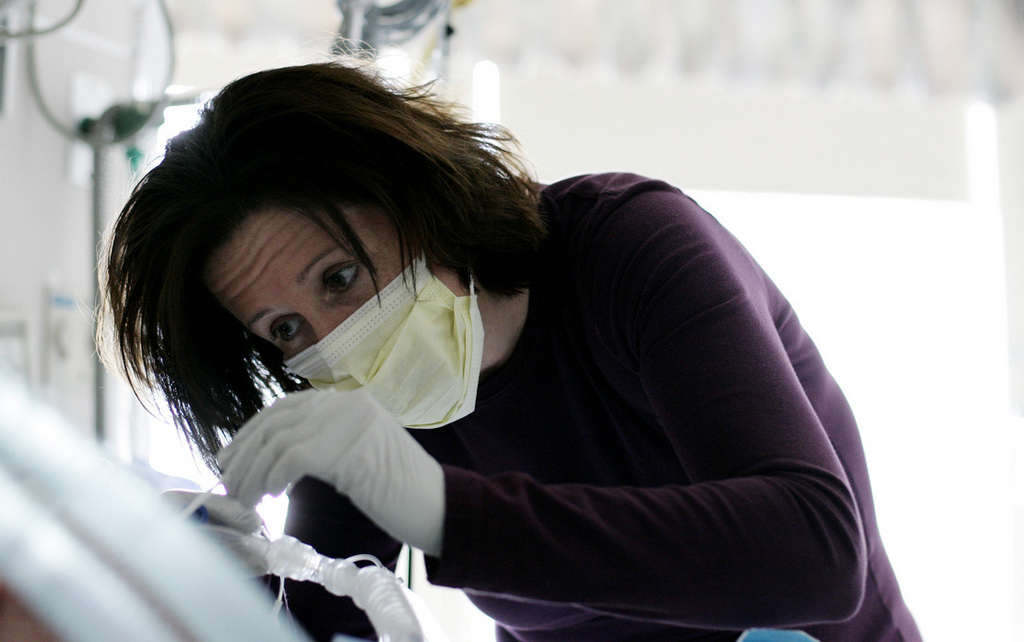
And there are the checklists the doctors go over during rounds to ensure every patient is getting the proper care. If a patient is on a ventilator, is the bed-head raised at least 30 degrees to reduce the risk of ventilator-associated pneumonia? Has his mouth been carefully cleansed? Has he been checked to see if he’s ready to be weaned off the ventilator?
The Rhode Island Hospital MICU started out with fairly low infection rates, Levy says, but through the ICU Collaborative, a joint effort by hospitals across the state to improve ICU safety, they have dropped even more, to the point that several months go by without a case.
Statewide, a report this month showed, the collaborative reduced the rate of catheter-related bloodstream infections to 1.73 per 1,000 central-line days from 2.61 last year, and 10 of the 23 participating units had zero cases for at least six months.
The rate of ventilator-associated pneumonia, meanwhile, dropped to 3.19 per 1,000 ventilator days from 3.76, and 11 of the units had zero cases for at least six months.
Next on the agenda is a project to address sepsis, a massive infection common in ICUs that can lead to multiple organ failure and is the leading cause of death in non-coronary ICUs.
Already, hospitals have gotten “a tremendous benefit” from the collaborative, said Dr. Mary Cooper, chief quality officer at Lifespan, the health system that includes Rhode Island Hospital.
The ICU Collaborative was born out of a challenge issued by U.S. Rep. Patrick J. Kennedy in 2004 to apply best practices in health care to make hospitals safer.
The Rhode Island Quality Institute – itself a collaboration between health care providers, insurers and policymakers – teamed up with the Hospital Association of Rhode Island and Quality Partners of Rhode Island to launch the project, enlisting all the state’s ICUs.
They decided to focus first on IV-related infections and ventilator-associated pneumonia because both are costly, sometimes deadly, and preventable. They brought in experts from Johns Hopkins University who had devised “bundles” of strategies to address each problem, most of them simple and inexpensive.
For example, the key to avoiding IV-related infections is to be immaculately clean and sterile, so ICUs were told, among other things, to maximize protective barriers – thus the whole-body cover; disinfect hands, and use a particular chemical, chlorahexidine, to clean the IV site.
To avoid ventilator-associated pneumonia, they were directed to keep the head of the bead raised, sedate patients properly, work to prevent peptic ulcer disease, and assess readiness to be extubated on a daily basis, among other things.
“We tend to be so enamored with the latest science and technology that we forget the basics, and the basics are what matters,” said Dr. David R. Gifford, the state health director and a supporter of the ICU Collaborative.
But the project didn’t just provide information. It also encouraged ICUs to develop a “safety culture” built on cross-disciplinary teamwork, communication and safeguards to ensure the right thing is done every time. In addition, the ICU teams were brought together every other month to exchange ideas and support one another.
“They encourage us to share shamelessly, and we do,” said Ellen Fales, a team leader in the eight-bed ICU at South County Hospital, which now has zero infection rates in both categories.
The South County team used ideas from other hospitals on how to control patient’s blood sugar, which can also reduce the risk of pneumonia. And on the group’s recommendation, the ICU set up a special cart with everything needed to set up an IV.
“It made it so it was very easy” to follow all the safety measures, Fales said.
The team approach also makes a big difference, Levy said, because it’s important for everyone to feel empowered to speak freely and stand up for safety. He and the MICU clinical manager, nurse Susan Ross, have been working together for seven years and have that level of comfort, he noted, but it’s not the norm, and it has to be.
“Do you feel empowered in your house to say to your husband, ‘That window is going to fall on our kids’ heads’? It’s the same here,” he said.
Dr. Leon D. Puppi, an ICU intensivist at South County, said being part of the collaborative has made it easier to get doctors to embrace new safety measures, because the project has taken such a standardized, “evidence-based” approach.
Yet even if the ICU teams are fully engaged in the safety effort, there is one piece that can make or break them, project participants and outsiders said: whether each hospital’s leaders support the safety effort. Some see the industry’s current budget woes as a distraction from quality improvement efforts, but Puppi said quality also pays.
“A complication such as a central line infection can cost $75,000,” he noted. “The cost to the hospital is phenomenal. So we have to become as efficient as possible and minimize complications as much as we can in order to help the bottom line.”
For Lifespan, the progress made through the ICU Collaborative also supports a key institutional goal, Levy noted: to make the hospitals national models for quality care.
Cooper and Lifespan CEO George Vecchione “understand that it’s not just making care better in the state, but it’s also demonstrating that what we do in Rhode Island really is different,” he said. “Sometimes Rhode Islanders can forget, because we get so provincial, but we may not only be doing it really well for patients, but we can serve as an example outside the state.” •