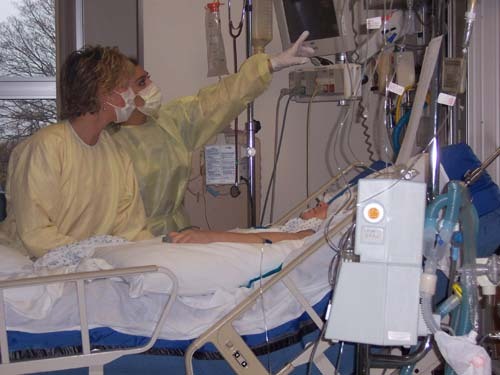
On TV, it looks dramatic, heroic, inspiring: Hospital teams rush to save a life, shock a dying heart back into action, watch weak vital signs jump up again.
Sometimes, it really happens like that. But more often, the scene in the intensive care unit is just sad. A frail, elderly patient who’s been consumed by heart disease, lung disease or cancer, whose body is spent, is forced back to life by technology, only to suffer for a few more days.
The family, pulled back and forth between hope and anxiety, gets traumatized. And if a week into the ICU stay, doctors have to ask, “Should we terminate life support?” the decision can be wrenching. Depression, anxiety, even post-traumatic stress disorder symptoms are common.
Worst of all, this happens all the time: Roughly one in five Americans will die in an ICU or shortly after being treated in one, studies have found. It’s a “remarkable figure,” said Dr. Mitchell Levy, “different from any other culture in the world.”
It’s also the motivation for the newest initiative by the Rhode Island ICU Collaborative, a project launched in 2005 by local hospitals and key partners that has already led to significant reductions in IV-related blood infections, ventilator-associated pneumonia and severe sepsis.
All those initiatives involved life-saving changes in safety practices. Now the focus is shifting to something Levy said is just as crucial: improving how ICU teams talk with patients and families, so they can better manage symptoms and, if appropriate, allow a peaceful death.
“Death is extremely common in the ICU, and how people die, and the quality of that process and the communication is extremely important,” said Levy, an international expert in ICU quality and safety and medical director of the Rhode Island Hospital medical ICU.
“I would argue,” he said, “that it’s just as important as preventing infections.”
“We have the technology now to keep people alive at any cost,” she said. “But often the downside is … we haven’t improved their quality of life, and they no longer can go back to their activities of daily living.”
Sometimes clinicians pursue aggressive treatments because they believe in them, Cornell said. And fighting to save lives is the default in an ICU; that’s why patients are there, she noted, because they are in critical condition and at risk of death.
Yet often, it’s clearly futile, said Rebecca Viney, manager of the ICU at The Westerly Hospital.
“Do most of the patients survive in the ICU? Of course they do,” Viney said. “But if they’re coming in extremely sick, with cardiac or respiratory problems, or sepsis, we can keep them alive for a very long time, only to end up with the same result, which is death.”
“What we’ve come to learn,” she added, “is if we address these things early on with the family, we may find out that these life-sustaining measures weren’t the patient’s wishes right from the beginning. So our goal is to do just what the patient and the family would’ve wanted, rather than go 21 days in an ICU only to end up with the same outcomes.”
So how do you address this problem?
In its previous efforts, the collaborative, which includes all 11 adult ICUs in Rhode Island, has used “bundles” of treatment guidelines, often including checklists and step-by-step protocols, to help standardize care; trained clinicians at large meetings; sent Cornell and other experts to advise hospital teams and held periodic conference calls to discuss progress and share ideas.
For the IV and pneumonia projects, the ICU Collaborative relied on bundles created at Johns Hopkins University, and for sepsis, it adopted the guidelines of the international Surviving Sepsis campaign, in which Levy has been a leader. And for every intervention, there are process and outcome measures.
Surveys of families of patients who died in ICUs clearly identified the two issues to focus on, Levy said: pain and symptom control, and poor communication with doctors about their loved one’s prognosis and treatment options.
To address the latter, the team created a “communications bundle” that starts by ensuring that clinicians talk with the patient and/or family within the first 24 hours to assess pain and symptoms, provide basic information, find out whether they should resuscitate the patient if a crisis arises, and identify a proxy decision-maker in case the patient can no longer speak.
Not all patients are being targeted; Cornell noted that anyone expected to stay for less than 24 hours, such as surgical patients, is being excluded, because resources are limited. Still, that leaves 50 to 70 percent of the typical ICU’s patients, she said.
Asked how success will be gauged, Levy said it will be mostly by process measures, and possibly family-satisfaction surveys. But the basic idea is the same as with previous projects.
“The goal is to simply facilitate our ability to remember to pay attention to small details,” he said. “Sometimes when patients are so very sick, I’m so focused on managing your blood pressure and making sure you’re breathing properly that I forget to find out if you’re in pain. I forget to find out if you’re anxious.” •