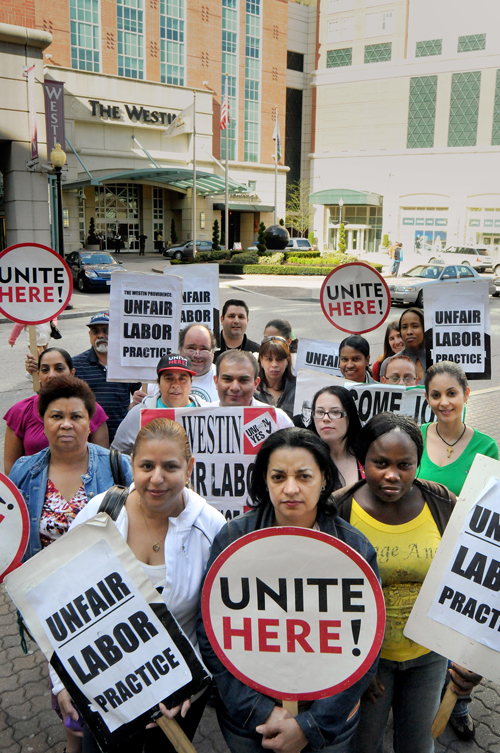
On March 11, in response to what they called “a state of impasse” in negotiations over a contract that expired Oct. 31, 2009, the owners of The Westin Providence imposed what they termed a “reset” in union-employee compensation and benefits.
Wages were cut 20 percent, health-cost contributions increased from 12 percent to 43 percent, and hours were increased for union housekeepers, conditions the owners, The Procaccianti Group, said were part of its final contract offer.
In response, Unite Here Local 217 voted 138-2 to authorize a boycott, asking visitors and conventions not to patronize the hotel. The March 18 vote authorized the union committee to call for a strike in the future. The union also filed charges with the National Labor Relations Board over The Procaccianti Group’s conduct.
As a result of the boycott, the Brown University Gala, a black-tie event for students, which had been planned to be held at the hotel, has changed its venue to an on-campus location, according to Haley Kossek, Brown Student Labor Alliance member.
With boisterous picket lines outside The Westin becoming a regular occurrence, the gap in contract negotiations as of last week seemed to be only widening.
Richard W. MacAdams, chief legal counsel for The Procaccianti Group, which owns 57 hotel properties nationwide, told Providence Business News the issues facing the owners of The Westin are about “having to do more with less,” resetting business plans and operating budgets to adapt to the current economic environment.
With revenue down, the hotel cannot operate profitably under the terms of the previous contract, he said. In the year-to-date hotel performance, hotel officials said that while “occupancy is up slightly, the average daily rate has suffered double-digit declines.”
The contract impasse has clearly hurt both sides.
For Chris Cook, union shop steward, who has worked at The Westin for 12 years as a purchasing and receiving clerk, the escalation in his health insurance copays has jumped from $140 to $450 a month, creating what he called “real hardships” for his family. “No one is getting rich working at The Westin,” he said.
And as the loss of the Brown gala illustrates, The Westin has lost some business due to the boycott, acknowledged Ralph V. Izzi Jr., director of marketing and communications for The Procaccianti Group. But he said it has also hurt workers as well, because any decline in the number of occupied rooms and functions affects the number of housekeeping jobs.
In terms of service, Izzi insisted there had been “no hiccups whatsoever,” with the hotel fully operational.
The Westin Providence has 211 union employees and 40 nonunion employees, according to company officials
The Westin is one of two hotels with union employees in Rhode Island, the other being the Providence Biltmore Hotel. Employees at both hotels are represented by Unite Here’s Local 217. The union represents workers in food services, hotels, casinos and distributions centers across the nation, according to Francis Engler, a union organizer working with Local 217.
One of the root issues for the company is its desire to subcontract work as a way to control costs. MacAdams cited an internal study that he said showed the cost of operations at The Westin was one-third higher than operating costs for Westin Hotel properties owned by The Procaccianti Group in Tyson’s Corner, Va., and Dallas, Texas.
“Subcontracting at the Westin could result in over $1 million going directly to the bottom line,” Izzi said.
Engler says that the company has already made contract proposals in negotiations to bring in subcontractors for about half the unionized work force – some 100 employees.
The union opposes subcontracting.
“We don’t want to see middle-class jobs replaced with poverty-level jobs,” Engler said.
Both Engler and MacAdams declined to comment on ongoing negotiations. •