
PROVIDENCE – The most recent tax reform bill, the Tax Cuts and Jobs Act, proposed Nov. 2 in the House of Representatives, contains tax code changes that will alter tax brackets, deductions, corporate income tax, estate tax and the process in which corporate profits are treated, among other changes. The following is a roundup of analyses prepared by two tax policy organizations and the Congressional Joint Tax Committee.
Congressional Joint Committee on Taxation:
Selling Luxury Real Estate Requires More Than Exposure
By Emilio DiSpirito IV License Partner | Private Office Advisor Engel & Völkers Oceanside www.DiSpiritoteam.com…
Learn More
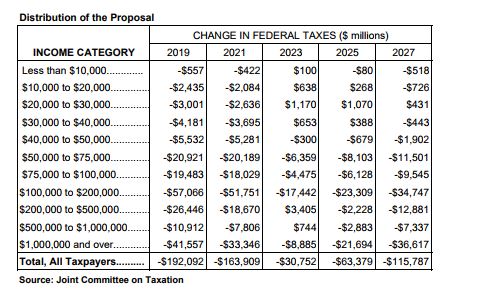
Congress’ Joint Committee on Taxation estimated the following taxation distribution changes. The following chart shows that while lower income levels initially receive tax reprieve, the total nominal burden would eventually increase for some income demographics. It would decrease, however, for the highest tax bracket.
However, the Joint Committee also said that the average effective tax rate 10 years out for every income bracket would either remain the same as it is under current law, or decrease, as seen in the right column below.
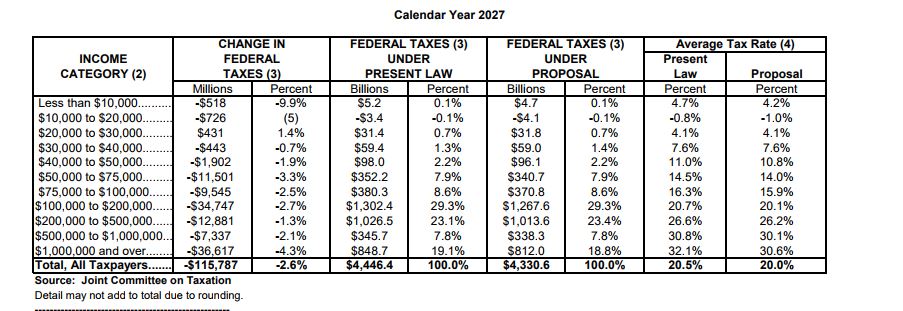 The committee did not release specific state breakdowns of the bill’s distribution.
The committee also released a summarized, yet comprehensive, summary of each provision proposed in the bill.
Institute on Taxation and Economic Policy:
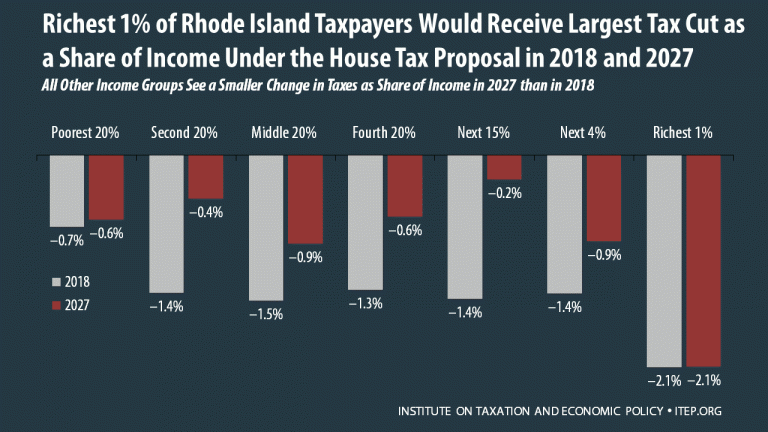
The ITEP found that tax changes would primarily benefit top 1 percent of both U.S. and Rhode Island earners due to the reduction of the corporate income tax rate, personal income tax rate and the estate tax. This was a trend that ITEP estimated to occur across the country and on average nationally.
 Tax Foundation:
The Tax Foundation released an estimate that said the tax cut would create 3,304 jobs in Rhode Island over 10 years. The foundation estimated that a middle-class family in Rhode Island would receive an average gain in after tax income of $2,707 over 10 years.
Nationally, the Tax Foundation provided two outlooks from the tax changes.
The table below reflects two concepts of how corporate taxes affect labor.
The foundation explains its dual estimation as follows: “Static estimates assume that 25 percent of the cost of the corporate income tax is borne by labor. Dynamic estimates assume that 70 percent of the full burden of the corporate income tax is borne by labor, due to the negative effects of the tax on investment and wages.”
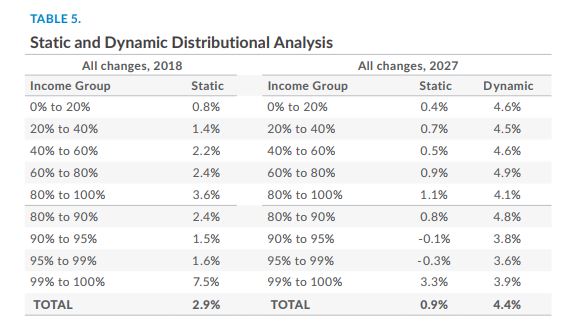
In this way, the foundation estimated a general all-around tax-cut saving with less income-related tax savings and more of an increase of passed-on savings from corporate tax reductions.
Nationwide the foundation expects the changes, as they are, to create 975,000 jobs over 10 years and create a 10-year savings average of $2,598 for a middle-class family.
The Tax Policy Center, another nonpartisan tax analysis organization, issued a report earlier this week that had concluded the top 1 percent of earners would benefit most from the study. The Center has since retracted its study, citing errors in its original figures. The center is yet to issue an updated analysis.
Chris Bergenhiem is the PBN web editor.