By 10:30 a.m. July 14, the queue of callers waiting to talk to someone in the unemployment insurance office of the R.I. Department of Labor and Training (DLT) already had climbed to 76.
When the phone system had been activated at 8 a.m., the calls flooded in immediately. Now, according to a computer system that monitors the phones, many of the callers could expect to be on hold for up to 48 minutes.
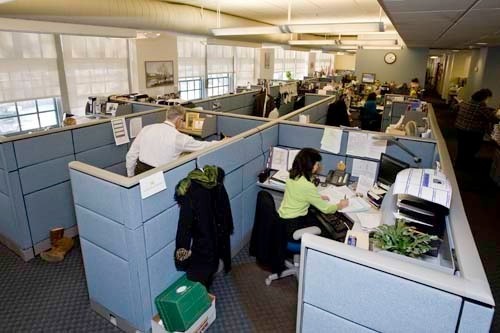
All around the DLT’s unemployment insurance call center, men and women in dozens of cubicles, each with a headset and a microphone, sat in front of computer screens fielding the calls.
Earlier this year, as the state’s unemployment rate ballooned well above 10 percent, the call center was overwhelmed by the staggering amount of new claims, with frustrated callers waiting hours on the phone and claims filed online going weeks before they were processed.
While those problems were mostly resolved when more staff members were hired in February and other changes were made, a midyear spate of layoffs has proved to be a new test for the DLT.
Department officials acknowledge that wait times on the phone lines have climbed again, from an average of 22 minutes for people filing new claims at the end of May to 40 minutes during the week of July 8. The processing time for claims registered on the Internet is also longer, going from three to five days just a month ago to six days last week.
“Is there a level of frustration [from callers] that is reaching us? Absolutely,” said DLT spokeswoman Laura Hart. “It’s inherently a stressful process.”
But the DLT says it’s doing the best it can with the resources it has at a time when the jobless rate stands at 12.1 percent as of May. And in terms of backlog, Hart added, “We’re nowhere near where we were in January.”
Some unemployed workers who have had to deal with the DLT in recent weeks have told Providence Business News of difficulties getting a hold of anyone in the unemployment insurance office.
Aside from those registering new claims, there are complaints of constant busy signals when attempting to use the TeleServe Automated Payment System, a weekly call that is required in order to get an unemployment check.
And there are also laid-off teachers who started collecting at the end of the school year. Because of municipal budget troubles, more teachers have been filing claims this year.
The week beginning July 6, for instance, the unemployment insurance system was averaging about 300 new claims filed each day by the Internet alone, according to Filippone. That’s more than double the usual amount of about 125 Internet-filed claims.
That said, Filippone believes the worst of the seasonal layoffs are over, with new claims sinking back to typical levels last week as some teachers are recalled and factories gear up again.
Still, DLT officials said last week that they have tweaked the system to better handle the latest surge. The 84 call center workers are now authorized to work four hours of overtime each day instead of the three hours allowed before. And many of the staff members – the newest additions earn $19.47 an hour plus benefits, a cost covered mostly by federal aid – recently have been asked to work Sunday to process the backlog of Internet claims.
In addition, Filippone said the call center is keeping its phone lines open an extra hour four days a week.
Sen. John J. Tassoni, D-Smithfield, who became somewhat of a DLT watchdog when complaints of slow service first surfaced earlier this year, said calls from out-of-work constituents seemed to diminish after the DLT hired 40 call center workers in February, but they have picked up again in recent weeks.
In particular, he said, he has heard that people filing unemployment claims that have unusual circumstances have had to wait six to eight weeks for an initial interview to discuss their case with an adjudication staffer.
Hart confirmed that interviews with the adjudication office are being scheduled at least six weeks in advance, compared with the four weeks’ lead time just a few months ago. Although she said she wasn’t immediately clear on the cause of longer delays, Hart suggested that recent staff changes may have played a part.
DLT officials said they understand the frustration of the people seeking unemployment benefits, but the shear number of people collecting checks has reached record levels.
As of the first week in July, 39,900 Rhode Islanders were collecting unemployment benefits of various types – nearly double the number collecting a year ago. And extended-benefit programs offered by the state and federal government have placed added pressures on staff members.
A computer closely monitors the number of people on the phones, why they are waiting and how long they have been waiting. It also tracks the actions of office workers – who’s on break, their various skills levels, how long they are spending on each caller.
Using that information, an office manager directs how staff members are utilized.
At 10:30 a.m., 30 callers were on hold to re-file unemployment claims. These were people who filed a claim less than a year ago, returned to work but now are again out of work. The estimated wait time: 46 minutes.
There were also four callers looking to file new claims. Estimated wait time: 48 minutes.
Why a longer wait for a shorter queue? Filippone explained that new claims require more questions for office workers to determine eligibility, such as if someone worked in another state.
And therein lies part of the problem, Filippone and Hart said. Most every case is different, and each takes a varying amount of time to process.
“This is not just a call center,” Hart said last week. “People think that it’s pressing a few buttons and someone moves you along.” •