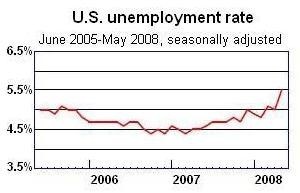
WASHINGTON – Employment nationwide shrank in May for the fifth consecutive month as the U.S. unemployment rate surged to a three-and-a-half-year high of 5.5 percent, the U.S. Department of Labor’s Bureau of Labor Statistics said today.
Non-farm payrolls accelerated their decline, shedding 49,000 jobs last month after losing a revised 28,000 jobs the month before, the BLS said.
Total employment in May amounted to 146.05 million jobs, for a total loss of 324,000 jobs since the beginning of the year. By comparison, the nation’s payrolls added 91,000 workers in the first five months of 2007. Analysts had expected a loss of 60,000 jobs would follow April’s previously reported 20,000-job decline, based on the median forecast from a Bloomberg News survey of 79 economists.
“The labor market continued to weaken in May,” BLS Deputy Commissioner Philip L. Rones noted in his address to Congress this morning.
“The unemployment rate increased by half a percentage point to 5.5 percent,” the largest increase since February 1988 and five times the 0.1-percentage-point rise predicted in the Bloomberg survey, “and jobless rates rose for most major demographic groups,” Rones said.
The increase was due in part to a flood of teenagers entering the labor force for the first time, and formerly discouraged workers who again began seeking jobs, the BLS said.
The nation’s labor-force participation rate increased to 66.2 percent last month, as the total civilian labor force grew by 577,000 to 154.5 million. But those new workers helped drive up the unemployment rate, which measures only those who are actively seeking work. Among the unemployed, the number of re-entrants and new entrants to the labor force rose in May, by 326,000 and 204,000, respectively,” the bureau wrote.
The number of newly unemployed – jobless for fewer than five weeks – also rose in May, however, increasing by 760,000 people to 3.2 million. And the number who had been out of work for 27 weeks or more rose by 197,000 to 1.6 million, or 18.3 percent of the people unemployed last month.
“In May, employment declined in construction, manufacturing, retail trade and temporary help services,” Rones said.
The service-providing sector gained 8,000 jobs last month, after adding a revised 72,000 in April, he said. “Health care continued to add jobs,” adding 34,000 posts in May. “Employment in food services continued to edge up over the month,” he added, although “since last fall, job growth has slowed markedly.”
Retail trade employment fell 27,000 jobs last month, led by department stores. “Since peaking in March 2007, the [retail] industry has lost 184,000 jobs,” Rones said.
“Temporary help services shed 30,000 jobs in May,” he added, bringing their total losses to “110,000 over the past four months and 193,000 since the industry’s most recent employment peak in December 2006.”
“Within the goods-producing sector,” Rones said, “employment in construction declined by 34,000. Job losses in the industry continued to be widespread. Since its peak in September 2006, construction employment has fallen by 475,000. Two-thirds of that decrease” – some 320,000 construction jobs – “has occurred in just the past seven months.
“Manufacturing employment also continued to decline in May,” falling by 26,000 positions. “Thus far this year, monthly job losses have averaged 41,000, about twice the average monthly decline of 2007 and three times that of 2006,” Rones said.
Meanwhile, average hourly earnings rose 5 cents, or 0.3 percent, to $17.94 – accelerating from an April gain of 1 cent per hour that was the smallest since May 2006. Average weekly earnings rose by the same 0.3 percent, to $605.48, as the average work week was unchanged at 33.7 hours. The average manufacturing work week held steady at 41 hours, but factory overtime dipped to 3.8 hours per week from April’s 4.0 hours.
“The labor market is still deteriorating,” Nigel Gault, chief U.S. economist at Global Insight Inc. in Lexington, Mass., told Bloomberg News. “The story is, we’re still on the verge of a recession … at best, the economy is growing very, very slowly.”
Additional information, including the 28-page Employment Situation summary and the BLS Commissioner’s Statement on the Employment Situation release, is available from the U.S. Department of Labor’s Bureau of Labor Statistics at www.bls.gov.