When Sanjiv Dhar graduated from Johnson & Wales University’s Providence campus in 1990, he took a job with Marriott Hotels in New York City. That same year, Kabob & Curry, a Thayer Street Indian restaurant that had opened two years before, came up for sale.
“One of the two partners that owned it called me up and said, ‘Listen, are you interested in this opportunity?’ ” Dhar, a native of India, said last week. “So that’s how I got into the restaurant industry in Rhode Island.”
Eighteen years later he’s still running Kabob & Curry, having bought out his partner 10 years ago. Two years ago he opened Rasoi, on the Providence-Pawtucket border. With that eatery, he’s trying to create a “commissary” through which he can feed satellite restaurants in the future, a new concept for Indian-food establishments.
Dhar is part of a long line Johnson & Wales graduates who have helped fuel the lively culinary scene in Providence.
Chow Fun Food Group founder and owner John Elkhay, for example, is a 1977 JWU graduate and has five Providence restaurants – including the new Chinese Laundry and Rick’s Roadhouse – and 235 employees.
“I’ve been using Johnson & Wales students since 1980,” he said last week. “For the past 28 years, they’ve been an integral part of how we run our restaurants and our labor pool. From chefs, sous chefs, chef garmange, baking [and] management.”
Steven Shipley, JWU’s director of development and alumni relations, estimates that about 95 percent of restaurants in Providence are owned by or have employed JWU students or alumni.
“I think what [the students] see is that they have an opportunity to grow” in Rhode Island, he said, adding, “It’s not only our students, it’s our faculty members – chefs from all around the world – who have decided to make Rhode Island their home.”
JWU Director of Communications Lisa Pelosi said that since being chartered in 1963, the Providence campus has graduated 67,500 students, about 23 percent of whom are still living in Rhode Island. Those graduates have opened more than 200 businesses in Providence.
When Pelosi began working at the school in March 2007, she started asking at restaurants if any alumni worked there – and most said yes.
Pelosi then came up with the idea for a dining guide that featured those restaurants where alumni work – the first edition of which was released during JWU’s October 2007 family weekend. The first was a success, Pelosi said, so early this year JWU sent a survey to the 2,676 culinary school alumni who live in Rhode Island. From the responses, JWU put together a new guide that includes 41 restaurants from around the Ocean State. It will be handed out to parents and students during the eight orientations this summer and it includes owners, chefs and managers.
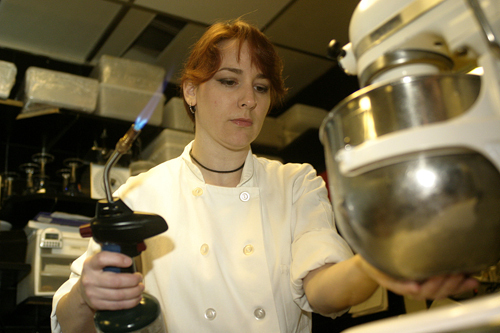
One of those that responded was Laurie Nadeau, who graduated from Johnson & Wales University in 1998. Since 2000, she’s been the pastry chef at Café Nuovo. She creates desserts, including an autumn-themed, carrot-cake parfait with a maple pastry cream that’s topped with maple-walnut ice cream and cranberry syrup.
“They’re all pretty much recognizable flavors,” she said, “but combined in a glass in an interesting way.”
She said that Johnson & Wales offers a few pastry courses – introductory and advanced sections – but they were fairly basic.
“But it did make it a lot easier for me to find work,” Nadeau said. “When I graduated, I had very little cooking experience, so I had trouble getting my foot in the door. But people were having trouble hiring pastry chefs … so it was easy for me to get a position.”
While the JWU Dining Guide is an attempt to bring the university’s alumni to the forefront, they’ve been helping sell Providence as a destination for years, said Shipley. Providence Warwick Conventions and Visitors Bureau President & CEO Martha Sheridan said she’s been using the city’s thriving culinary scene to attract travelers and conventions since the early 1990s.
“It’s obviously a major selling feature for us when we are promoting this destination to meeting planners, event planners and leisure visitors,” she said, adding that Providence Restaurant Weeks, Federal Hill Strolls and the JWU Culinary Archives & Museum are usually involved in her pitch.
And other cities are taking a cue from Providence.
In North Carolina, the Charlotte Chamber of Commerce was one of the local agencies that courted JWU before it opened a campus in Charlotte during 2004, CCC Vice President for Research and Economic Development Tony Crumbley said. That city, with about 600,000 residents, has nearly four times the population of Providence.
“We knew that they had outgrown their facility in Charleston, where they had improved the quality of food service dramatically,” he said. “And we felt the need to have them in a downtown location here.”
Charlotte had two main motives: adding residents to the financial district and improving the quality of food service. It’s still early to definitively tell whether the university has – or will have – a lasting impact on the city’s culinary scene, Crumbley said, adding, “we certainly are seeing more high-quality restaurants in this area and we are seeing higher numbers of people in the downtown area.”
There were incentives for JWU, too. Charlotte-based food-service company Compass Group North America – an $8.8 billion subsidiary of the $20.2 billion, UK-based Compass Group PLC – agreed to hire 300 graduates a year and give the school more than $1 million, Crumbley said. “Obviously, that’s been a major benefit to an existing company here – and a benefit to the school to have that commitment,” he added.
The economic-development group Charlotte Center City Partners’ President Michael Smith said that the city offered JWU a $10 million grant, along with selling it city property at book value.
“They’ve been absolutely culturally transforming for our city,” Smith said. “They recruited students from 48 states and eight countries and one of the things that I think is so transforming about them is that of their graduates, 60 percent stay in-market. That’s roughly 600 students per year that stay here in Charlotte.”
In Providence, JWU’s College of Culinary Arts was founded in 1973. The school’s prominence, however, is hardly a guarantee of success for graduates like Dhar.
Creating a thriving restaurant can be tough – never mind creating multiple restaurants, he says. You have to offer value and be in the right location. In the 18 years that he’s owned Kabob & Curry on Thayer Street – the East Side’s most prominent restaurant melting pot – his rent has quadrupled. And the down economy has added to the pressures.
“The restaurants are doing fine, but it’s obviously a tougher and risky climate out there right now,” he said, adding he would still like to grow his business, “but I’ll have to do it a little bit more diligently.” •