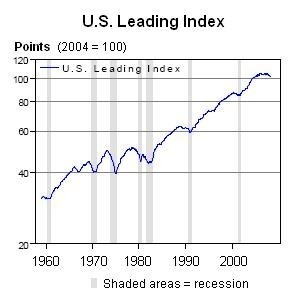
NEW YORK – The U.S. Leading Economic Indicators rose for the second month in a row in April, surprising analysts, The Conference Board reported today.
“The small increases in the Leading Index in both March and again in April could be a signal that the economy may not weaken further,” Ken Goldstein, an economist with The Conference Board, said in a statement this morning.
The trade group’s Leading Index – a predictor of the nation’s economic performance over the next three to six months – edged up 0.1 percent last month to 102 points (2004 = 100), after rising 0.1 percent in March and falling 0.3 percent in February. (The base year for the board’s leading, lagging and coincident indexes – previously, 1996 – moved to 2004 with its March report. “These revisions do not change the cyclical properties of the indexes,” The Conference Board said at the time.)
Analysts had expected the Leading Index to hold steady in April, after rising in March for the first time in September, based on the mean prediction of 53 economists polled by Bloomberg News. (Their expectations ranged from a decline of 0.6 percent to an increase of 0.3 percent.)
Six of 10 leading indicators improved compared with March while three deteriorated, the board said. The biggest positive contributors were stock prices, the interest-rate spread and building permits, all of which rose last month. Smaller improvements were seen in average weekly initial claims for unemployment insurance, which fell in April; vendor performance, as measured by the index of supplier deliveries; and manufacturers’ new orders for consumer goods and materials.
The biggest negative contributor last month was the public’s mood, as measured by the Reuters/University of Michigan Consumer Sentiment Index, which continued to fall in May (READ MORE). Also falling in April were average weekly manufacturing hours and manufacturers’ new orders for non-defense capital goods. The 10th indicator, the nation’s real money supply (M2), was unchanged from March.
Meanwhile, the Lagging Index continued to rise, gaining 0.1 percent to 112.2 points, slowing from the 0.4-percent gains of March and February. Three of seven components advanced last month, the board said, led by commercial and industrial loans outstanding. Also rising were the Consumer Price Index for services and the ratio of consumer installment credit to personal income. Losing ground were average unemployment duration, the average prime rate charged by banks and the change in labor costs per unit output. The ratio of manufacturer inventories to sales held steady in April.
The Coincident Index – a measure of current economic activity that has not risen since October – was unchanged at 106.9 points, after holding steady in March and falling 0.3 percent in February. Two of the index’s components rose in April while the other two fell: Industrial production and non-farm employment both fell compared with March, but those declines were offset by gains in personal income less transfer payments and real manufacturing and trade sales, the board said. As a result, the coincident to lagging ratio fell for the fourth consecutive month.
“During the first quarter, real GDP expanded at a 0.6 percent annual rate, the same growth rate that prevailed in the fourth quarter of 2007,” the board noted in its report. “The current behavior of the composite indexes so far still suggests that economic activity is likely to remain weak in the near term.”
The report spurred cautious optimism among analysts: “The message on the economy is that activity is soft but not moving down sharply,” Michael Moran, chief economist at Daiwa Securities America Inc. in New York, told Bloomberg News. “The economy is muddling along.” Likewise, John Lonski, chief economist at Moody’s Investors Service, told Bloomberg Television that “this particular slump seems to be milder than any recession since the Great Depression.”
The Conference Board is a nonpartisan, nonprofit business membership and research organization with offices in New York City, Chicago and abroad. Additional information, including this month’s full Leading Economic Indicators report, is available at www.Conference-Board.org.