
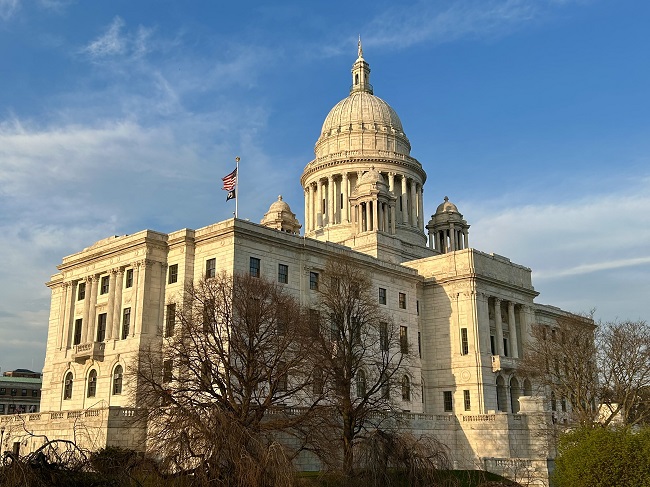
A Senate-led special legislative commission concluded in January that the University of Rhode Island is well-poised to open a public medical school on its Kingston campus. But a House Republican is encouraging her colleagues to, as the university’s marketing tagline suggests, think big.
Rep. Marie Hopkins, a Warwick Republican and nurse, said the state should consider adding a dental school at URI as well.
Building a Strong Data Foundation in the Age of AI
Artificial intelligence (AI) has become a key priority in the boardroom and across management —…
Learn More
“We are hemorrhaging dentists in the state,” Hopkins said at the initial hearing of her bill before the House Committee on Education Tuesday. “They can’t afford to be here.”
“And people label this as greed,” she continued. “I don’t think that comes into play. They are businesses at the end of the day, and a business needs money in order to keep the doors open.”
Hopkins’ bill, H7418 outlines a broad, enabling statute that would formally establish schools of medicine and dentistry at URI and authorize it to award degrees in these disciplines. It would require the school to obtain proper accreditation, and it would fashion a pipeline, in the bill’s words, to foster “collaboration with hospitals, health systems, dental clinics, and other health-related institutions” already in the state.
Samuel Zwetchkenbaum is a practicing dentist at Providence Community Health Centers who testified in support of Hopkins’ bill.
“We have the lowest dentist-to-population ratio in all of New England,” said Zwetchkenbaum, who also works as dental director at the Rhode Island Department of Health and in the state’s Medicaid program.
The national average is 60 dentists per 100,000 people, he told lawmakers. In Massachusetts, there are 80 dentists per 100,000 people. And in Rhode Island?
“We have only 50 dentists per 100,000 people,” Zwetchkenbaum said. “The impact of that manifests itself as longer wait times for appointments. All dentists are very busy. They’re busy enough that they choose not to participate at all with Medicaid.”
Many dentists even choose not to accept commercial insurance “when they achieve a certain level,” Zwetchkenbaum said. That leaves many dental offices open only four days a week during business hours. That wasn’t the case in New Jersey, where the Warwick-raised Zwetchkenbaum once briefly lived — a place, he said, where the dentists are plentiful.
“You see dental offices open on weekends,” Zwetchkenbaum said of New Jersey. “You see dental offices open in the evenings, and that’s really advantageous for people who work or people who are in school.”
Dental schools can also double as clinics. Sometimes, Zwetchkenbaum recommends people head up to Tufts University in Boston, “where the rates are a lot lower for dental care,” he said.
“Yes, you have to sit for longer periods of time, but dental schools become a site of care,” Zwetchkenbaum said. “Dental schools typically accept Medicaid.”
Pros and cons
Another bill related to the URI commission’s recommendations asks the General Assembly to put a $22.5 million general obligation bond on the ballot in November to kickstart the school funding process. It was submitted by Rep. Kathleen Fogarty, a South Kingstown Democrat, on Feb. 11 and referred to the House Committee on Finance, where it awaits a hearing. That likely won’t arrive for several weeks, House spokesperson Larry Berman said via email, as the finance committee is still working its way through budget articles first.
Under the schematic outlined by the special commission in its final report in January, that $22.5 million would be the estimated yearly commitment from state coffers to keep the medical school afloat.
Hopkins’ bill does not get specific about funding. Still, she was unafraid to acknowledge the complex economics behind the initiative. The issue’s intricacy is why Hopkins, who is a graduate of both Brown University and URI, submitted the bill. She wants the medical school to be vetted, discussed and hopefully improved over the course of the legislative process and “not just in a commission” where every stakeholder may not have a say, she argued Tuesday.
“I’m going to give you the pros, and then I’m going to also give you the cons, because I think the debate has to be honest,” Hopkins told the committee.
One of the people voicing skepticism to the medical school idea is Hopkins’ own brother, who she said is an MD who is “adamantly opposed” to the concept.
“He thinks it’s a terrible idea,” Hopkins relayed to the committee. “He says we cannot spend all that money and expect these doctors to stay. If we’re, bottom line, not paying the doctors, we’ll spend the money and they’ll leave anyway.”
Rep. Richard Fascia, a Johnston Republican, told Hopkins he actually had “no reservations about a medical school here in Rhode Island.” But Fascia was worried that the bill did not contain language prioritizing Rhode Island students – something Hopkins agreed the bill should include going forward.
“Obviously, if the taxpayers of this state are doing this work and this investment, you need to pay off on investment,” Hopkins said.
Indeed, return on investment formed a recurring theme in the conversation, especially on the dental side. Rep. Megan Cotter, an Exeter Democrat, told an anecdote about her own dentist.
“I really enjoy his bedside manner,” Cotter said of her dentist. “But as soon as he found out I was a state rep, he waits for me to be numbed up, and then he starts about the state stuff, which is funny. He’s great.”
Cotter’s dentist was not a fan of the medical school idea.
“He does not take Medicare or Medicaid, and he said he’d love to be able to take those patients, but he can’t,” Cotter said.
Hopkins replied that some Rhode Island practices use a “blended” model which accepts regularly insured patients alongside “concierge” clients who pay extra for better access. But insurers don’t always make this easy or even allow it, Hopkins said.
“Currently, it’s go concierge or don’t,” Hopkins said. “Nobody can afford to keep the doors open on what Medicaid pays. It’s like $37 at the lowest for the face time with the doctor.”
The medical and dental school idea is a slow burn, Hopkins conceded, but her remarks suggested the times are desperate.
“The problem is, it’s an avalanche,” she said. “It’s not a snowball, it’s an avalanche, and we’re getting crushed.”
“If we do decide to go forward with this, we have to recognize that we are playing the long game, and we still have to provide other solutions for our primary care crisis, which is beyond a crisis,” she said. “It’s an autopsy at this point.”
Like most bills upon their initial hearing, Hopkins’ legislation was procedurally held for further study.
Alexander Castro is a staff writer for the Rhode Island Current.



