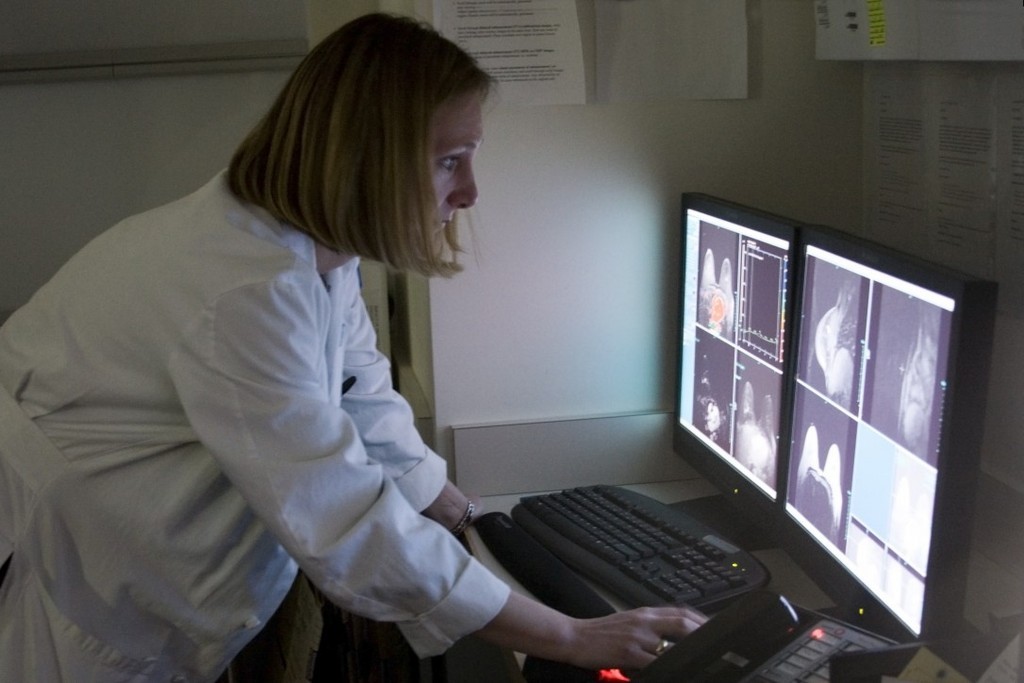
If hospitals in the real world functioned like the doctors on “House, M.D.” every diagnosis could cost a year’s salary, and health insurers would go broke – presuming they paid for all the lab work and imaging.
As it is, Americans’ growing use of high-end technologies is one of the reasons health care costs have gone up so much in recent years. But what if $1,000 spent on diagnosis could save $10,000 in later treatments, or actually save a life?
That is the question that doctors, insurers and researchers are constantly asking about high-cost technologies. And last week, with regard to MRIs and breast cancer, a Brown University biostatistician helped reshape the answer.
In an article published in the New England Journal of Medicine and co-authored with several of his colleagues in the American College of Radiology Imaging Network, Brown Prof. Constantine Gatsonis reported that MRIs had detected additional tumors that mammograms had missed in women already diagnosed with breast cancer.
The study came out just as the American Cancer Society was issuing new guidelines supporting the use of MRIs to supplement mammography in breast cancer screening for high-risk patients.
Each article focused on a different type of patient, and neither advised replacing mammograms with MRIs altogether – or using MRIs to screen all women. But together they offered a glimpse into how quality and standard practices in medical care come to be defined.
The ACRIN study, in which Gatsonis was involved, focused on women who were known to have cancer in one breast. Medical studies have shown that about 10 percent of women who develop cancer in one breast eventually develop it on the other side as well. What the ACRIN researchers sought to determine was whether MRIs could detect cancers that mammograms had missed.
Mammograms are low-dose X-rays of the breast that show differences in the density of the tissue.
Magnetic resonance imaging, or MRI, uses powerful magnetic fields and radio waves to create images of the breast. Unlike mammograms, which require the breast to be repositioned to get different views, MRIs can easily get multiple perspectives, and they’re very sensitive, detecting a wider range of variations in the tissue than a mammogram can.
The U.S. Food and Drug Administration approved breast MRIs in 1991, but they’re not the standard diagnostic tool for two main reasons: the cost – Medicare currently pays $82 in Rhode Island for mammograms of both breasts, and $576 for comparable MRIs – and concern about false positives.
The new American Cancer Society guidelines cite studies from the Netherlands and the United Kingdom showing more than twice as many positive results from MRIs than from mammograms (19.7 percent vs. 7.2 percent in the U.K. review). In addition, twice as many positives were later confirmed as cancers (1.44 percent vs. 0.69 percent in the U.K. study).
Many of those extra positives didn’t require additional tests to determine they really weren’t cancer, but a lot did, and more than twice as many women who underwent MRIs in both countries went on to have biopsies. The U.K. trial also found the MRIs caused more distress.
Four years ago, when the American Cancer Society last updated its breast cancer screening guidelines, concerns about these kinds of issues and a shortage of definitive data led the group to avoid specifically recommending the procedures, though it did say some high-risk patients might benefit from the.
Dr. Martha Mainiero, a radiologist at Rhode Island Hospital who specializes in mammography, said in an interview that she has seen MRIs used more and more in women who have been diagnosed with breast cancer already.
“So far, it’s particularly been useful in women who have very dense breasts or who have breast cancers that are hard to see on mammography or ultrasound,” she said. “The principal reason that we do it is to make sure we understand the extent of disease.”
Rhode Island Hospital also does MRI-guided biopsies for hard-to-spot tumors, she said, and some doctors use MRIs after surgery “just to make sure nothing was left behind,” and then as a follow-up.
The two technologies “really are complementary,” Mainiero said. “There are times that mammography shows the extent better and MRI underestimates it, but there are also probably more times that MRI shows the extent better. You need both of them.”
This is where the ACRIN study comes in. Knowing the vulnerability of women who already have cancer in one breast, researchers did MRIs on 969 women whose mammograms had shown no cancer in the other breast, then went on to perform biopsies on 121 women after positive MRI results. Of those women, 30 had cancer, and 18 had invasive tumors.
Within a year, Gatsonis said, cancers had been found in a total of 33 women, but finding 30 early, he said, shows that MRIs “definitely” should be considered for this type of patient.
Gatsonis stressed that the ACRIN study wasn’t entirely comparable to the American Cancer Society review, which looked at a broader population, including women with known genetic mutations, or with female relatives with breast cancer.
Mainiero said she expects the new evidence to result in increased use of MRIs to detect breast cancer. And while she said insurers are already generally willing to cover the expensive procedures – Blue Cross & Blue Shield of Rhode Island in particular is “very good” about it, she said – last week’s reports might make them more amenable to doing so.
Dr. Peter Hollmann, senior medical director for Blue Cross, said the insurer initially considered breast MRIs appropriate only after a ruptured implant, but now it covers them in many situations.
Now, Hollmann said, “what we’re going to be doing is modifying our guidelines to make sure that they’re consistent with the American Cancer Society.” But as a physician, and having seen the impact of a false positive and a needless biopsy, he still has questions.
“How often do you get more information that leads to more testing and then even potential harm to the patient?” he said. And the “real bottom line,” he added, is whether MRIs can save lives.
Finding an incurable cancer early doesn’t really help much, he noted, but “as you get better and better at treating a disease, you can benefit from finding it earlier and earlier.”