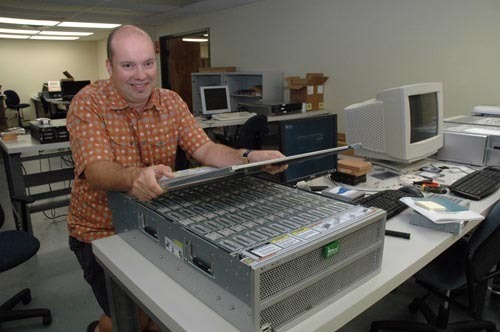
The team at Heartlab Inc. first saw the need as they dealt with health care providers. As more and more aspects of their operations went digital – billing, patient records and imaging – they were swamped with data, and storing it all was a huge logistical and financial challenge.
The servers they were using were not well-suited for long-term data storage, and they consumed enormous amounts of energy, at great cost. The problem wasn’t unique to health care, either: All kinds of businesses, large and small, were struggling with this.
So after selling Heartlab to the Belgian giant Agfa in 2005, former CEO Robert Petrocelli and others started a new company in 2007 to focus on efficient, lower-cost storage. And this month the firm, greenBytes, based in the Hopkinton Industrial Park, launched its first product.
PBN: What did you see at Heartlab that led you to start greenBytes?
PETROCELLI: At Heartlab we were frequently in the first wave of hospitals buying any kind of serious, large-capacity data storage. Up to that point, hospitals were focused on buying systems to support their transactional storage needs, like patient billing and some limited patient records. But what we found was that the options available to our customers were very, very costly on a per-gigabyte basis, because they were systems that were originally developed to deal with things like e-mail – high transactional data, not the bulk data that hospitals and other kinds of people use a lot more these days.
Beyond Cash Donations: How New Forms of Giving Are Transforming Not-for-Profit Accounting
Evolving Funding Landscape for Not-for-Profits Not-for-profit organizations are being asked to do more with less,…
Learn More
PBN: Did you design your software specifically for the health care industry?
PETROCELLI: No, we set out to do it for the entire horizontal market. The general storage business as we see it in the U.S. is about a $6 billion business. Given that footprint, we realized we didn’t have to have a lot of market share in order to do well. Unlike a vertical such as Heartlab, where we really had to dominate our market, here we could grow more organically. So we started developing products, and today we’re starting to launch a number of them. We have several out with customers already.
PBN: The first one is Cypress?
PETROCELLI: That’s the first one we have told the world about. We have some follow-on products that will be announced in July; they will be aimed at different price points. There’s an entry-level product that’s going to be very attractive to small-to-medium businesses. And what these products do is use a technology called data de-duplication that finds duplicates as the data is being stored and only stores data once, rather than storing it many times over. The scenario that people can identify with would be the case of sending e-mail attachments to 1,000 people. In the storage system, all of those people may have received the attachment, but it’s only stored once, even though it may look to the user like they have their own copy.
PETROCELLI: We have brought in another technology we developed that allows us to very intelligently cycle down the drives in these systems. Most people who only have one hard drive in their computer don’t think about this, but the average data center has 2,000 drives in it. Those drives consume, on average, 14 to 15 watts each, and they are running 24/7. Our Cypress product, nominally sitting there, consumes 1,000 watts, but when we manage the drives on it, we can reduce its nominal power consumption to 500 watts.
PBN: What kind of application is Cypress designed for?
PETROCELLI: This is for any type of information – your Word files, your Office files, backup data – this is very efficient for enterprises that have to back up thousands of desktops, because when you have 1,000 users, there’s a lot of duplicate data. … So we can improve the efficiency of the backup storage by about a factor of 10 to 20.
PBN: How many clients have you tested this with already?
PETROCELLI: We’re out with about half a dozen data sites right now, and we plan on having both this and another product that’s aimed at a higher-volume consumer in the pipeline sometime around mid-July.
PBN: How big a market do you see for this?
PETROCELLI: We have some pretty unique technology, but to give you a sense, the market this year by Gartner Group for de-duplication, which is only part of what we do, is $1 billion in the U.S. So I would expect that given our experience, in the next three to five years, there’s no reason why we can’t grow to get 20 percent of the share. •