The Community College of Rhode Island has become a popular place to be recently.
Enrollment has swelled to more than 16,000 – the highest level it’s been in recent years – boosted by the stalling economy and rising unemployment as people are either looking for a cheaper alternative to a four-year school or returning to the classroom to pick up skills for a new job.
Now state leaders are looking to capitalize on that popularity.
A special panel has begun examining ways to retool the Ocean State’s only public two-year school so it can consistently turn out graduates with training that matches the need of local industries now and in the future.
The CCRI 21st Century Workforce Commission has already met once, late last month, and has hired a nonprofit consulting group to help guide the 13-member panel of state lawmakers, school administrators and state agency directors.
Just which industry needs the commission will focus on hasn’t been decided yet.
Armeather Gibbs, the commission chairwoman and chief operating officer of the United Way of Rhode Island, said last week that her group will attempt to “connect the dots,” reaching out to the business community and potential employees for recommendations on how to proceed.
“We’re really looking at what the bigger, broader opportunities will be,” Gibbs said.
Commissioners expect to complete their work early next year, after four or so meetings, and then issue an “action plan” for CCRI.
J. Michael Saul, executive director of the R.I. Economic Development Corporation (EDC), said other states have made similar moves to use their community colleges as work force development tools.
“It’s a well-timed commission,” Saul said last week of Rhode Island’s effort. “It will be laying the groundwork and making recommendations as we come out of the recession.”
Officials insist they must act quickly. While the state’s unemployment continues to rise, labor officials also say there are jobs that go unfilled in some sectors because, employers complain, there are no applicants with the needed skills.
And, Julian Alssid, executive director of the New York-based nonprofit Workforce Strategy Center that has been hired to assist the CCRI panel, noted that jobs that require an associate’s degree or a post-secondary certificate are growing much faster than the rest of the job market, according to some studies.
Statistics indicate that CCRI is already a critical feeder to the state’s work force, with 80 percent of the school’s graduates employed by Rhode Island companies, according to the EDC.
And, while not ignoring the school’s overarching academic mission, CCRI administrators say they already have taken some steps toward developing training programs aimed at specific sectors.
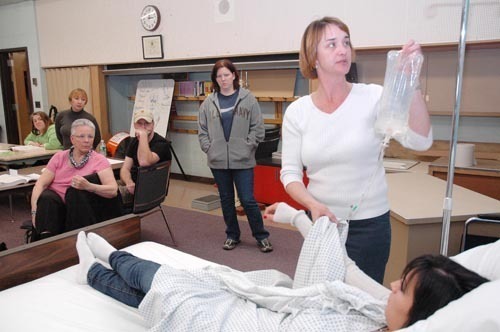
For example, CCRI’s Center for Work Force and Community Education recently launched a certified nursing assistant program. It was developed at CCRI’s Aquidneck Island Adult Learning Center after school administrators learned that nursing homes, hospitals, visiting nurses associations and other health care facilities had a desperate need for more CNAs. Those administrators then contacted various state agencies to identify potential trainees.
The adult pilot program covers not only the nurse training, but remedial lessons and testing for licensing.
Ray Di Pasquale, CCRI president, said the school has similar arrangements with Electric Boat and Lifespan.
“That has worked well with the businesses,” Di Pasquale said. “This might be an example of what [the commission] may want to do in the future.”
Indeed, Alssid said those direct partnerships with companies – some of which also exist in programs such as United Way’s Skill Up initiative – will be critical in developing a plan for CCRI.
“Many of the pieces are in place, but what is missing is the framework to put it all together,” Alssid said. “The employers are going to be key to making this happen.”
In Rhode Island, Alssid got involved after he moved here and was approached last year by then-EDC Executive Director Saul Kaplan. The commission was first suggested in the EDC’s 2008 Economic Growth Plan and was later established by legislation sponsored by House and Senate leaders.
Since then, Alssid said he was able to pool about $105,000 in donations from the Rhode Island Foundation, United Way of Rhode Island and the Quincy, Mass.-based Nellie Mae Foundation to pay for the Workforce Strategy Center’s work with the CCRI commission.
Alssid said he’s optimistic about the outcome, in part because of the attitude of the state leaders.
“This is the first state I’ve been involved with [where] the governor and the lawmakers agree on the close link between the economy and the community college,” he said. “The will is there. There’s a real interest in seeing this happen.”
Using his previous experience, Alssid said his group’s role is “shortening the learning curve” for the commission as it develops its report, what Alssid called a “blueprint to action.”
The Workforce Strategy Center already is conducting a “gap analysis” of sectors the EDC previously has identified for potential job growth – such as health care – in an effort to identify areas of opportunity.
Then the commission can figure out “what programs need to be expanded,” Alssid said.
Gibbs said the commissioners’ jobs may be easier because, unlike other states, Rhode Island only has one community college, making coordinating work force development that much simpler.
Although he’s not a member of the CCRI commission, Di Pasquale said in a recent interview that he’s pleased with the attention the school is receiving, and the potential role CCRI will have in future economic development.
“This is going to put CCRI in the forefront,” he said. As new companies come into or grow in the state, “we’ll be seen as the catalyst for developing the work force for those companies.” •