Look at the salary figures of nurses and those who teach them and one of the causes of the state’s rising nursing shortage becomes clear, according to some in the health care industry:
An associate professor for nursing at the Community College of Rhode Island earns about $48,000 annually – about the same as a first-year registered nurse working for the state’s largest health system Lifespan, not including overtime.
And an experienced nurse holding a master’s degree can earn upward of $80,000 to $110,000 annually.
With lots of money to be made in the hospitals, few are willing to accept a smaller salary to teach a future generation of nurses. It doesn’t help that many of the existing nursing professors are reaching retirement age, and master’s and doctoral nursing programs aren’t producing enough graduates to meet the need for new faculty.
Some in the industry say the result is fewer faculty members, limited classroom space and a diminished capacity to address the growing number of vacant positions at area medical facilities.
The waiting list for students to enroll in CCRI’s nursing program, for example, numbers more than 400.
“The nursing faculty shortage is really ground zero in our attempts to increase the capacity in the nursing colleges,” said Brandon Melton, senior vice president of human resources at Lifespan. “We can’t increase the capacity until we provide more nursing faculty.”
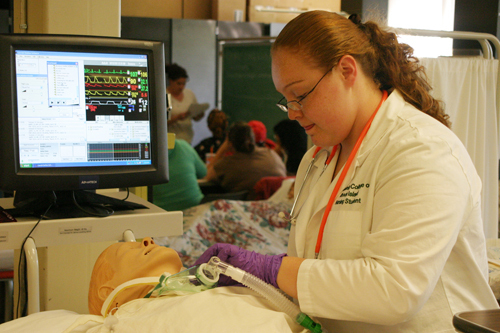
That’s why some area hospitals are allowing staff members who hold a master’s degree in nursing to serve as part-time instructors for the clinical portion of the college’s nursing programs.
Maureen McGarry, dean of health and rehabilitative services at CCRI, said it started with Kent Hospital about five years ago, providing one staff member so that Kent employees on the CCRI waiting list could start taking courses sooner.
Kent still provides a staff member for two clinical sessions each semester. Now Butler Hospital – which, like Kent, is a Care New England facility – provides three staff members for clinicals for its own employees. And Lifespan provides four instructors, one from Miriam and another three from Rhode Island Hospital.
In each case, the hospitals pay those instructors their hospital wages for time they spend instructing nursing students.
“This is absolutely essential,” McGarry said last week, referring to the assistance from the hospitals. “In times of fiscal constraint such as we’re in right now, this makes things doable. It helps us be able to stretch ourselves in other financial ways.”
The health care industry is going the extra mile because of a dire need for nursing staff, a need that is projected to get much worse in the coming years because of a mix of growing demand and an insufficient pool of qualified workers.
According to the R.I. Department of Labor and Training, the health care sector employs about 70,000 in the state, and that number is projected to grow by another 14,500 by 2014.
Lifespan’s own forecasts show that its nurse vacancy rate will climb dramatically over the next 20 years as older nurses retire, according to Melton. While Lifespan’s vacancy rate has been at about 13 percent – although it recently declined because of a crop of recent nursing school grads – Melton said it is projected to jump 30 percent by 2015 and more than 50 percent by 2025.
Ruth Ricciarelli, executive director for the Center for Health Professionals at the Hospital Association of Rhode Island, said there is no doubt there is a shortage of nurses, but she said it has little to do with the amount that nursing professors are paid.
Comparing the salaries of nursing professors and nurses is not fair, Ricciarelli added. “Those are two different career paths,” she said.
While acknowledging that a growing number of retirements may thin the ranks of nursing faculty, Ricciarelli said local schools have done a “pretty good job in attracting faculty.”
Instead, she said more effort should be put into retaining nurses already in the work force by, among other things, providing additional advancement opportunities.
Ricciarelli said the education model should be examined, too, to ensure that nursing students at CCRI, the University of Rhode Island, Rhode Island College, Salve Regina University and the St. Joseph School of Nursing at Our Lady of Fatima Hospital are learning the skills that they’ll need in the work force.
The Center for Health Professionals is developing a Web-based “centralized clinical placement registry” that will connect medical facilities that are willing to host clinical sessions with nursing faculty members.
In order to increase the number of nursing graduates and reduce the size of its waiting list, CCRI started the Summer Nursing Admission Program (SNAP) last year with 98 students. The program, a partnership with Lifespan and Care New England, graduates nurses in 16 months instead of two years by offering courses in the summer.
CCRI is also transitioning from the current waiting-list system to a merit-based policy in which students will be allowed into health-science programs based on grades.
Gov. Donald L. Carcieri raised his concerns about the nursing shortage in a meeting with the Providence Business News editorial board last month, saying he supported efforts that have gone nowhere so far to increase the maximum class size from eight to 12 students in order to open more slots.
Melton said hospital administrators have also proposed that the R.I. Board of Nurse Registration change the requirements to teach at the college level so that a nursing instructor would need only a master’s degree, not one specifically in nursing.
That would make more nurses eligible to teach. “We need all the nursing faculty we can get right now,” he said. •