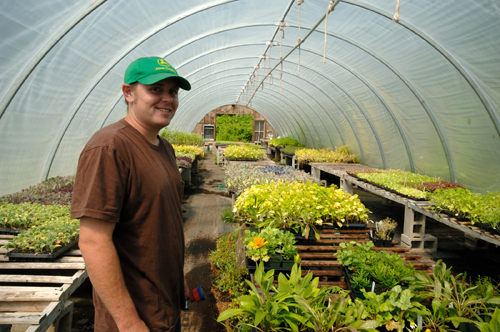
Farmer Erik Eacker watches from across a field of neat, leafy rows as two workers, riding in low-slung seats behind a tractor, plug parsley seedlings into the ground.
He’s watching but Eacker, 33, has his mind on other things. The strawberry harvest has just been completed, and the raspberries are almost ripe for picking. So are the salad greens.
He has been up since 5:30 a.m., and his day probably won’t be complete until after midnight. There’s always something to do on a farm.
Eacker is the owner of Ledge Ends Produce, a business he started four years ago after the East Greenwich Municipal Land Trust granted him permission to work the land at the historic 84-acre Briggs-Boesch Farm.
Through Ledge Ends, Eacker leases the property, living in a 250-year-old Colonial farmhouse on the land with his wife, Trisha Garland.
So far, it’s been a success.
Certified organic by the U.S. Department of Agriculture, Ledge Ends sells fruits and vegetables at several farmers markets in Rhode Island and to the Whole Foods in Cranston.
Like many of the hundreds of operating farms in Rhode Island, Ledge Ends also participates in a community-supported agriculture (CSA) program, where member families pay upfront for a share of the crop yield. More than 200 families have signed on, and many more are on a waiting list.
He declines to reveal his annual sales figures, but Eacker is happy with how things have gone. “The market in Rhode Island for local organic food is just amazing,” he says.
It took Eacker a while to get to this point.
Unlike many farmers who were born into the occupation, Eacker says he was raised in the suburbs of Salem, N.H. He did, however, always have an interest in landscaping and farming.
By the mid-1990s, he was preparing to transfer from a college in Colorado to one in California with an agri-ecology program, but his life took a different turn. When his parents bought a 170-acre farm in Gouverneur, N.Y., Eacker figured he’d give farming a try instead.
“The learning curve was huge, but I had some good mentors,” he says now.
After seven years of operating that farm, Eacker moved to managing another farm in New York’s Hudson Valley, but he longed to call his own shots.
“I needed to have my own business,” he says.
In 2003, Garland stumbled across a request for proposals on the Internet from the East Greenwich Land Trust for the Briggs-Boesch Farm. With the deadline close, the couple wrote a 30-page business plan in two days. Impressed with the proposal, the trust awarded Eacker a 20-year lease.
Protected by the trust from development, the land doesn’t look like it has changed much since the Briggs family farmed it in the 1700s. The red clapboard farmhouse sags slightly with age, as does a nearby barn. A dusty dirt road snakes through the woods, connecting various fields.
Eacker figures the property would be worth millions to a real estate developer and acknowledges there’s no way he’d be able to make the mortgage payments, or even the property tax payments, if he actually owned the property. Many local farmers lease farmland for the same reason, he says.
The soil here is good. “Whoever cleared this land long ago did a good job,” he said.
There are problems that, uh, crop up. Fuel prices have put the squeeze on Ledge Ends and other farms. While farmers raised their prices in response, those like Ledge Ends that have a CSA program didn’t anticipate skyrocketing fuel costs when calculating membership prices months ago.
And most recently, Ledge Ends had difficulty securing work visas for migrant farm workers from El Salvador. When the visas finally came through in June, Eacker was already a month behind his planting and harvest schedule.
“It’s hard to find local people who are willing to do this type of work,” he said.
Right now, five people work the farm from June to November, with the farm’s assistant manager Deanna Levanti staying on full time during the winter. (Garland is a teacher at the Met Center and doesn’t work at the farm full time.)
Eacker has maintained the organic farm certification by avoiding synthetic pesticides or fertilizers, planting rye in the winter to prevent erosion, and rotating crops each year. An inspector from the R.I. Department of Environmental Management checks the farm periodically.
Eacker says he never seriously doubted the farm would be a success.
“It was a sound business model,” he says. “Being so close to a population center like Providence, it’s been great.” •
company profile: Ledge Ends Produce
OWNER: Erik Eacker
TYPE OF BUSINESS: Organic fruit and vegetable farm
LOCATION: South Road, East Greenwich
EMPLOYEES: 5, mostly seasonal
YEAR ESTABLISHED: 2004
ANNUAL SALES: WND
Rhode Island's Market Has Changed. Developers, Builders, Investors and Sellers Must Change With It.
By Emilio DiSpirito IV License Partner | Engel & Völkers Oceanside Leader | The DiSpirito…
Learn More