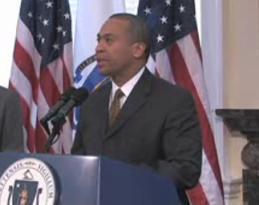
WESTPORT, MA – Gov. Deval L. Patrick revealed today that he is attempting to obtain federal funding sooner than originally planned for construction of the South Coast Rail project, which would bring commuter rail service from Boston to Fall River and New Bedford.
Speaking at the 2009 South Coast Legislative Luncheon at White’s of Westport, the governor assured the more than 300 people present that plans for the rail project are continuing to move along and his office is now in the process of presenting the alternative route analysis to the federal government.
Seifert Systems Invests in Energy Efficiency to Strengthen Operations
For manufacturers, energy is more than just another operating expense. It plays a critical role…
Learn More
Departing from his prepared remarks, Patrick told the audience that he hopes to get funding “sooner than thought” and “there’ll be more news on that when we have it.”
After his speech, during an impromptu news conference with the media, Patrick at first declined to elaborate, but then said he is attempting to meet with U.S. Reps. Barney Frank, D-Fall River, and James McGovern, D-Worcester, “to talk about whether there is a strategy and what that strategy is” to identify federal funding sources for the rail project. “We’re looking for ways to make the South Coast Rail project a reality sooner rather than later,” he said. No date has been set for his meeting with the congressmen.
Patrick noted that the federal recovery bill does include competitive grants for rail projects, but he said he expects Amtrak to get much of it.
Three alternative routes have been proposed for the South Coast project, although one would involve rapid bus service rather than rail. Timing and cost depend on which route is chosen: rail through Attleboro would cost more than $2 billion with a startup date of about 2020; rail through Stoughton would cost about $1.4 billion and begin in 2016; and the bus service would cost $500 million, with a starting date also in 2016. Terminal points for all three routes would be Fall River and New Bedford, although the Stoughton proposal includes an option to serve part of Taunton.
The state is expected to announce its preferred route around Labor Day as part of the draft environmental impact report. Final selection is scheduled for spring 2010 when the final environmental report is done.
The legislative luncheon was sponsored by the Fall River Chamber of Commerce and the New Bedford Chamber of Commerce.
In other news, Patrick said the state has identified a $156 million budget shortfall in the current fiscal year “because tax receipts continue to decline,” with the possibility of an additional $400 million shortfall by June 30. “The road ahead continues to be full of challenges,” he said, but he held out hope that “because all economies are cyclical, we will cycle out of this downturn.”
He noted that between October and January, state government identified and closed $2.5 billion in budget gaps caused by declining revenue. “We have cut programs in every area except K-12 education,” he said, “and laid off 1,000 people with more to come.”
However, funding remains available for important economic development projects in the Fall River and New Bedford regions.
Assuring the audience that he cares about the South Coast – “I know that in the past you’ve felt that state government stops at [Interstate] 495,” he said – he noted that his office on Thursday announced $2.6 million in Growth District Grant funds for rehabilitation of streets to support the Fairhaven Mills redevelopment in New Bedford. The mills, part of a 14-acre development, will be converted to office and retail use.
In Fall River, Patrick noted, less than two weeks ago the Fall River Industrial Park was named a Growth District and, with the help of state Sen. Joan Menard and the local legislative delegation, $2 million in Growth District Grants will go to improve Riggenbach Road. The road improvements will facilitate development of the University of Massachusetts Bioprocessing Center, which will serve as an incubator for small life-sciences companies in the South Coast region, Patrick said.
The state Seaport Advisory Council has allocated more than $11.5 million to fund projects in New Bedford and Fairhaven during the last two years, Patrick said, including grants to develop waterfront tourism and the historic ports initiative.
Thursday’s appearance at the legislative luncheon marked the second time in as many days that Patrick has been to the South Coast. He went to New Bedford on Wednesday to announce $25 million to $35 million in new federal funding through the American Recovery and Reinvestment Act of 2009 for cleanup of the New Bedford Harbor Superfund site. When asked about the repeat visits during the impromptu news conference, Patrick said people should not be surprised. “I’m governor of the whole state,” he said.