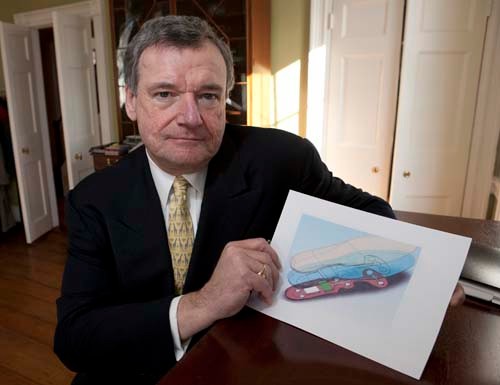
A long-time Providence health care consultant is working to develop vibrating inner soles to help the elderly better maintain balance. It’s a product he hopes to have manufactured in Rhode Island and first sold in the United Kingdom.
Steven Metzger, president of Phoenix Medical Technologies LLC, expects to eventually create 86 direct new jobs by 2015 in Rhode Island, consisting mostly of salespeople to market the product once it becomes available in the United States as well as those involved in manufacturing and assembly.
“I am planning to use Rhode Island companies to manufacture as much of the insole and bay [battery-charging] station as I can,” said Metzger, who in November received a $100,000 tax credit from the R.I. Economic Development Corporation board of directors. He said he is currently in negotiations with potential manufacturers, but declined to identify them.
The innovation tax credit offers investors up to a 50 percent credit on eligible investments in small businesses, with a maximum tax benefit of $100,000. To be eligible, companies must have less than $1 million in annual revenue.
Christine Smith, executive director of the R.I. Science & Technology Advisory Council within EDC, explained why Phoenix received the tax credit.
“Phoenix is the type of venture that the Innovation Tax Credit is designed to assist: a high-growth, high-potential company that can attract angel investors and serial entrepreneurs as partners in building our economy,” Smith said.
James Collins, a professor of biomedical engineering at Boston University, made the initial ground-breaking discovery that low-level noise, “so subtle you can’t even feel it,” actually improves the performance of sensory nerves, such as those in the feet, Metzger said. “Best estimates are that 25 percent to 40 percent of the information your brain needs to make your body walk comes from feeling pressure on the bottom of your feet,” he explained.
The vibrating inner soles, placed inside shoes, can so improve balance that “a 75-year-old can perform like a 35-year-old,” Metzger said, citing recent clinical studies. Collins presented his findings during a Providence researchers’ conference in August.
A now-defunct Providence technology company, Afferent Corp., took Collins’ work and over the course of eight years (2000 to 2008) tried to develop vibrating inner soles for the American market, conducting about 15 clinical trials and raising about $10 million in venture capital and research grants.
“I’ve always been a fan of technology,” said Metzger, who worked for Afferent for several years in the early 2000s, “so I decided I’d like to pick up [the project] and see if I can run with it.” That’s why he named his firm “Phoenix.”
“I’m trying to pull superb technology from the ashes of Afferent,” he said.
The noise created by the vibrating inner soles is so “subtle,” Metzger said, that the average person cannot hear it. But the sound does stimulate foot nerves so a senior citizen would need to use less of his or her own energy to fire those nerves to walk and retain balance. An early Afferent prototype had problems because the battery was too big and the soles too thick to fit easily inside shoes.
Metzger for the last 18 months has been working to iron out these and other difficulties, using his own money because he could not find an investor willing to take a risk on his startup. But he is confident that, once a prototype is developed within the next five to six months and he is able to market the product in the United Kingdom, he will find opportunities for further financing.
The inner soles would be regulated medical devices, available over the counter in the U.K., if approved. Before he can go to market there, he needs approval from the United Kingdom’s equivalent of the U.S. Food and Drug Administration, the Medicines and Healthcare products Regulatory Agency.
Metzger said when he weighed three key market attributes the U.K. process won out because it is quicker (than the U.S.), provides more reimbursement to suppliers than Medicare and allows sales over the counter, rather than by prescription, as required in America.
“I will be able to show the national health care system [in the United Kingdom] that [the soles] would save them long term … roughly three times the amount of what the device would cost,” he said. The price of a pair of vibrating insoles would be about $225 to $250, he said. •