
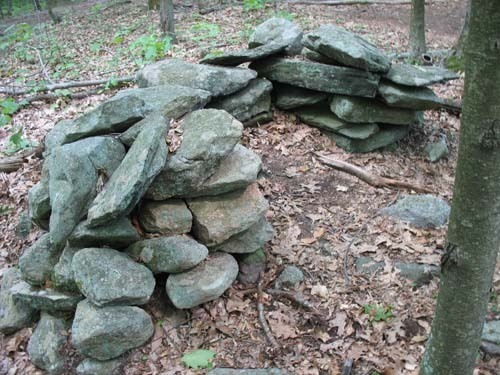
A fierce battle is being waged in the courts over a hitherto obscure corner of North Smithfield, a place where American Indians warred with Colonial settlers over ownership of the land more than 300 years ago. Today the dispute is preservation versus progress, but property rights remain at the core of the case.
The Town of North Smithfield has filed suit in Superior Court, seeking a declaratory judgment to protect and preserve what may be hundreds of American Indian burial grounds dating from at least the 17th century. Mounds of rocks about 2 feet tall, which may mark American Indian graves, are located at the proposed Rankin Estates, a development of 120 single-family homes on 264 acres in the northwest corner of the town.
There are at least 390 rock mounds in the vicinity, according to Donald P. Gagnon, chairman of the North Smithfield Conservation Commission, and there could be as many as 400 or 500. The mounds are situated both on the site where Rankin Estates would be built and on nearby properties. “We have more than enough proof to say these are Native American burial sites,” Gagnon said. “Based on history and on what we have documentation on, we have good reason to believe that what we have is the real thing.”
The attorney for the developer, however, maintains the mounds are piles of rock left by farmers clearing the land centuries ago and the town is trying to stop his clients from building anything at all on the site. Michael A. Kelly, a Providence attorney representing the developers, spoke dismissively of “rocks strewn about the property.”
“Where’s the evidence they are burial grounds?” he demanded.
There is no solid evidence. No human remains have been unearthed anywhere in the vicinity. However, history tells us that this area near Nipsachuck Swamp was the scene of two bloody battles during King Philip’s War, a conflict between English settlers and American Indians that threatened much of southeastern New England in 1675-76. King Philip was a Wampanoag leader also known as Metacom.
On behalf of the town, Frederick F. Meli, lead archaeologist with Archaeological Services and Consulting in North Kingstown, did a walk-through survey of the area in June of 2007 and concluded that the mound piles he examined “fit the criterion defined to identify ancestral indigenous burial grounds” and “were not associated with farming and/or wall construction.”
Kelly, representing developers Narragansett Improvement Co., Rankin Path LLC and USB Realty LLC, countered with his own archaeological survey. In 2000, he said, experts at the Public Archaeology Laboratory in Pawtucket examined the “alleged rock piles” and concluded they had nothing to do with burial grounds. He took aim at Meli, challenging the credentials of the North Kingstown archaeologist who, Kelly maintained, “has never designated any Indian burial grounds in his life.”
Contacted last week by Providence Business News, Meli was cautious in his remarks. He said there is “no absolute proof” to identify the mounds as graves, and his job simply was to report to the town any “suspect” features he felt could be of historical significance. Questioned about a triangular rock he found that he had said in published reports may be a Manitou stone, a marker American Indians used at sites of spiritual importance, Meli said his theory is “not accepted by everyone.” He was careful to say that the artifacts he examined were not taken from the proposed site of Rankin Estates, but came from abutting property.
Meanwhile Kelly, on behalf of his clients, has sued the Rhode Island Historical Cemetery Commission, charging that Chairwoman Evelyn Wheeler exceeded her authority by unilaterally designating certain sites in the Rankin Estates area as historical cemeteries without giving developers an opportunity to be heard. “It’s outrageous,” Kelly said. “They go on our property, they don’t tell us, they don’t do a study like we did, they just walk by. There was no commission meeting, there was no vote, there are no rules or regulations to use as standards on which to make a determination of this kind.”
Attorney Patrick J. Dougherty, special counsel for North Smithfield in this case, defended the cemetery commission as a “state body” that was “certainly within its rights” to identify historical burial grounds. He pointed out that local deeds specify several Colonial-era burial plots and numerous rights of way crisscrossing the proposed Rankin Estates site, as well as the remains of a pre-Colonial village. The developers, he said, had a legal obligation to identify all such features in their plans, but ignored them. The second part of the town lawsuit seeks to protect the rights of way.
The town planning and zoning boards have issued rulings against Rankin Estates that Kelly is challenging in court. Dougherty and North Smithfield Assistant Town Solicitor Robert V. Rossi say the design plans are fundamentally flawed, showing, for instance, retention ponds at the highest points of the subdivision. Town officials also are worried about what they say will be an exorbitant amount of gravel removal at Rankin Estates, but Kelly maintained the only excavating will be “in conjunction with putting in the roads.”
Dougherty flatly dismissed the notion that the town is out to stop the development. “The town wants to protect and preserve the burial grounds, if that’s what the court determines them to be,” he said. “It is patently untrue to say the town wants to block development of the site.” No hearings have been scheduled yet in Superior Court, according to Dougherty, who said he expected the case to be settled in about one year. •











Those “clay balls” in the photo accompanying your article are simply children’s marbles. Before glass marbles were affordable, children in the US played with commercially-made clay marbles. You can find them in almost any antique store. They are certainly not proof in any way of Native American habitation or burial.
According to a history of marbles at http://www.centralconnector.com/GAMES/marbhist.html, Clay marbles such as the ones in the photo began to be produced commercially in bulk around 1870.
Mr. Dan of Tempe:
Any first year archaeology or anthropology student knows that a research url without an edu at the end is worthless, as is your information. If you knew anything about Native American burials and or archaeology in general your comments might be worth the effort of reading them. However, since you seem to know very little about habitation and ritual items associated with a potential grave site, I would leave the study of grave sites to the archaeologist, and not amatures.