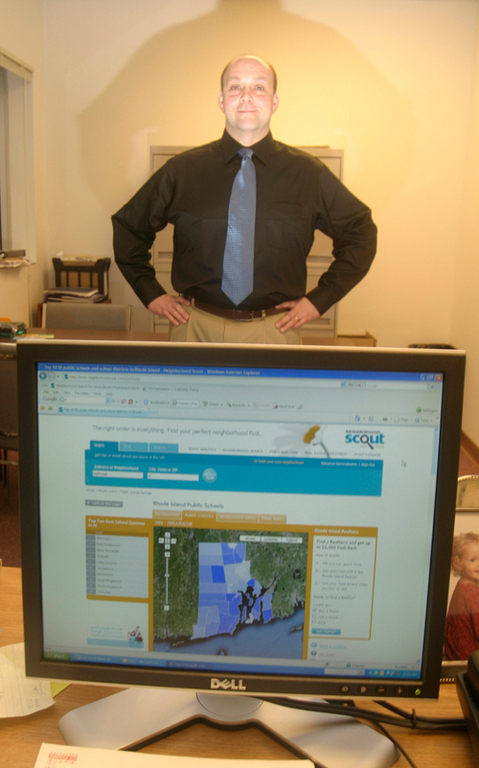
There are few things about which communities are more sensitive than the quality of their public schools. So when NeighborhoodScout.com, the locality-comparison Web site developed by Woonsocket-based Location Inc., created its first-ever lists of the nation’s 100 best and worst schools, the reaction was swift and sharp.
“I guess it’s human nature – the schools that did poorly are grumpy and the schools that did well like it,” said Andrew Schiller, Location Inc.’s founder and CEO.
Schiller put together the rankings by creating an algorithm, which he plans to patent. It uses each state’s student passing-rate on the National Assessment for Educational Progress test, which is uniform across the country, to standardize the testing results that individual schools report as part of the No Child Left Behind law.
“It’s elegant,” Schiller said, because the algorithm controls for the different No Child Left Behind tests used in each state.
The results proved controversial. The most defensive response came from education officials in South Carolina, which had the unfortunate distinction of being home to nearly 40 of the schools on the Worst 100 list.
The South Carolina Department of Education fired back at Schiller in a memo sent to superintendents across the state, which called his methodology “simplistic,” and said the school rankings were “primarily a marketing tool … as opposed to any serious ranking of education performance using tried, verifiable research methods,” a local newspaper, The Aiken Standard, reported.
“I know what it feels like now to show up on the cover of a tabloid due to bad information,” one superintendent of a district that had a school on the list told the Spartanburg Herald-Journal. He pointed out that just eight out of more than 850 students at the school in question had taken the standardized test on which the rankings were based.
The rankings made their biggest splash in the Palmetto State, but they stirred discussions in Chicago, St. Louis, Phoenix, Los Angeles and other cities as well. Massachusetts placed the most schools on the Best 100 list, while none of the schools in Rhode Island made either list.
Schiller dismisses his critics as engaged in shooting the messenger. He pointed out that states and the federal government also use the National Assessment for Educational Progress for comparison purposes.
“In Phoenix, they were defensive because, year-over-year, they had improved,” he said. “But if I get an F-, and then in the next quarter I get an F+, that doesn’t mean you’re an A student.”
If education officials don’t like his findings, Schiller added, they ought to work on improving their schools and their test results. Instead, he said, “They tried to discredit me.”
Despite the controversy, the school rankings proved to be a bonanza for NeighborhoodScout. On March 10, the day the list was highlighted on the main page of AOL.com, the NeighborhoodScout site had 49,193 unique visitors – more than it had over the entire month of August last year, when a redesign was launched. For the full month of March, the site’s traffic jumped to 228,283 unique visitors – up from 166,005 in February – and 1.2 million page views.
The school rankings were created as part of a deal Schiller has signed with AOL to provide the portal with original research from his database. This month, the site featured Schiller’s list of the most family-friendly neighborhoods in each state. (In Rhode Island, it was Nichols Corner in East Greenwich.) Next month he will showcase “blue-chip neighborhoods,” those which have bucked the housing-price decline. •