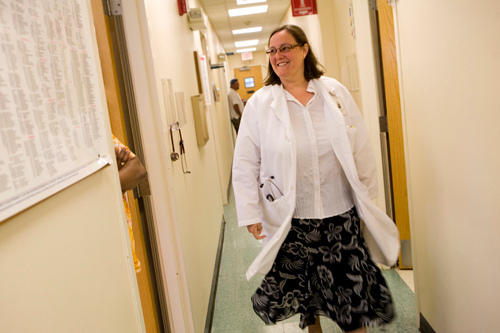
As the recession started taking hold months ago, Dr. Sarah Fessler thought the community health center where she serves as director would start to see an influx of patients.
East Bay Family Health Care in East Providence provides medical attention on a sliding fee scale based on income, and the center is willing to work with patients to settle medical bills, in some cases charging as little as $10 for an office visit.
But the number of people coming in for primary care has dropped off significantly in the previous year, Fessler says.
“I thought we’d be immune to the recession,” Fessler said. But even with the center’s sliding fee scale, she added, “People don’t even want to pay that right now.”
Fessler’s observations match the findings of a recent survey conducted by the American Academy of Family Physicians (AAFP) that reveal that doctors nationwide are reporting more canceled appointments, and they are seeing more patients with advanced health problems as the result of forgoing preventative care.
The physicians group is blaming the hard economic times.
With money growing tight, some patients don’t want even to pay the deductible for office visits. A growing number have lost their employer-sponsored insurance coverage all together as a result of layoffs.
“Patients are canceling or deferring important preventative screenings such as pap smears, mammograms and colonoscopies,” said Ted Epperly, president of the Leawood, Kan.-based AAFP. “They also are failing to return for recommended follow-up visits or to refill medications that are vital to managing their chronic conditions.”
Some patients are cutting prescribed pills in half, without their doctor’s knowledge, to make their medicine last longer, Epperly said.
Low insurance reimbursement rates have already strained some family-doctor practices in Rhode Island, and the diminished ability of many patients to pay their bills is adding to the financial pressure.
With younger doctors choosing better-paying specialties, retiring family physicians are not being replaced.
That said, McHale says, many family doctors still are willing to work out pay arrangement with patients, particularly long-time patients.
“But to many people it feels like charity,” McHale said. “It’s embarrassing to them. They feel like they don’t need charity, that they’re just going through a rough patch.”
The national online survey found that 66 percent of 505 family physicians who responded have cut their fees in the last year, increased charity care, provided free screenings or moved patients to generic prescriptions.
Other results from the survey released late last month include:
• 73 percent of the doctors said they have seen an increase in the number of uninsured patients.
• 64 percent said the number of employer-sponsored or privately insured patients has declined.
• 87 percent reported a significant increase in patients exhibiting major stress symptoms.
Fessler, president of the Rhode Island Academy of Family Physicians, says the results match the anecdotal reports she’s been hearing from doctors across the state.
Among those patients in particular, Fessler has seen a clear increase in stress-related illnesses. “They’re depressed and they don’t know where to turn,” Fessler said.
That’s why East Bay Family Health Care recently stationed a staff member in the waiting room who can connect patients to other social services. So far, Fessler said, that staffer has been overwhelmed with inquiries.
Yet one program designed to make primary care accessible to the uninsured has been slow to pick up participants.
HealthAccessRI, a program developed by a group of physicians more than a year ago, offers primary care for $25 to $30 a month, plus $5 to $10 per office visit.
“I thought [the number of participants] would go through the roof in the recession,” said McHale, who is executive director of HealthAccessRI, along with her duties with the Academy of Family Physicians. “But I think people are afraid to make the commitment right now, and take away from paying for things like food.”
Choosing to put off a doctor’s visit because of money concerns might be more costly in the long run, Fessler says.
“A lot of [unemployed] folks are putting off [making appointments with doctors], thinking they will go see the doc when they get another job,” Fessler said. “I think it’s going to catch up with them.”
But she said she’s already seen patients with ailments in advanced stages that could have been diagnosed and treated earlier. •