
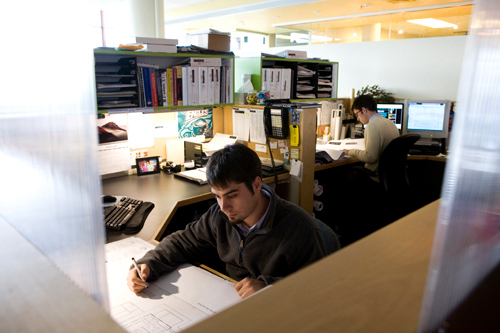
With the overhead lights switched off during daylight hours last month in Vision 3 Architects’ Providence office, the firm relied instead on natural light.
“Some people do have desk lamps and, if you saw our office, we do have full windows on the north wall, west wall and east wall,” Principal William E. Gray said during the last week of the month-long experiment.
The firm also turned off its automatic fans and inched the thermostat down. Since the firm’s 10,000-square-foot office has 12-foot ceilings, it has been “a little cooler,” said associate Paul Castellone.
“But we have layers,” Gray joked.
Those changes were part of an “energy-use analysis” intended to help the firm create a benchmark for how little energy it can use in a month. The effort also included reusing scraps of paper, buying recycled office supplies and reducing energy used by the firm’s computers by having them hibernate when not in use for 15 minutes.
“We’ve separated and looked at about a half-dozen different areas of our business to evaluate critically – what we do and how we do it,” Gray said. When the firm’s February energy use is calculated, the team that’s been assigned the project – internally dubbed “Gang Green” – will compare those statistics with January’s regular-use figures.
Of course, Vision 3 isn’t the only business that is becoming concerned with its carbon footprint. Gray said the firm’s motive in reducing its energy use is in part a step toward being able to bring an expertise to clients, many of whom expect their projects to be as sustainable and “green” as possible.
“More and more of our clients are coming to the table now demanding responsible design and responsible decision-making with respect to being good stewards of the environment,” Gray said.
One of those clients is Pawtucket-based Collette Vacations, which hired Vision 3 to design its under-construction Canadian office outside Toronto. That building will be a Leadership in Energy and Environmental Design (LEED) Gold building under the Canadian Green Building Council standards. For that 8,000-square-foot building, Collette opted to spend about $100,000 extra for a geothermal heat pump. That involves drilling 12 wells in the parking lot to use the earth’s natural heat to warm the building.
“They’ll realize the savings within eight years and the system will last for 20 years,” Castellone said. “That’s compared to a conventional system, which might only last 10 years before they’d have to replace it.”
Studying energy use in business has become important in academia in recent years, said S. Bradley Moran, an oceanography professor and assistant vice president for research at the University of Rhode Island. That’s why Moran last year started a new master’s degree in oceanography that’s coupled with an MBA program.
“The idea is that there are many green MBA programs floating around [that advocate] corporate responsibility,” Moran said. “This flips the model around – we’re taking science and engineering students who want a bridge over to the business world.”
Because the program is based in studies of the world’s climate and the ocean, URI dubbed the program “The Blue MBA.”
“You can go to the top-tier schools and they’ll have a green component, but when you break them down, they’re really about corporate responsibility,” Moran said. “They’re not getting the grounded, true-science background” that URI offers.
And Moran has been part of the approximately 15-member URI council that was created in 2008 when URI joined the American College & University Presidents Climate Commitment. In that role, he’s calculated the university’s annual carbon footprint dating back to 1997. Since 1997, the kWh consumption has risen by about 80 percent to more than 60 million kWh per year. The university’s annual energy costs exceed $12 million.
Commuter fuel usage rose 16 percent in the same period, to more than 2 million gallons of gas annually, according to Moran’s report.
URI Vice President of Administration Robert A. Weygand said that’s why one of the council’s first major initiatives has been looking at transportation around the Kingston campus. Last month, URI instituted a new R.I. Public Transit Authority shuttle service to Wakefield and South County Commons in South Kingstown.
“That’s so students don’t have to take their cars off campus to go shopping or go to a movie or go to a restaurant,” Weygand said. “That helps enormously for them financially, but also for our carbon footprint.”
The school is also gearing up to unveil a biodiesel fuel program that will use waste from dining halls to fuel much of the university’s diesel-vehicle fleet.
He added that an overall sustainability plan is now being created for both the university’s facilities and academic curriculum. That includes certifying all new buildings as U.S. Green Building Council LEED projects. (Vision 3 designed the university’s new LEED Silver Hope Dining Hall.)
“Because we are a flagship research institution, all of the issues of research and education that are wrapped into the issue of sustainability are very important to us,” Weygand said. “The issue of climate change is particularly important to us at the university because of the amount of facilities that we have here. We have over 15,000 students and almost 3,000 faculty and staff members. We are a large community in one location.”
Weygand added that the university has the “responsibility” to reduce its carbon footprint, but it’s also an opportunity to reduce some amount of cost.
And Vision 3 Architects this month will calculate the difference between its lowest possible monthly energy bill and what it had been spending. And, like URI, it’s an effort to lower energy use until it becomes “business as usual,” Castellone said.
Gray added, “We’ll take this as a benchmark going forward to implement some other changes.” •










I am very pleased with the thought and don’t feel like adding
anything in it. It a perfect answer.
——————————-
financial service