The nation’s economy will worsen unless the federal government takes strong action to resolve the foreclosure crisis and help prevent hundreds of thousands of families across the country from losing their homes, according to U.S. Sen. Jack Reed.
“To date, the Bush administration’s voluntary efforts are not working,” Reed said. “If we don’t take more dramatic action to resolve the housing crisis, it becomes the most significant economic issue facing our nation and, until the housing market is stabilized, our economy is going to continue to fall.”
Reed, a senior member of the Senate Banking Committee, played a major role in the committee’s recent passage of the Federal Housing Finance Regulatory Reform Act of 2008, designed to help as many as 500,000 homeowners avoid foreclosure. But the Rhode Island Democrat, in a recent telephone interview from his Washington, D.C., office, said strengthening the economy is just as important.
As an example of how critical the housing industry is to the nation’s economy, Reed pointed to the fact that automobile sales are low. He suggested that many homeowners cannot use home- equity loans for such purchases as they have in the past. Auto-industry experts expect 2008 sales to drop to 15.5 million new vehicles, the worst showing in more than a decade.
Reed also noted how detrimental foreclosures can be to a neighborhood, with one often followed by a string of others as vacant buildings further exacerbate the overall decline in property values. “This is the right thing to do,” he said of resolving the housing crisis, “not only for homeowners, but for the economy.”
The measure that the Senate Banking Committee passed May 20 on a 19-2 vote would help as many as 500,000 mortgage-holders with escalating monthly payments obtain 30-year, fixed-rate loans insured by the Federal Housing Administration (FHA).
Although the Senate legislation would expand FHA eligibility requirements, Richard Godfrey, executive director of Rhode Island Housing, expects that few Rhode Islanders would qualify. “Many of the people we see are so far into trouble that no refinancing plan would help them,” he said. The foreclosure crisis is more severe in Rhode Island than elsewhere, Godfrey said, because “Rhode Island is the least-affordable place to live in the country, and the predatory lenders saw that our state was ripe for the picking.” His agency, Godfrey said, takes an individual approach to provide “immediate support and help relieve the suffering of those who cannot refinance.”
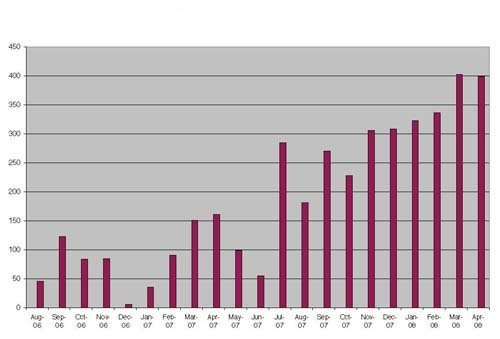
In April there were 399 foreclosure initiations in the state, with 55 percent, or 218, in Providence alone, according to Rhode Island Housing figures. This compares to approximately 155 statewide in April 2007. In the last year, 3,192 properties received notices for foreclosure.
An April report by the Pew Charitable Trusts has Rhode Island leading the pack in New England, with one in every 31 homeowners expected to experience foreclosure and more than half of all homeowners – 56 percent – likely to feel ripple effects such as deteriorating neighborhoods or decreased property values. Massachusetts ranked second, with one out of every 48 homeowners directly affected and 39 percent indirectly.
Rhode Island’s ten urban cities represent nearly 74 percent of subprime loans in the state, of which 91 percent are owner-occupied, according to December data provided by Rhode Island Housing. Nearly 70 percent of the owner-occupied subprime loans in urban areas have adjustable rates, and an average of 35 percent of these were at least 30 days past due or in foreclosure as of December. Again, Providence leads with about 1,400 subprime loans versus about 550 in Warwick, the second-place city.
The Senate bill would require lending institutions to refinance a mortgage at 90 percent of the appraised property value. Their incentive would be the certainty of FHA insurance. “The banks would have to accept some loss,” Reed said, but he noted the loss would be greater if homeowners default and banks are left with foreclosure costs as well as vacant properties of decreasing value. The housing bill is expected to generate $300 billion for refinancing.
Reed was willing to postpone full implementation of a longtime pet project of his, a dedicated source of federal funding for affordable housing that would be shared by all 50 states.
Under the Senate bill, at Reed’s instigation, the mortgage giants Fannie Mae and Freddie Mac would pay a small fee (less than a half-cent on each new dollar of business) into a permanent fund for affordable housing, expected to total $500 to $900 million a year.
In negotiations with Senate Republicans on the banking committee, Reed agreed that this money for the first three years could be used to pay the estimated $1 billion cost of the refinancing program, so taxpayers do not have to absorb it. This compromise, Reed’s aides say, allowed the refinancing measure to move forward.
Godfrey praised Reed’s efforts to reform the government-sponsored enterprises (GSEs) Fannie Mae and Freddie Mac and, in particular, the establishment of a permanent trust fund for affordable housing. “It’s about time the GSEs return money to Main Street, America, as opposed to serving Wall Street,” he said.
The state housing director made it clear that he supports the Senate bill, even if its impact in Rhode Island turns out to be limited, because “Congress needs to act” to resolve the housing crisis, he said. “I hope the Senate, the Congress and the president can agree on a housing bill.”
Time will tell. The full Senate was expected to consider the refinancing bill in the first week of June. Differences with a House bill sponsored by Rep. Barney Frank of Massachusetts would then have to be reconciled, but supporters say the final legislation should be ready for the president’s consideration in early July. •