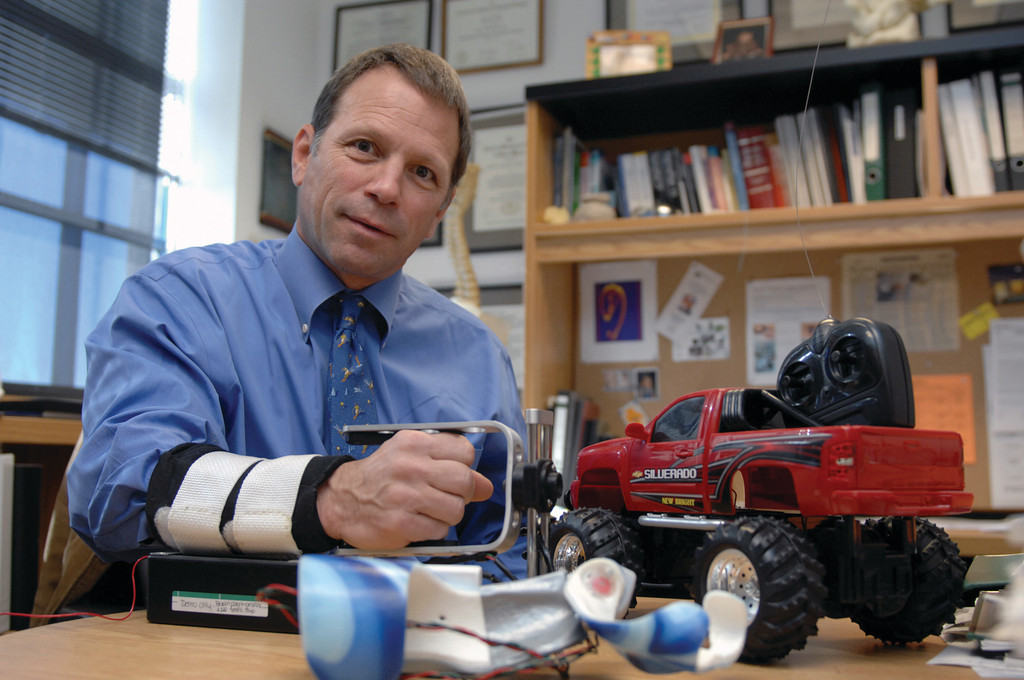
Researchers associated with Lifespan and Brown University hope to conduct clinical trials next year for a device that will allow disabled children to exercise arm and hand muscles while playing with remote-controlled toys, a supplement to usual physical therapy treatments.
Joseph “Trey” Crisco, a Lifespan employee affiliated with the Department of Orthopedics at the Warren Alpert Medical School at Brown University, said clinical trials involving as many as 200 children are “the next big step” in a development process that began with research and conceptual work in January 2007.
The idea behind the therapeutic toy controller, Crisco explained, is that playing with toys would provide the motivation for disabled children to exercise upper extremities at home in a way that is generally more appealing than physical therapy in a clinical setting. “The goal here is to use play as a motivator,” he said.
A $20,000 grant from the Innovation Providence Implementation Council awarded this year allows work on the project to continue while researchers await word on a request for additional funding from the National Institutes of Health. The federal health dollars would be used to prepare for the clinical trials, Crisco said. He declined to speculate on when the device might be ready for the marketplace.
Children afflicted with cerebral palsy in their upper extremities are the largest group that could use the device, Crisco said. “They’re the biggest group we’re looking at right now,” he said. But he noted that “any child who needs physical therapy” for the arms or hands due to a brain injury or other illness could benefit from a therapeutic toy controller as well. He stressed that the toy controller is intended to augment rather than replace physical therapy.
The electronic device replicates the switches found on a remote-controlled toy that a child usually can control with fingers and thumbs. In the case of a child with cerebral palsy, movement of fingers and thumbs can be difficult. Yet, continual exercise of the hands and arms is necessary so that the child’s muscles do not become too stiff to move at all, Crisco explained.
There are all sorts of remote-controlled toys on the market today, in the form of bugs, stuffed animals, cars and trains. Crisco said his device can be used “on any available [remote-controlled] commercial toy that we’ve worked out an agreement with.”
Rather than develop their own toys or adapt regular toys to remote-controlled usage – a process Crisco said would be far too expensive – researchers are teaming with commercial toy makers so the device can be adapted to as many existing toys as possible, Crisco said.
Cooperation with toy manufacturers is essential because, he explained, each company must provide researchers with “the electronic protocol” for operating its toys. “The challenge is getting the electronic part of the brace built and developed,” he said. “We’re working on four or five different types of toys now.”
Crisco is working with one toy-making firm in the area, but said research agreements prevent him from publicly identifying it. He said the company is donating the time of its engineers and other employees to work with researchers on the therapeutic toy controller.
Also working with Crisco on the project is Dr. Karen Kerman, a pediatric neurologist affiliated with Lifespan and the Brown medical school. If clinical trials prove successful, and the device eventually is marketed, Crisco said his plan is to form a company separate from Lifespan to handle business associated with the toy controller.
Funding is needed to build more devices for the trials and to streamline design of the five prototypes already built, which he said are “heavier” and “more clunky” than researchers would like. He said he expects to see “positive results” during the first six months of what will be yearlong trials.
The project also has received funding from the R.I. Science & Technology Advisory Council, based in Providence.
The council, working under the umbrella of the Greater Providence Chamber of Commerce, is charged with measuring progress and driving strategy for development of Rhode Island’s knowledge economy. The group sets the agenda for moving the knowledge economy forward, distributes grants through a formal process and works to help jump-start projects that will expand key industries and nurture the entrepreneurial spirit of the city and state.
Constance A. Howes, CEO and president of Women & Infants Hospital in Providence, who chairs the council, said Crisco’s project is an excellent example of the kind of “innovation and collaboration” that the panel seeks to support.
Funding comes from Providence, the federal government and the Chamber.
The council intends to spur further innovation in related areas by funding such research work, she said. Crisco’s project also involves two of the economic-development sectors that the council has targeted for financial support, she noted, health care and design.
“People need to realize the value to this community of having the medical facilities and the universities here,” she said, “because they bring bright people – and bright people bring bright ideas.” •