PROVIDENCE – The Rhode Island business community remains largely optimistic about the state’s economic future, although a real-time survey taken Wednesday morning shows the bullish attitude could be slowing.
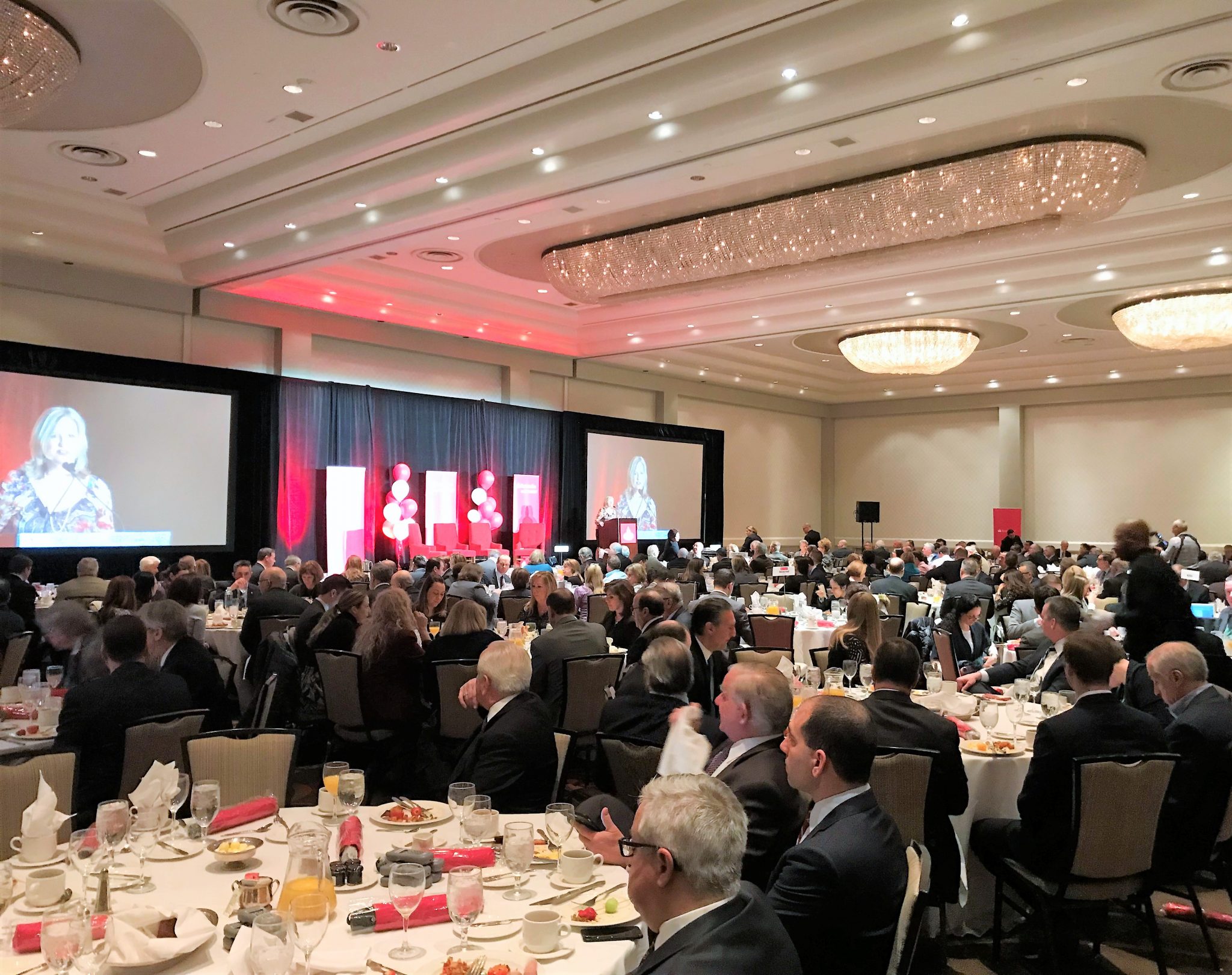
Nearly 300 members of the local business community were invited to participate in the survey during an annual economic-outlook breakfast hosted by Santander Bank and the Greater Providence Chamber of Commerce.
Your Business Has Gone Global. Has Your Insurance?
A decade ago, “doing business internationally” was mostly a large-company concern. Today, a manufacturer in…
Learn More
Nearly two-thirds of the respondents – 64.6 percent – said they believed the Rhode Island economy would improve over the next year. The sentiment was echoed by Chamber President Laurie White, who said the overall business climate has improved in the state, especially for small-sized companies.
“Improving the conditions for small businesses is really essential, and we’ve made great strides on that,” she said, highlighting a recent Business Insider report that ranked Rhode Island’s economy No. 9 in the nation.
The survey results, however, show the optimism could be slowing.
The 64.6 percent of favorable respondents represents a near-20 percentage point decrease from 2017 results, which totaled 82.1 percent.
The survey is not scientific, but White said it helps show in real time the thoughts and opinions of the business community.
The results of the impromptu survey were not quite as optimistic as the recent PBN Winter 2018 Business Survey, in which nearly 73 percent of respondents said that they expected the Rhode Island economy to improve in 2018.
The trend of slowing optimism about the state’s economy, however, was not replicated when business owners were asked about themselves. About 74.7 percent of respondents expected their businesses to improve over the next year, representing a 6.1 percentage point increase compared with prior-year results.
Mike Lee, head of commercial real estate at Santander, echoed the bullish sentiment, saying the Spanish-owned bank has grown its workforce locally under the Gov. Gina M. Raimondo administration. Raimondo was scheduled to speak at the event, but was waylaid by winter-storm preparation.
Lee, a native Rhode Islander, hosted the 18th annual event at the Omni Providence Hotel. He was encouraged by the overall survey results, but stressed there’s always more that can be done.
“We all have an opportunity to do more,” he said. “We can all play a bigger part in the economic success of Rhode Island.”
The event included a panel discussion, comprising Maureen Boudreau, director of the Healthcare Technology Center at Johnson & Johnson, Kelly Coates, president and chief operating officer at Carpionato Group LLC, and James Karam, president and CEO of First Bristol Corp.
Carpionato Group recently acquired the properties formerly owned by Benny’s, a popular Rhode Island-based retailer that shuttered last year. The developer announced it would invest $100 million into redeveloping the buildings, and has already signed 75 tenant leases. Coates declined to get too specific, but said tenants would include banks, restaurants and supermarkets.
“We love food in all forms and shapes,” he quipped.
Carpionato Group, which is responsible for developing large portions of Route 1 in Attleboro and North Attleborough, is also working on a near-$240 million mixed-use project east of the Providence River in the former Interstate 195 land. Coates also said the company would officially unveil a near-500 apartment project on Harris Avenue in Providence next Thursday.
Boudreau, meanwhile, told attendees about how Johnson & Johnson is putting a major focus on the research and development of health care technology. The manufacturing giant last year opened a 75-person technology office in Providence, and was approved for about $5 million in state tax incentives.
Rhode Island, she said, is a good place to grow the company’s health care technology arm because there’s a strong and growing talent base. Boudreau is looking forward to the completion of the Wexford Science and Technology project, also in the I-195 land, so she can move her health care technology operations into the new space.
“We’re predicting that at the rate that we’re going that we’re going to need [the extra space],” she said.
Karam, whose company is building a hotel near the Citizens Bank headquarters in downtown Providence, said the growing number of hotels is a good sign for Rhode Island because “hotels don’t drive economic development, they follow it.”
He warned that occupancy rates and prices have recently started to flatten out in Providence, but suspects that could change again once the Wexford project is completed.
Karam compared the I-195 land to the Seaport District in Boston, which has boomed in recent years with development. To ensure Rhode Island can keep up with a talented workforce, however, Karam said the state needs to do a better job investing in the University of Rhode Island.
Nonetheless, he underscored, the perception of doing business in Rhode Island has improved in recent years.
“People in Worcester and Boston are asking us about Providence,” he said. “Developers are looking at this city and state in a positive manner.”
Eli Sherman is a PBN staff writer. Email him at Sherman@PBN.com, or follow him on Twitter @Eli_Sherman.