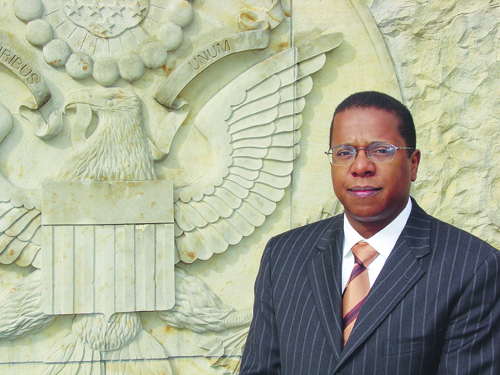
The free-trade agreement with Colombia that’s stalled in Congress would, if passed, benefit some Rhode Island companies, according to Brian A. Nichols, deputy chief of the U.S. Embassy in Bogota.
Rhode Island companies exported $4.3 million worth of goods to Colombia in 2006. “Just walking around in Bogota, the one company that I’ve seen, most frequently, with my own eyes has been GTECH Corporation,” said Nichols, a Providence native who was in the Ocean State last month.
Much of Rhode Island’s exported products in 2006 – the most recent year for which figures are available – were semiconductors, electrical switches and plastics and resins, Nichols told Providence Business News. And tariffs on those items entering Colombia ranged from 8 to 16 percent. “If the free-trade agreement comes into force, those tariffs would be reduced to zero. Most of that reduction would happen immediately,” he said. And that would likely increase Rhode Island’s exporting to Colombia, he said.
Citing 2004 statistics, Nichols said 112,000 Rhode Island jobs are linked to exporting. That’s nearly one of five jobs in Rhode Island, he said, and those jobs pay an average of 18 percent more than “comparable jobs that are not linked to exports.”
Since 2002, trade between the United States and Colombia has increased 118 percent, according to Nichols’ office.
The trade agreement is backed by President Bush’s administration, which completed negotiations during 2006 with the Colombian government, led by President Alvaro Uribe, who was elected during 2002.
In 2007, the Colombian Congress passed legislation endorsing the agreement and in April 2008, Bush forwarded the agreement to the U.S. Congress under the Trade Promotion Authority, allowing for the agreement to be fast tracked for a vote within 60 days.
On April 9, the U.S. House voted to remove that expedited timetable, essentially suspending the bill, Nichols said.
Much of the opposition in the United States to the agreement cites violence against organized workers in Colombia. The Washington, D.C.-based pro-union group American Rights at Work dismisses the free trade agreement, saying that the United States would in effect be supporting the brutal violence in Colombia against trade unionists.
The AFL-CIO Executive Council in March reported that more than 2,500 union tradesmen have been killed in the country since 1986 and that only 5 percent of workers in the country are unionized, with less than 1 percent covered by collective bargaining agreements.
Much of the violence in the country stems from two insurgent groups, the Revolutionary Armed Forces of Colombia, known at FARC, and the Army of National Liberation, or ELN, that have been battling the government for 40 years, Nichols said.
But there’s been progress in taming the violence and an agreement with the pro-American government would allow that progress to continue, Nichols said. The Bush Administration reports that, since 2002, kidnappings in the country have dropped by 83 percent and murders by 40 percent.
“One of the reasons that we, in the administration, firmly support the agreement is that it provides an economic development alternative for Colombians who historically have had a lot of challenges,” Nichols said, citing the country’s long history with violence and the cocaine trade.
The United States now has an agreement with five South American countries, including Colombia, called the Andean Trade Promotion and Drug Eradication Act. But that agreement has to be frequently renewed – it expires in February 2009 – adding to uncertainty in Colombia’s economy, Nichols said.
But with a presidential election coming up, the agreement with Colombia has the potential to become a polarizing political issue. “Certainly this is a very politically charged year and that makes it more difficult to pass any trade agreement,” Nichols said. “But this is the right thing to do for our country and for our national interests.” •