KINGSTON – “At this point, I believe Rhode Island is indeed in the early stages of a recession,” University of Rhode Island economist Leonard Lardaro wrote today in his monthly report on the state’s economy.
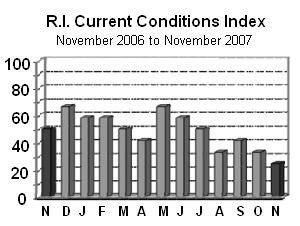
“November was another disappointing month,” as the Current Conditions Index plunged to 25 points, Lardaro said. The CCI’s level was the lowest since July 2001, although it still was 8 points above the all-time low of 17 points, registered in April 2001.
The CCI measures the strength of the Rhode Island economy, by following the behavior of 12 indicators; 50 points is the neutral value, with higher scores indicating the state’s economy is expanding while lower levels indicate contraction.
November’s six-year low followed readings of 33 points in October, 42 in September and 33 in August – and a neutral reading of 50 in July – that indicate the state’s economy has been contracting for four consecutive months. (READ MORE.)
“This is recession performance,” Lardaro wrote. “But it must be understood that recessions have stages. In the early stages of a recession – where I believe Rhode Island currently finds itself – the levels of indicators are not terribly different from those during recoveries.”
In later stages, “conditions continually deteriorate,” he said, until “eventually, a bottom is reached.”
For the nation as a whole, “if it is currently in recession – I continue to think it is not – recovery would begin in the second half of this year,” Lardaro added. But for the Ocean State, “the boost it gets from this improving national activity will be largely blunted by the necessity of dealing with a large budget deficit starting on July 1. Timing really is everything!”
Only three of the CCI’s 12 indicators improved in November: Private service-producing employment, which grew 1.2 percent compared with the same month of 2006; the state’s labor force, which grew 0.5 percent, accelerating slightly from the month before; and the average manufacturing wage, which surged 4.2 percent as the shortage of skilled manufacturing labor continued.
The unemployment rate – an indicator that had been improving for some time – worsened in November by 2.0 percent (rising 0.1 percentage points to 5.2 percent, from 5.1 percent in November 2006). “Expect this [trend] to continue for some time in the future,” Lardaro wrote.
Meanwhile, for the second month in a row, declines were seen in every one of the four components that serve as leading indicators:
• “Employment service jobs, which includes ‘temp’ positions, fell at a double-digit rate again in November (-11.4 percent), its fourth consecutive decline and a long way from the string of double-digit increases that extended from October 2006 through March,” Lardaro said.
• New claims for unemployment insurance “rose again – for the 11th time in the past 12 months – even after an econometric adjustment for recent changes in benefit eligibility by senior citizens.” The increase from a year ago was 12.9 percent.
• Single-unit residential building permits, a measure of new home construction, “fell by 29.8 percent compared to last November,” holding at the recent level of about 100 units per month.
• And the average manufacturing work week “fell again (by 2.2 percent),” as weakness in the sector moderated. “Manufacturing weakness in Rhode Island appears to be less severe than it is nationally at the present time.”
Also losing ground were the Reuters/University of Michigan Consumer Sentiment Index (-17.2 percent); benefit exhaustions, a marker of long-term unemployment (+13.1 percent); retail sales (-0.9 percent); and government employment (-0.8 percent).
The bottom line, Lardaro wrote, is that “the overall performance of the CCI and its leading indicators will not be improving anytime soon. Add to this a weak national economy, and the likelihood of our state being in a recession is even greater.”
Efforts to eliminate the budget deficit “will only exacerbate the length and severity of this recession,” he added.
The Current Conditions Index, created by University of Rhode Island economist Leonard Lardaro, measures the strength of the state’s economic climate. Additional information, including historic data, is available at members.cox.net/lardaro/current.