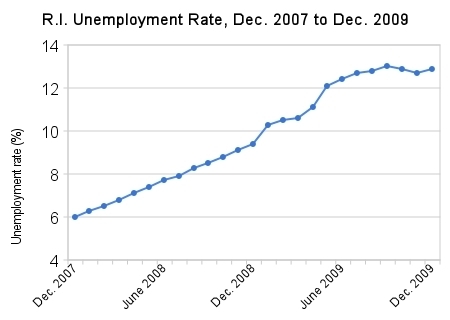
PROVIDENCE – After declining for two months, Rhode Island’s unemployment rate climbed two-tenths of a point to 12.9 percent in December, dampening hopes that the local job market was improving.
The number of unemployed Rhode Islanders rose last month to 73,500, an increase of 1,100, the R.I. Department of Labor and Training said Friday in its monthly jobs report.
Beyond Cash Donations: How New Forms of Giving Are Transforming Not-for-Profit Accounting
Evolving Funding Landscape for Not-for-Profits Not-for-profit organizations are being asked to do more with less,…
Learn More
The state’s average unemployment rate for 2009 was 12 percent, up from 7.8 percent in 2008 and double the 6 percent average in 2007.
While the national jobless rate held steady at 10 percent for the month, several other states reported a mixed picture.
Massachusetts’ unemployment rate jumped to 9.4 percent in December, up 0.7 point from a month earlier. In Michigan, which has long had the highest jobless rate in the nation, saw it decrease for the third consecutive month in December to 14.6 percent, a tenth of a point lower than in November. Not all states had reported their figures as of late Thursday.
In Rhode Island, the unemployment rate had retreated from September’s record high of 13 percent over the previous two months, and the number of unemployed residents had also declined. But in December, the numbers turned discouraging once again.
The Ocean State’s resident employment – the number of Rhode Islanders who hold jobs anywhere in the country – decreased by 1,400 in December to 496,800. The state’s labor force lost 300 people, shrinking to 570,300.
Non-farm payrolls statewide shrank to 453,800 – the smallest number of jobs since December 1997 – from November’s revised total of 455,100.
Moreover, average weekly claims for unemployment benefits surged to 41,430 in December, a jump of 14.2 percent – or 5,149 – from November’s average.
Rhode Island’s largest job losses in December were in manufacturing, which lost 700 jobs. Makers of jewelry and silverware made particularly large cuts, DLT said.
The state’s manufacturing sector lost 4,400 jobs last year, double the number lost by the second-hardest-hit industry, accommodation and food services, which shed 2,200 jobs, 500 of them in December.
Professional and business services also shed 700 jobs in December, as landscaping and janitorial companies laid off employees, DLT said. That sector lost 2,100 jobs in 2009. Losses were also reported in retail trade (200) and government (100) in December.
Meanwhile, five sectors added jobs: financial activities (300), transportation and utilities (200), “other services” (200), information (100) and arts, entertainment and recreation (100).
Employment was unchanged in health care and social assistance, educational services, wholesale trade, construction, and natural resources and mining.
Manufacturing-production workers in Rhode Island earned an average hourly wage of $14.37 in December, unchanged from November and up 31 cents from a year ago.
The state’s average manufacturing work week in November was 38.2 hours, up 0.8 hours from November and 0.4 hours from a year ago, DLT said.