A research team at Rhode Island Hospital has made what it says could be a groundbreaking discovery: that tiny particles shed by cells, especially when they’re injured or distressed, can be absorbed by other cells and actually change the host cells’ genetic makeup.
In a study published in the March 2010 edition of the journal Experimental Hematology, the team, led by Dr. Jason Aliotta, documented how particles released by lung cells made bone-marrow cells start behaving like lung cells, and reproduce over and over as lung cells.
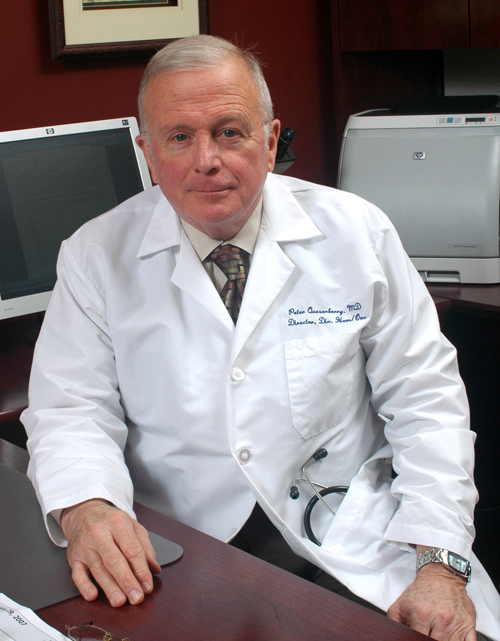
Those particular cells came from rats and mice, but the team has done the same with cancerous human cells, said Dr. Peter Quesenberry, co-author of the journal article and director of hematology/oncology at the hospital and at Brown University’s Warren Alpert Medical School. In both cases, the change persisted over time, even after transplantation.
It’s a big discovery, Quesenberry said, because biologists have always believed that cell phenotype is stable – lung cells remain lung cells, liver cells as liver cells, etc.
“What this says is, rethink that,” he said.
For his own team, which has an $11 million Center of Biomedical Research Excellence (COBRE) federal grant to study stem cell biology and tissue regeneration, it’s a game-changer, Quesenberry said. And as this new knowledge grows and takes shape, he added, it could affect the work of biomedical researchers and clinicians around the world.
The question the team set out to answer was how bone-marrow cells are able to help repair unrelated tissues. Scientists have known about microvesicles for a long time, Quesenberry said, but they always thought they were “junk.” A lab experiment suggested otherwise.
The team cultured lung cells in a petri dish next to bone-marrow cells, but with a membrane in-between that kept the cells from crossing over into each other’s space. When the lung cells were injured – by radiation, for example – they began shedding microvesicles that crossed through the barrier, and the bone-marrow cells gradually turned into lung cells.
Healthy cells shed microvesicles, too, Quesenberry said, but the process is accelerated when a cell is stressed, damaged or affected by an illness.
“This may be a big part of [the body’s] repair processes,” he said. “If you’re a lung cell that’s hurting, you can deliver microvesicles to a monocyte or a stem cell that’s floating by, which can then convert to a lung cell” and repair the tissue.
The researchers have found that microvesicles contain different types of RNA, plus transcriptional proteins, he said – “it’s like the cell is delivering its own machinery to another cell.” Now they’re looking further into that process, and also trying to understand what has to be on the surface of the other cell to be able to receive the packet.
“If we can really understand this and control this, if you have a diseased or damaged organ, microvesicles might be critical in repairing that organ,” Quesenberry said.
These studies could also help fight cancer, Quesenberry noted, because both cancer and common treatments for it stimulate the release of microvesicles, which may help cancers metastasize and also lead cancers to reoccur even after the tumors are fully removed.
New therapies could inhibit microvesicles’ release, Quesenberry said, and/or make the host cells unable to receive them. But first, the team wants to test the idea, and animal studies are being prepared to verify whether bone-marrow cells altered by microvesicles from cancerous cells and implanted into immune-deficient mice will lead the mice to develop tumors.
There are many questions that still need to be answered, Quesenberry acknowledged, but the team is working aggressively to answer them and publish follow-up studies – and to take the new insights into the clinical realm as soon as possible.
Rhode Island Hospital is working with Roger Williams Medical Center to open a joint bone-marrow transplantation program, Quesenberry noted, that could be up and running within a year. Within that program, he’s hoping to have clinical trials applying these concepts within two to three years, and he’s already working with a colleague, Dr. Howard Safran, to prepare. •